7/14/17 – Chester
Seventeen years ago, after our last visit to the UK, a good friend of ours – Tad – wondered if we had visited Chester. We hadn’t, but he spoke so highly of it, we put it on our bucket list should we ever return to the UK.
We were not disappointed. In fact, we had no idea we would as pleased with the town as we were.
I am all about ancient history and a lot of Roman history has survived the centuries via writings and ruins spread through what was once a vast Roman empire.
Chester was once a part of that empire. Founded around 70AD as a military fort – Deva Victrix – it was probably used to defend against Celtic tribes as the Romans advanced northward.
By the 5th century the Romans had left Britain and the fortress was abandoned. The Saxons arrived and the settlement was known Legacaestir – Old English for “City of the Legions.” Then the Normans conquered the island and Legacaestir became “Castor” (Latin for army camp) which, as the English language modernized, became Chester.
The Romans built walls enclosing their fortress and these walls have survived to this day. A two mile walk along the walls takes you all around the historic old city with great photo ops everywhere.


We began our wall walk at the Northgate. We passed the remains of the Roman Amphitheater and left the wall to visit the Roman Garden, an area with locally found roman relics. We saw where the walls had been breached during the English Civil War in the 1600s. We walked down to the River Dee to see the promenade, bridges and a fish weir. We walked along a portion of the river whose access to the sea made Chester the main seaport in the Northwest until the river silted up and Chester handed over its title to Liverpool.
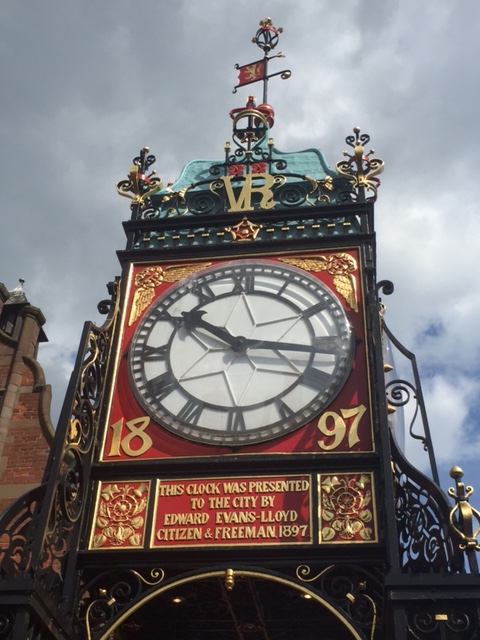
We returned to the walls and passed the Cathedral Falconry and the cathedral. We walked under the 2nd most photographed clock in the country – Big Ben being the first. We glimpsed the famous Rows in the heart of Chester.
We walked past the Roodee, England’s oldest racecourse and once the Roman harbor before the river silted up and changed course. We passed the defensive tower where King Charles I watched the defeat of his army during the Civil War and had to flee for his life.
And then we descended into the city proper.
We were met with half timbered buildings ranging in age from 400 to a modern 150 years old. As we walked down Northgate we came across The Pied Bull, a pub that had been in business since the 1200’s and whose current building had been erected in 1547. That is 900 years of pouring beers!


We passed the stone archway that was the original entrance to the Chester Abbey. As with most other abbeys in England, it was dissolved in Henry VIII’s quest for separation from the Catholic Church. Someone in the church hierarchy was pretty smart though because a year later the abbey was reconsecrated as a cathedral of Henry’s Anglican Church, saving it from destruction. We saw the impressive Town Hall.
We finally reached the Cross; a junction of four streets: Northgate, Watergate, Eastgate and Bridge Streets. The Cross serves two functions that we could see; it is a meeting place and it introduces the Chester Rows.

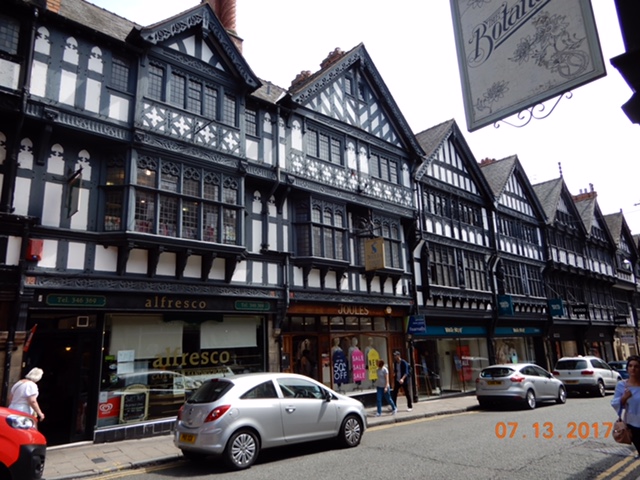
The Rows are covered walkways with entrances to individual shops on the 2nd story level of buildings. The lower or street level is another set of shops. The walkways are continuous with access from the street level by way of numerous stairways. These Rows date back to the medieval era – probably around the 13th century and nowhere in the world is their equivalent.
They are along all four streets that make up the Cross. They are often contained within very architecturally distinctive buildings. They are a shopping Mecca with worshippers flocking to pay homage. They are picturesque as all get out.


We walked back to the Cathedral and upon entering it were treated to an organ recital. We walked about the interior listening to the music. Cathedrals are always amazing and this one was no different. Along the south wall are large mosaics representing events from the lives of Abraham, David and Moses and the cloisters are the first we’ve seen that are enclosed, usually they face out to an open green space.
We returned the next day to complete a couple of errands: Bruce got a badly needed haircut and we needed to start thinking of the most economical way to stay online after we left the UK.
We have been using SIM cards in our unlocked phone and iPad. Our first month on the continent we used the Lebara company’s data SIM card. We got it in Delft and for €20 we received 6GB of data. That, and available wifi use, was enough to last us for the month. When we reached the UK we were introduced to Three phone company. They had a phone/message/data package that gave us 12GB of data for 30 days for £20. We could use my iPhone as a hotspot and Bruce could connect through me to get online. We also purchased a 3GB data-only SIM for the iPad, good for 3 months. The 3 months will end about the time we return to the Continent and we wanted to purchase a SIM card that will last a year and give us 9GB data usage abroad. According to what research I could find, the deal for the 9GB was the best currently available so we wanted to buy it and be done.

While Bruce was getting his haircut, the barber explained the activity that was happening outside. The Cathedral was closed to the public for the day and Northgate Street was being cleared of vehicles. A funeral procession was being made ready for.
In late May, you may recall, the city of Manchester had a terrorist attack at an Ariana Grande concert. Among the murdered victims was a policewoman from Chester. It was her funeral that the city was preparing for.
We thought back to yesterday’s organ recital at the cathedral and wondered if perhaps it had actually been a practice session for the funeral.


Around 1:30 pm the procession began: a dozen police officers dressed in formal uniforms lined up as honor guard at the entrance of the cathedral. With great solemnity, elegance and dignity, the coffin was carried into the walled city by a horse and carriage, preceded by two mounted officers. Chester citizens lined the street to pay their last respects while in the background tourists, oblivious to the event took selfies in front of landmarks.
After the procession we made our way back to the bus station and returned to the camping to cook dinner and prepare for our departure.
 Bruce N' Peg