9/7/17 Paris, part 2:
Our Hemingway tour expanded into a mini-literary tour when we went in search of the original location of Sylvia Beach’s bookstore “Shakespeare and Company” on Rue de l’Odeon in the 6th arrondissement.
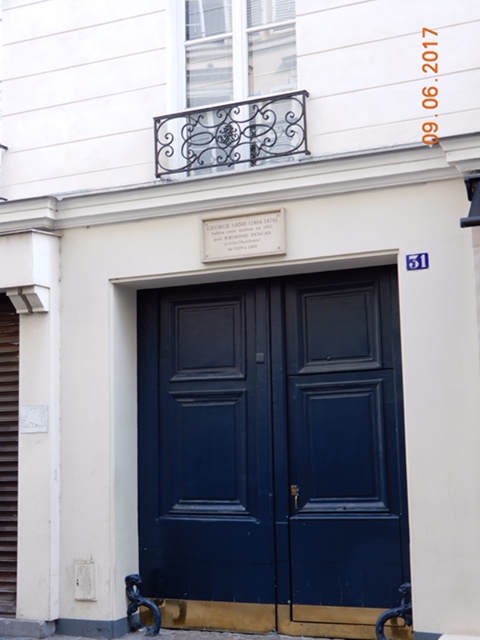
On our way we found a plaque on Rue de Seine detailing how French author Amantine Lucile Aurora Dupin – more commonly know by her pseudonym, George Sand – had lived at that house for a year in 1831.


We also stumbled across the home of French painter Eugene Delacroix, located off the charming, tiny Furstenberg Square.
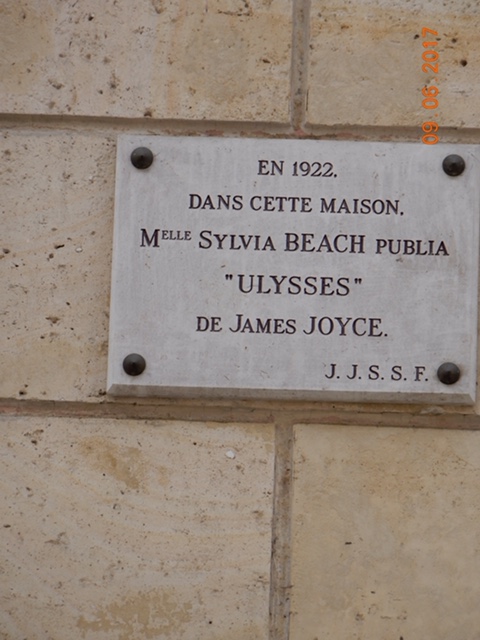
Once we reached Rue de l’Odeon, we learned that not only did Sylvia Beach have her bookstore there, but that she published James Joyce’s novel “Ulysses” from that location.
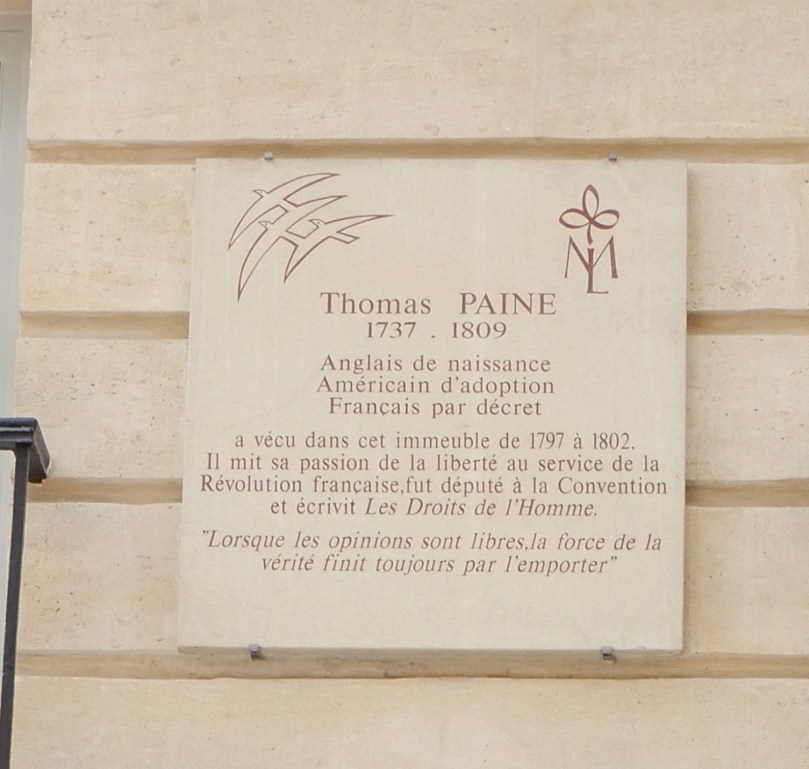
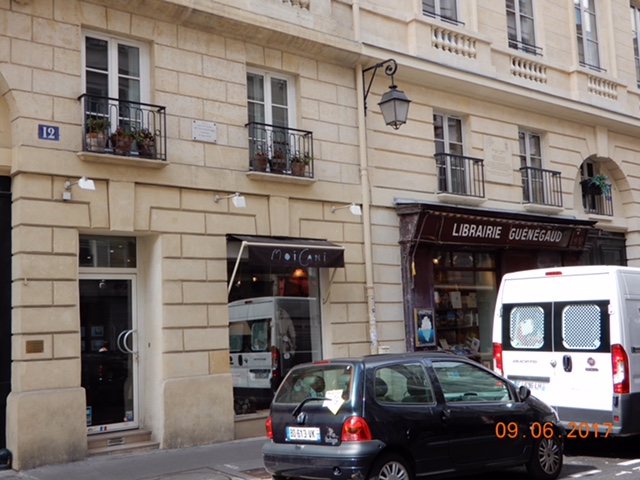
Two doors down, and in an earlier time, one of our own Founding Fathers, Thomas Paine – author of the influential “Common Sense” lived. He wrote “Rights of Man” while living on Rue de l’Odeon. It’s a pretty impressive street.
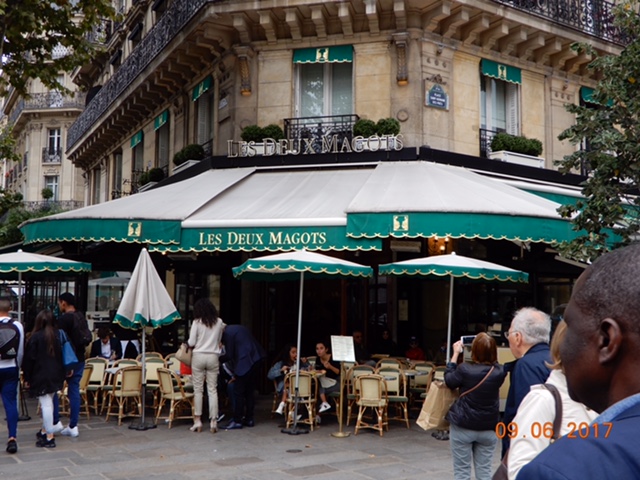
Our next quest was for the cafes Hemingway and fellow literati frequented. We walked Blvd Saint-Germain – a delightfully busy street – until we came upon Les Deux Magots, supposedly Hemingway’s favorite spot in Paris in the 1920s. It turns out other famous authors and artists favored the café as well: Jean Paul Sartre, Simon de Beauvoir, even Picasso stopped by.
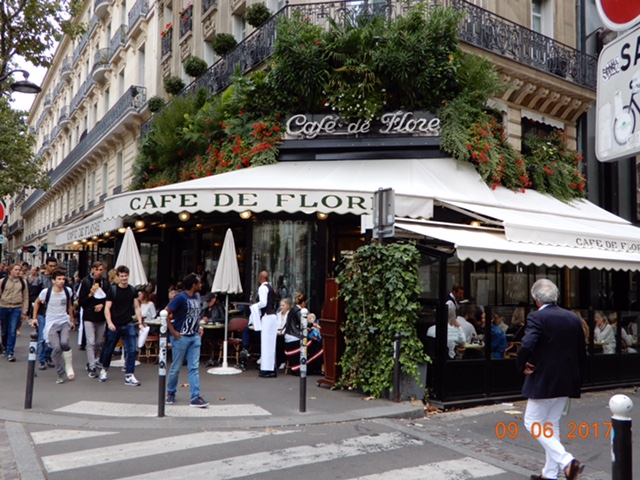
Les Deux Magots’ chief rival was the Café Flore, a short block away. Both cafes were used as “offices” for impoverished writers in the 1920s. Buy a coffee and they could occupy a table for hours on end, writing and holding court. Today they are a tourist destination and probably a lot more expensive.
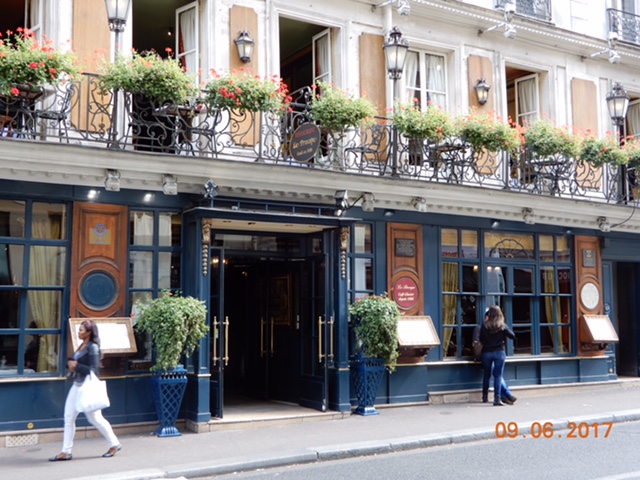
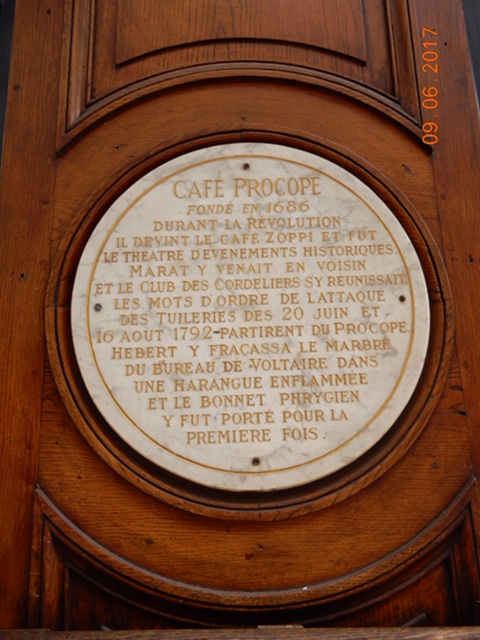
Other cafes we saw were Brassiere Lipp, also frequented by Hemingway, and a little off literary topic, the Cafe Procope, oldest café in Paris, founded in 1686.
We visited Eglise Saint-Germain du Pres, from whom the district (and boulevard) gets its name.
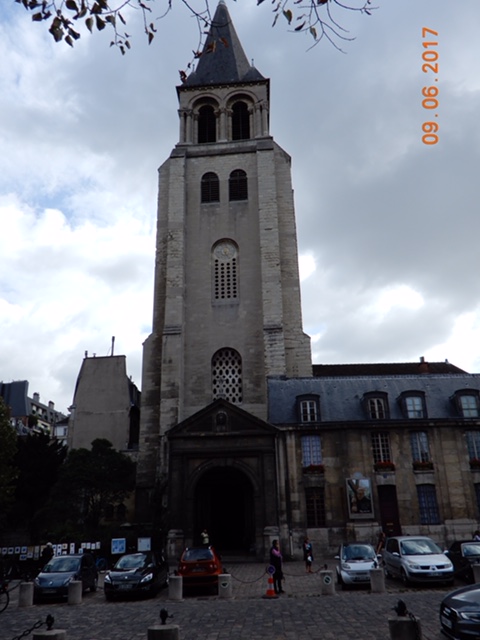


This is the oldest church in Paris, originating in 542AD. It has had many changes over the centuries and currently is undergoing a seriously needed cleaning of the interior. What has been completed shows a vibrant use of color on ceilings, walls and columns vs the gray, darkened pre-cleaned appearance. Bruce says he almost likes the pre-cleaned look better because the colors are so vivid and he wonders why they picked the color combos they did. I think it looks great.
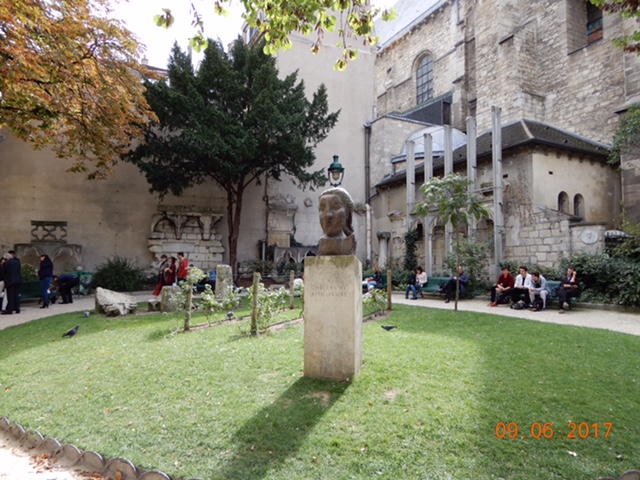
Behind the church is a small, peaceful square with an original sculpture by Picasso, “Homage to Apollinaire,” a tribute to a poet friend.
We found a website – smarterparis.com – that suggested a walking route through some of the covered walkways near the Grand Boulevards. We weren’t aware of these walkways so we decided to explore them. During the first half of the 19th century these covered arcades became very popular. Located mainly on the right bank, they contained shops and cafes catering to the wealthy.
The walk suggested we begin at the Palais Royal. Conveniently, it was new territory for us in keeping with our desire to see new things this trip. The Palace – a gargantuan affair – was built by Cardinal Richelieu (of infamous Three Musketeers fame) in 1639 and called Palais Cardinal. The royal family took over ownership after the Cardinal’s death and renamed it.


In 1830 the large inner courtyard – the Cour d’Honneur – was enclosed creating Paris’s most famous covered arcade – the Galerie d’Orleans. Unfortunately for our tour, it was demolished in the 1930s although the pairs of columns still stand. The garden area of the Palais was nicely laid out with sculptures, trees providing shade and two floral gardens separated by a great circular fountain spraying green algae-filled water all around (that was the one negative in the garden).
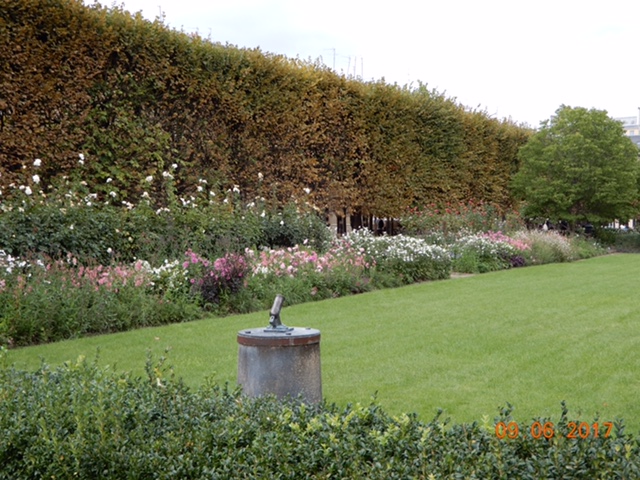
A teeny tiny cannon is mounted on a small plinth in the center of the garden. It has been there since 1786. It used to fire every (sunny) day at noon, with its fuse lit by the sun’s noon rays magnified through a lens. Too bad that doesn’t happen anymore.


Leaving the Palais-Royal we walked through the entrance of the Galerie Vivienne and were flabbergasted. Clothing boutiques, wine cellars, bookstores, gourmet food shops and tea rooms flanked a wide mosaic tiled floor with a beautiful glass roof. The galerie was quite long and quite lovely. Built in 1823 it still had a very old world feel to it.
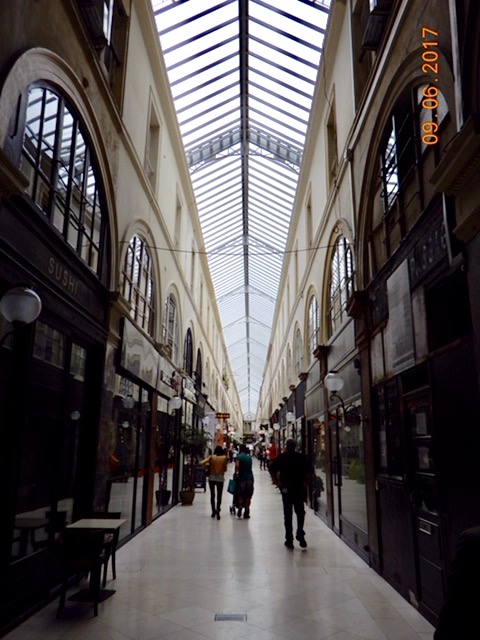
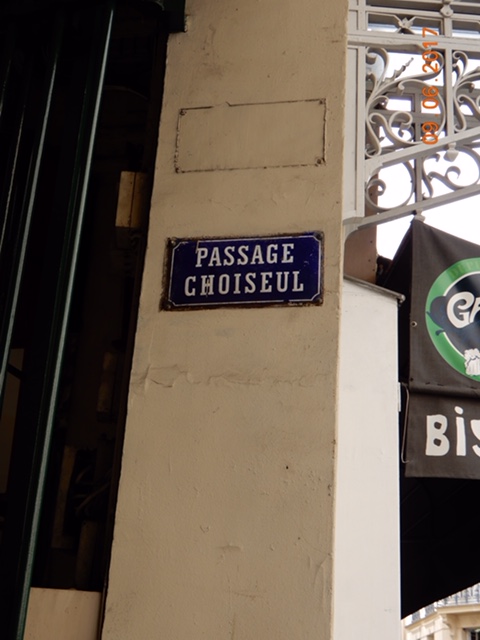
From the Galerie Vivienne, we next found the Passage Choiseul. Another oldie – built in 1825 – it was not as elegant but still grand and quite well used.
From the Passage Choiseul, we got off track from the “tour” and spent the rest of our day following streets that looked interesting.
We had one more day in Paris and we chose to visit the Basilica of St. Denis, in the northern suburb of Paris. St. Denis was originally a Gallo-Roman cemetery. They are still finding remains there in archeological digs.
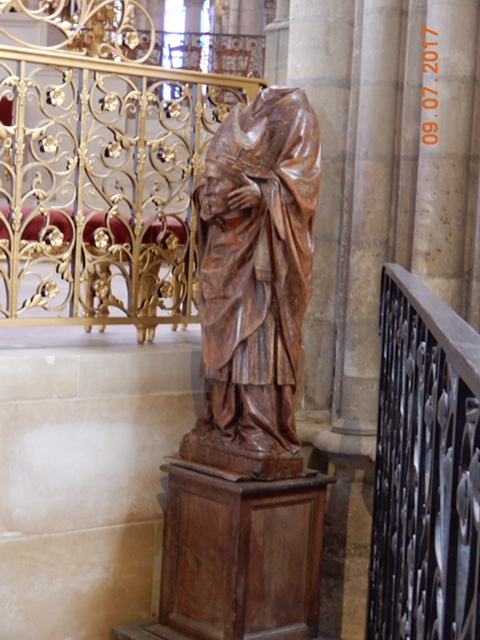
St. Denis is a Christian martyr of the 3rd century who was beheaded by the Romans for his faith. He is the patron saint of Paris and France. Christian legend has it that he picked up his decapitated head and walked for several miles to St. Denis, preaching repentance.
St. Genevieve, who is also the patron saint of Paris (they can have several patron saints? Doesn’t that diminish the importance?) purchased land in 475 AD and built St. Denys de la Chapelle. Dagobert, king of the Franks, had St. Denis’ relics reinterred at the basilica in 639AD. Dagobert was the first king to be buried in the basilica.
The basilica became a place of pilgrimage and the burial place of French Kings with nearly every king from the 10th to the 18th centuries being buried there, as well as many from previous centuries. The earliest French King to be re-interred was Clovis, the first king of the Franks and the founder of the Merovingian dynasty. He was also the first French king to become a Christian, circa 496AD. (If you read Dan Brown’s fictional book “The Da Vinci Code” you may remember the Merovingians were supposedly descendants of Mary Magdalene.)
The Basilica of St. Denis – originally an abbey – is regarded the first Gothic church from which all other Gothic churches were patterned. It had two great spires on its western façade, but in 1846, a violent storm damaged them so severely, one had to be torn down and the other abbreviated in height.


Today there is a renovation project to enhance the interior and also rebuilt the missing spire (there was a lot of noise going on in the church what with the workers and their power tools).
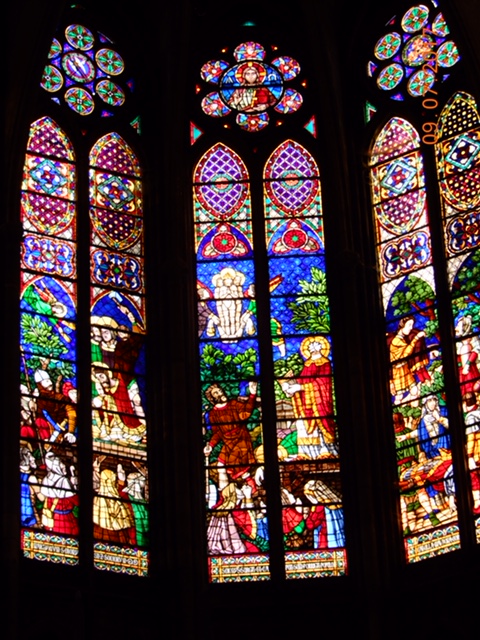
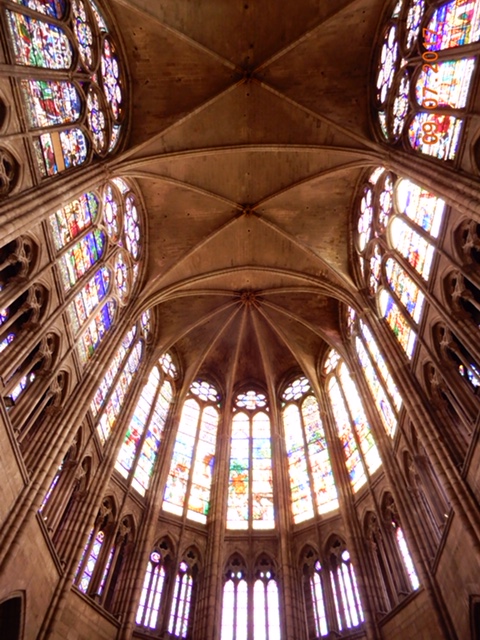
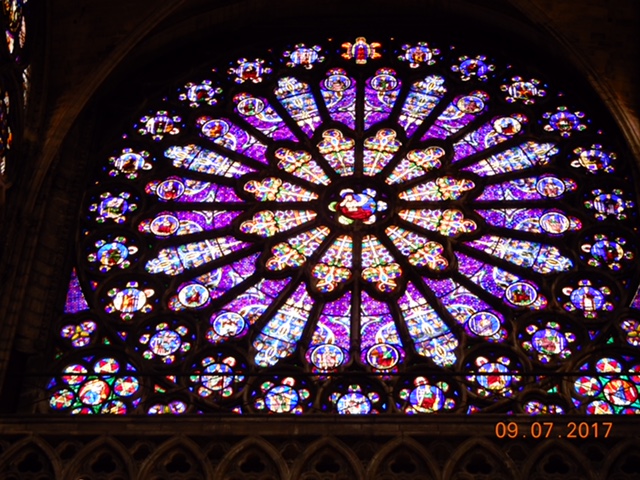
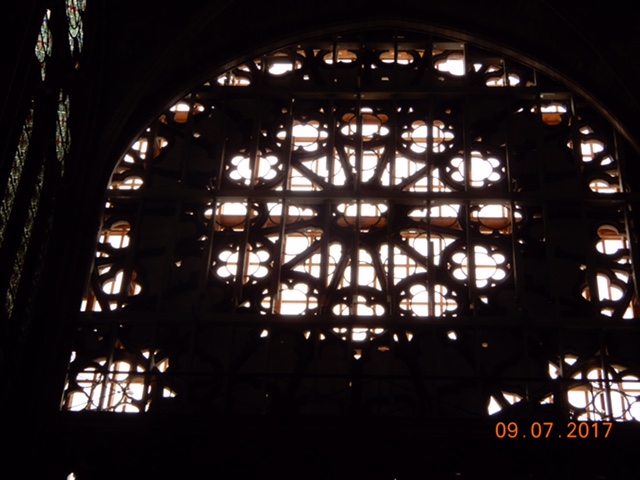


The interior has stained glass windows representing all the kings of France, and effigies and tombs abound representing those kings and their queens.


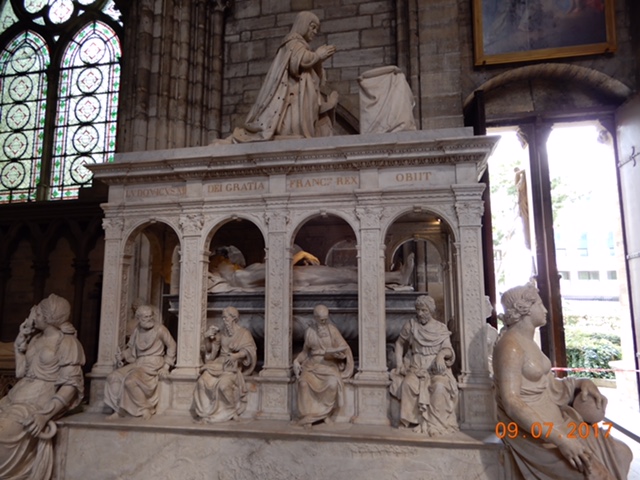
We saw the tomb of Francois I, the French king responsible for bring Leonardo da Vinci (and the Mona Lisa) to France. We saw the tomb of Clovis I, we saw effigies of Charles Martel and Pepin the Short – grandfather and father of Charlemagne.


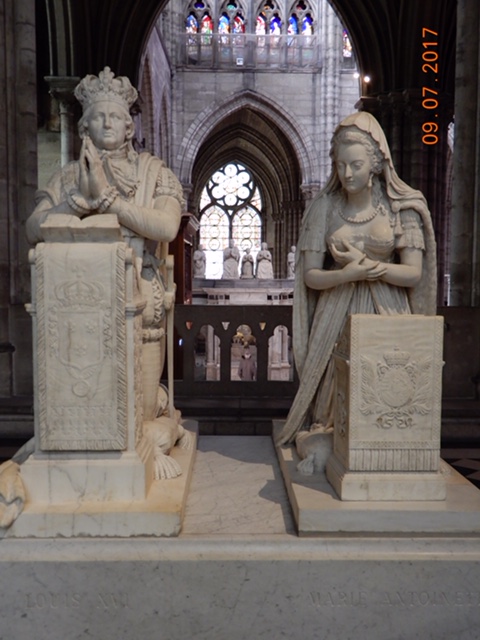
Below in the crypt, we found the remains of Louis XVI and his wife Marie Antoinette, in the Bourbon vault. Above, in the church itself was a memorial statue of them. We saw the tomb of Louis XIV – the Sun King and longest reigning monarch at 72+years.
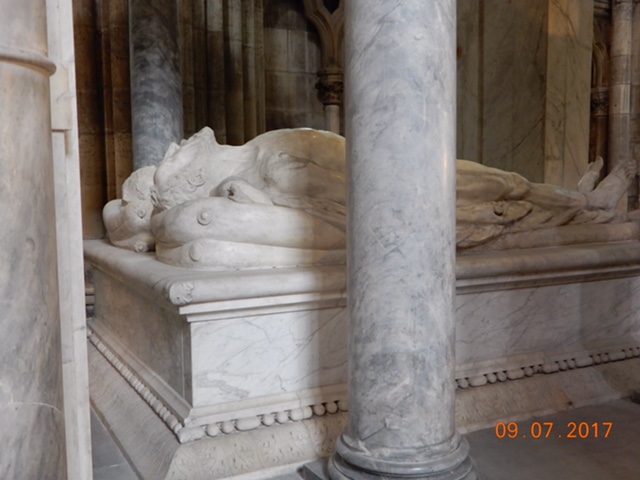
We saw Henry II and his wife, Catherine d’Medici, who was responsible for the creation of the Tuileries Gardens.


There are a lot of dead kings and queens at Basilica St. Denis.


We returned to Paris proper and began a round robin of many of the sights that are iconic Paris: Arche de Triomph, Place de Concorde, Champs Elysee, Eiffel Tower, Tuileries Gardens, Louvres, Ile St.Louis, Notre Dame and our favorite street in Paris: Rue de Rivoli.
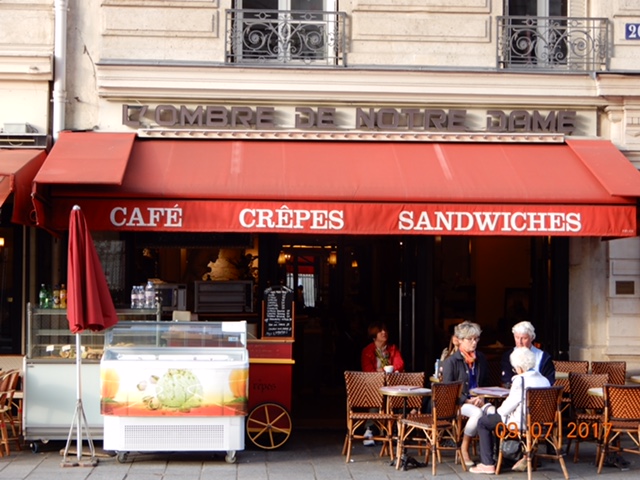
We finished off our day with French Onion Soup at our traditional restaurant in the shadow of Notre Dame. The very same waiter we had on our first visit in 1999 is still there!
We love Paris.

