7/15/17 – Travel Day:
We crossed over into Wales today. This was not a particularly astounding feat since Chester is right on the border of England and Wales, but nonetheless we entered a new country.
It turned out to be castle day. Our objective was to visit Caernarfon Castle in northern Wales – the castle where the investiture of the Prince of Wales takes place. It is also across from the Isle of Anglesey, the location of the Celtic Druids’ last stand against the Roman army back in AD70 (spoiler alert: they lost.)
On our way to Caernarfon we passed 4 castles in the 67 mile drive from Chester; this leads me to believe that the Welsh – much like the Scots – were a major pain in the ass for the English.


We stopped at Conwy, a walled market town on the northern coast of Wales with a complete castle and the smallest house in Great Britain. The town boasts a stay from William Wordsworth whom it likes to claim, was inspired by a gravestone in the church to write his poem “We Are Seven.”


We crossed over to Anglesey and had a drive around, but while the island is verdant and lovely, its history was what caught my interest and we saw no sign of that.
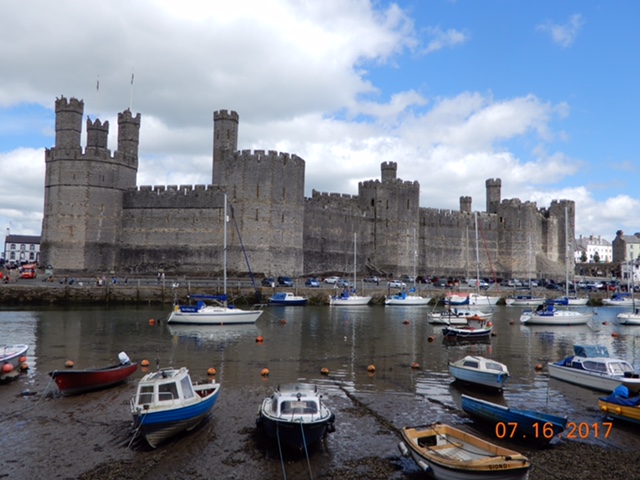
We arrived at Caernarfon (I dare you to pronounce that – it took me 3 days to get it right and retain it) and were immediately enchanted with the castle and the walled town. I’m beginning to think there are as many restored castle as there are ruins in this country. The current castle was built by Edward I, replacing a motte and bailey (wooden) castle constructed in the days of Norman conquest. It is another UNESCO World Heritage site, and it is still owned by the British Royal Family.
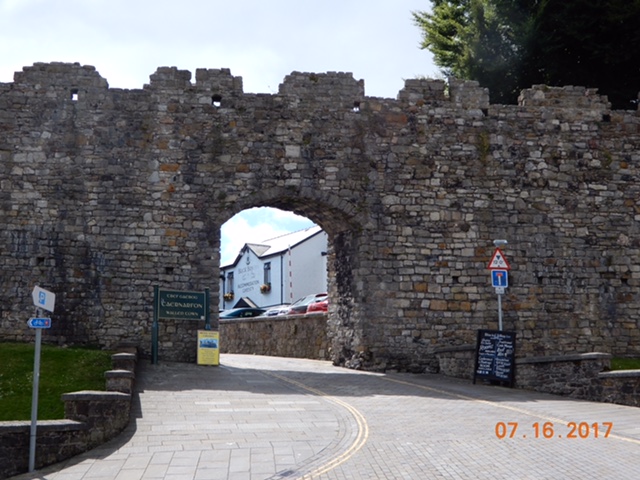
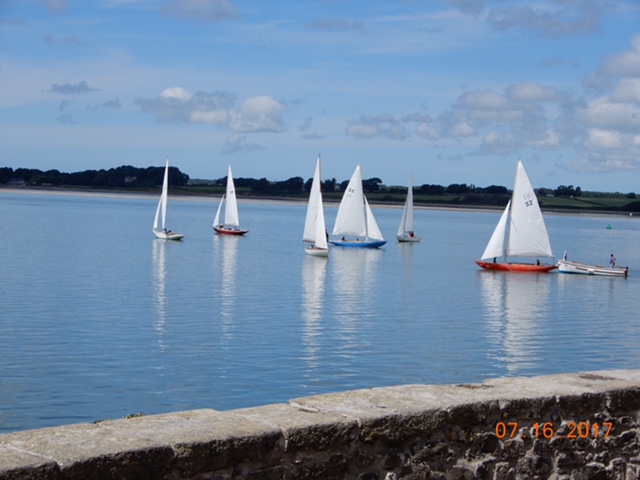
The castle and town lie on the eastern shore of the Menai Strait, opposite the Isle of Anglesey. I was unable to learn where the Romans attacked the Druids on Anglesey but I would not be surprised if it weren’t here, where the bay is shallow when tide is out. We walked about, looking for the best camera shot of the castle. We watched sailboats playing in the Strait with Anglesey in the background.


As we were leaving town we saw a sign directing us to Segontium, the old Roman fort manned by the army of General Agricola, who led the attack on the Druids. Of course we stopped to see it. It was at the top of a hill overlooking the Strait. The stone foundations of the fortress showed the typical orderly pattern the Romans used to lay out their camps.
Finally we got back on our way to Porthmadog and Portmeirion.
 Bruce N' Peg