6/29/17 – National Railway Museum and Jorvik Viking Experience
I must be honest and say we don’t have a great fascination for trains. We grew up after the train era in the U.S. and we grew up in California where the automobile is king. Trains were never on our radar but it was suggested to us repeatedly that we should visit the railway museum while in York – and it was free, so why not?

Seal of the royal railway

Mallard – record setter for speed for steam engine

Rocket – old steam engine

Royal “salon” car

More facility checking

Checking the facilities
The museum was about a twenty minute walk from the Rowentree camping site and very near the city’s rail station. We walked into an overwhelming display of locomotives, over 200 years of royal Pullman cars and a warehouse full of 750,000 railroad items, from monogrammed chinaware to crossing signs to model trains to street lamps; all the sort to make any train enthusiast weep for joy.
Locomotives traced the history of railroads from the first primitive steam engines to the worlds fastest, and the transition to diesel and then electric powered engines. Several royal cars -used by kings and queens when the railroads were in their prime – were displayed in all their opulence; even their servants rode the rails in relative luxury.
Along with perhaps 30 steam and diesel locomotives, a Japanese bullet train was in the collection as well as a working turntable. If one were so inclined, a crash course in the British rail system was at hand.
We spent about two hours at the museum then walked back into town to do the Jorvik Viking Experience.
In the 900s AD the Vikings (Anglo-Scandinavians is the new terminology) ruled York, calling it Jorvik (I think their name eventually evolved into ‘York’). In the 1970s an archeological dig stumbled onto the remains of a pretty sophisticated Viking village dating back to pre-Norman conquest. Eventually the archeologists recovered enough artifacts to be able to piece together the village and guesstimate how the people lived and worked.
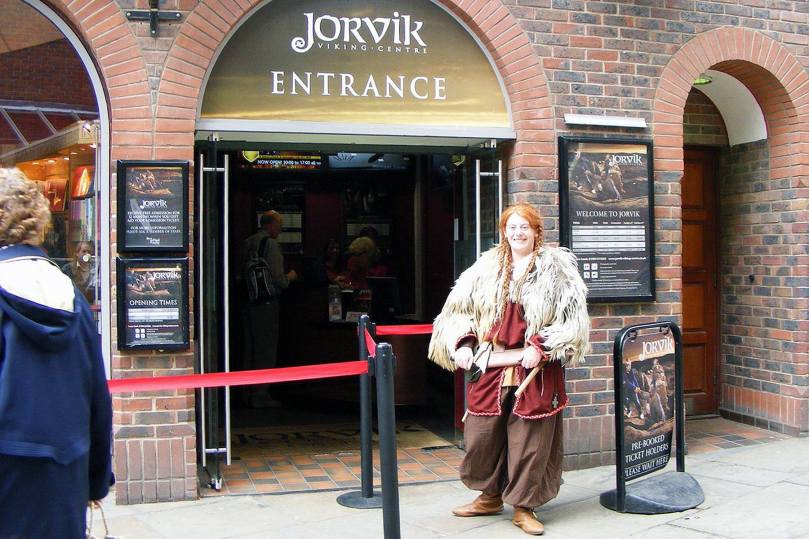
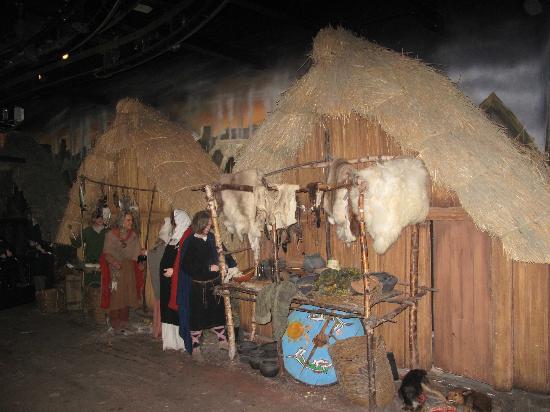
It was decided to share this knowledge with the public and the Jorvik Viking Experience was born. A Disney-type ride takes you through the recreated village with animatronic people and animals going about their daily lives. After the ride you visit galleries with some of the recovered 1,000 year old finds on display. I think it is a great introduction to both history and archeology.
7/1/2017 Robin Hoods Bay & Whitby
We left York Friday morning and after a little grocery shopping at Lidl – my favorite grocery store – we drove to Robin Hoods Bay on the east coast. (Once again our drive was an exhausting 30 miles – lol)
We have visited Robin Hoods Bay before, and our real purpose was to revisit nearby Whitby for (more) fish and chips, but the closest camping with facilities was at Robin Hoods Bay.
Robin Hoods Bay was once a smugglers outpost (and who knows, it may still be). The village flows down a steep hillside with a rabbits warren of narrow alleyways the smugglers used to move their contraband around the village and away from the authorities. Today is seems to make a living exploiting its romantic past.
It is adorable.
After settling in we hiked from the campground to Robin Hoods Bay via the North Yorkshire National Trail, dropping into the bottom of the town at the very base of the cliffs. The east coast is facing the North Sea and we came out onto the cobbled boat launch that led to the sea.
The fun thing for us to do is to wander the town and the convoluted alleyways. We can’t get lost, but only because the town is so small, eventually we will find our way back to the one main road that goes through it. I mention the town is perched on a steep hillside; over the years stepped walkways were built making those steep hikes up and down a lot more bearable.


While down at the base of the town we watch a small group of people walking down the hill and towards the sea. They did some sort of little ritual and stuck their feet in the water. They were looking very pleased with themselves so we asked them “wazzup?” It turns out Robin Hoods Bay is the end of the Coast to Coast Walk, a 192 mile walk across England starting at St Bees, on west coast and ending here. It took them 13 days and crossed the Lake District, the Yorkshire Dales and the North Yorkshire Moors. Wow – what a walkabout. (Joel and Louise; think we four should try that?)
After wandering through the town, taking photo after photo trying to capture the town’s charm for you, dear reader, Bruce found a small fish and chips shop and we took some home for dinner. I gotta tell ya, by the time we get out of the U.K. I am going to be as tired of fish and chips as I was of bratwurst while in Germany on previous trips.
Saturday elevenish we walked to the bus stop to take the bus into Whitby, about 5 miles away. We thought about walking but reviews of the coastal path implied pretty rugged going and 3 hours, so we opted for the bus. As we waited three other couples joined us. While we waited we chatted a little bit, nothing serious. We waited and waited; we kept looking at the posted schedule, knowing we had missed one bus by minutes but the second bus was quite late. Finally, after a good half hour, we saw the bus approaching only to watch it pass us by without even slowing down. It was obviously full but we had been waiting for a long time so we were quite chagrined. The three couples, who were together, decided to go to a pub but we decided to wait for the next bus. The next thing we knew, a car pulled up and it was one of the couples – they had all decided to drive to Whitby and offered to take us with them. We eagerly accepted and had a good time chatting it up with them.
Once arrived at Whitby, we made a beeline to Trenchers, a restaurant known for its (wait for it…) fish and chips. As we waited we saw a four seat table opening up and invited the couple behind us to share the table. That too was a delightful experience; sharing a fish and chip lunch with Pete and Pauline from Nottinghamshire.
Whitby is a fishing town that grew around the estuary of the river Esk with a naturally protected harbor. It must have more fish and chip takeaways and restaurants than anywhere else in the world! It has a long history dating back to the Saxons and Vikings. The 18th and 19th centuries saw it develop into an industrial port and a shipbuilding town, as well as a whaling center.
Whitby is known for the black fossilized wood turned gemstone – jet – mined locally. Whitby Jet was popularized when Queen Victoria wore is as mourning jewelry. Today scores of jewelry stores sell it in all sorts of settings.
Captain Cook, the 17th century explorer – who was killed in Hawaii by angry natives – was apprenticed here to a shipping firm.
The ruined Whitby Abbey looms above the town, its stark silhouette still used by mariners as a landmark. To reach the top of the cliff where the Abbey and the parish church St. Mary’s stands, 199 very popular, very well used steps were built.
Literary (and movie) buffs will remember that Bram Stoker’s Dracula made landfall at Whitby and began the eery story that has held a fascination to millions for over 100 years.

We joined a horde of tourists wandering the cobblestone streets, walking from one point of interest to another. Everywhere we turned people were eating fish an chips and seagulls were flying overhead hoping to steal a carelessly dropped chip.
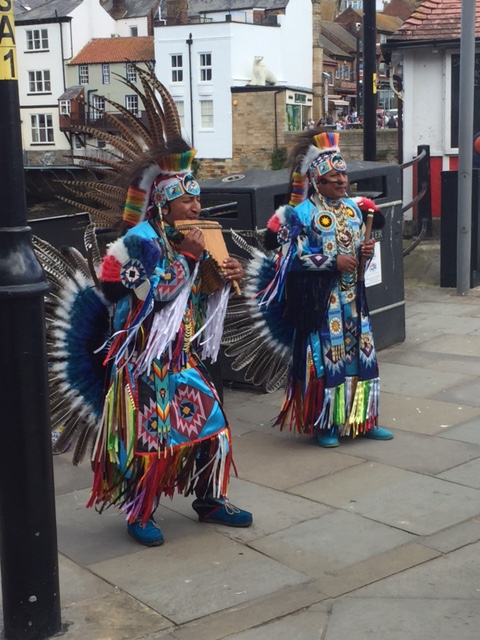
We finally found our Peruvians! When we last visited Europe we were convinced a group of Peruvian entertainers were following us from city to city. Everywhere we went we heard the lovely music of pan pipes (which after a while became like the bratwurst and fish and chips). They showed up in Whitby dressed in full tradition attire. We actually enjoyed seeing them.
Bruce loves Buskers (street entertainers) and always takes photos of them. (Peggy always makes him pay for the photo. If you know Bruce, you know he is a tightwad, so he begrudgingly digs in his pocket and finds the smallest coin Peg will allow.) Two very good ones were working the square and B got his obligatory photos.
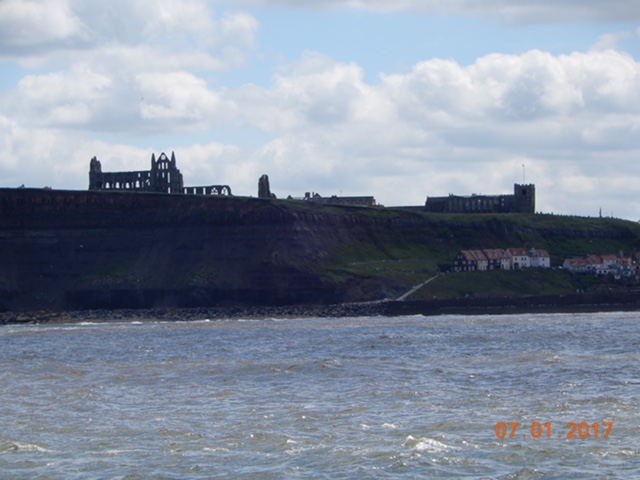
We took a short half hour boat cruise out into the bay and saw a different perspective of the town from the sea. It was a bit choppy so all our photos were either of the sky or the water. We deleted them. We met an Australian couple on a two month holiday and chatted them up for most of the ride.
By then it was late afternoon so we decided to find the elusive bus that would return us to Robin Hoods Bay. This time it showed up at the station right on time and we had an uneventful return to our camping.





 Bruce N' Peg