After much consideration and taking into account the amount of time we have left for our trip, we have once again changed our itinerary. This cannot come as a surprise anymore, we have been continually changing it since we arrived in April. We will be going home in a little over a month so rather than spend long hours driving to Spain and Portugal and then turning around and driving long hours to return to Utrecht, we have decided to spend our last month in France and take our time to enjoy what France has to offer.
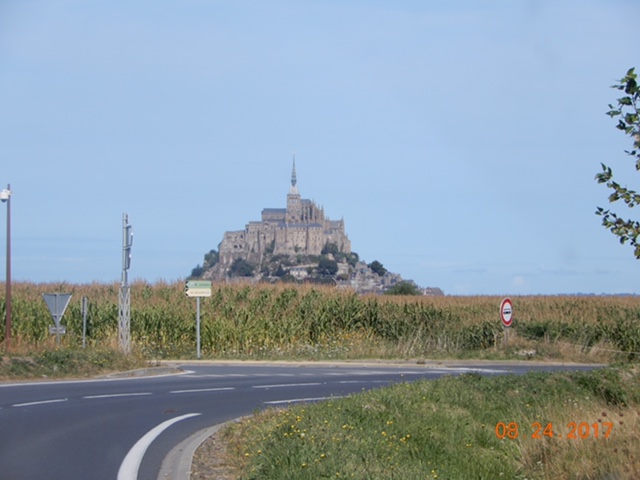
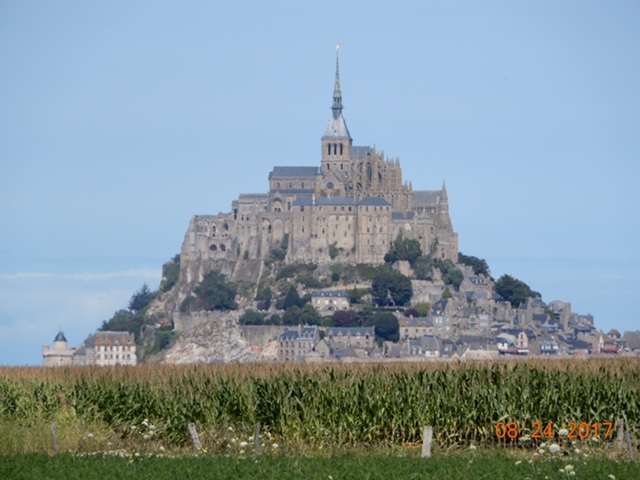
On Thursday, 8/24 we left the beaches of Operation Overlord and drove west towards Brittany to visit San Malo. Along the way we planned to stop at Mont St. Michel, the incredible monastery in a tidal basin that is daily cut off from the mainland by the tides. It was a place of religious pilgrimage for centuries. In modern times it is a tourist Mecca but still carries a wonderful aura of sanctity if you will take the time to wade through the layers of tourism. We have stayed twice at a conveniently located camping at the far side of the causeway to the Mont and thought it would be fun to have lunch there and take some new photos of one of our favourite places in France.
The approach to St Michel has changed in the 8 years since our last visit. No longer can we drive to the causeway and to the camping, but rather we, and all the cars, campers and tourist buses are herded towards pay and display parking lots were we then can board shuttles to the monastery. The parking is several kilometres from where we once could camp, and in fact we don’t even know if the camping is still there. The parking lots were almost full and the vehicles being funneled into the lots were backed up waiting to get in.
It was awful.
We chose not to add to the madness. We got out of the traffic mess and stopped at a little frites stand where we made our lunch, bought some fries and took zoomed-in photos of one of our favourite places in France.
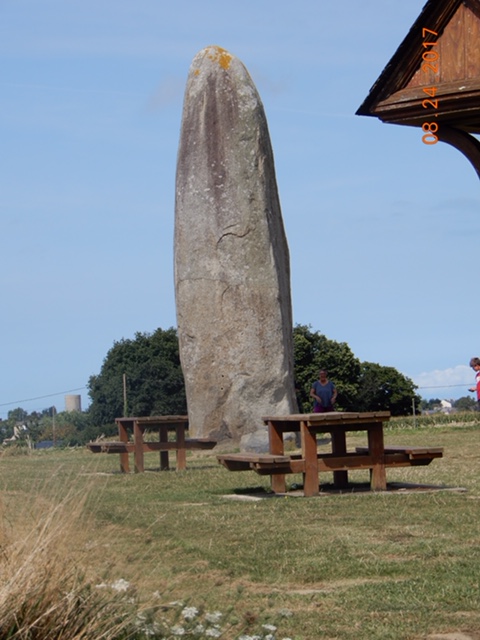
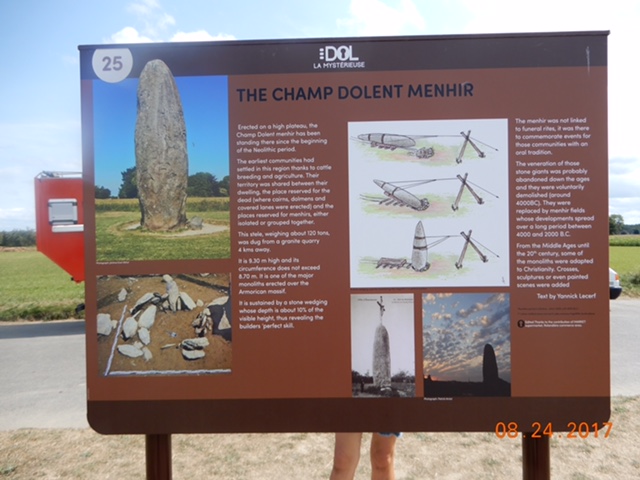
On our way from Mont St. Michel, looking at our map, I saw we were not far from a menhir (standing stone) we saw on our last visit to Britanny. It is called Le Champ Dolent and it is the tallest standing stone in Britanny, if not all of France. We detoured to see it again and it was as impressive on second viewing as it had been on the first.
A couple of years ago I read a book “All the Light We Cannot See” by Anthony Doerr. It is a novel of WWII. The walled port city of St. Malo, in eastern Britanny, has a starring role.
St. Malo, only 56 km from Mont St. Michel, had never been on our radar before, but the reading of this book definitely made it a must-see.
Remains of Roman wall
Camping in trees of Alet
Cite d’Alet (looks like Tubbs Hill in CDA)
Our campground
We found a camping very near the city on a small peninsula across the harbor: Municipal Camping de la Citi d’Alet. Alet was the original settlement of the area going back to Celtic and Roman times.
Machine gun turret
Entrance to Fortrress
Bunker with gun
Bunker
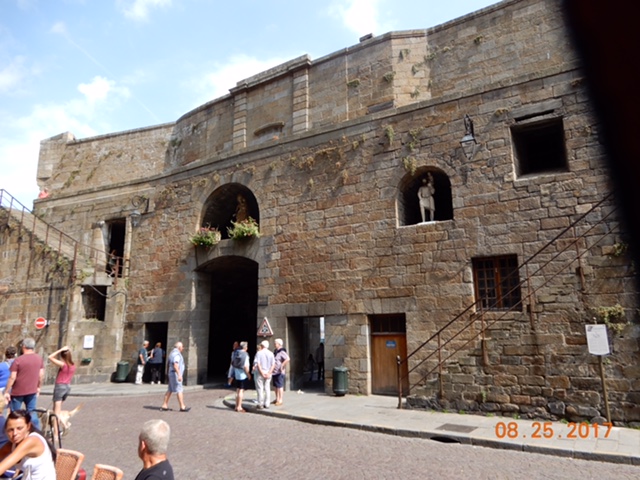
In the 18th century a fortress was built whose most recent occupants were the Germans in WWII. Our camping backs right up to the fortress.
During WWII the Germans took over the area, with that fortress behind our camping as a major defensive fortification. In August, 1944, with the Allied Forces advancing on Britanny, a major battle occurred as the Germans did everything they could to destroy the harbor of San Malo. The shelling between the Germans and the Americans bombarded San Malo and destroyed 70% of the city. The city was meticulously rebuilt in 12 years, from 1948 to 1960.
Somehow, on this trip we seem to be made aware of the incredible destruction WWII had on the cities and towns of Europe. Anyone who studied world history in high school or college is made aware of the destruction caused by war, but I think perhaps it is our visiting of these small compact cities, like Ypres and San Malo, and learning of the specific rebuilding projects they endured to come back to life, that makes it so immediate for us.
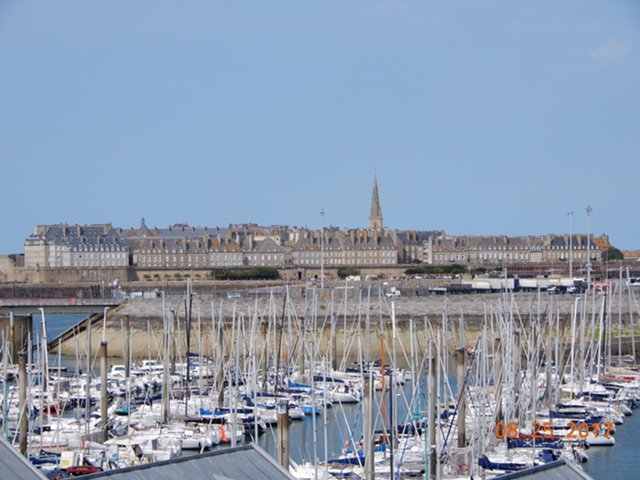
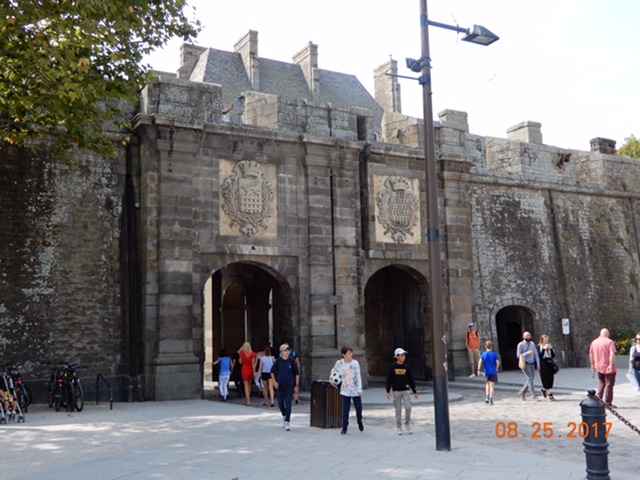
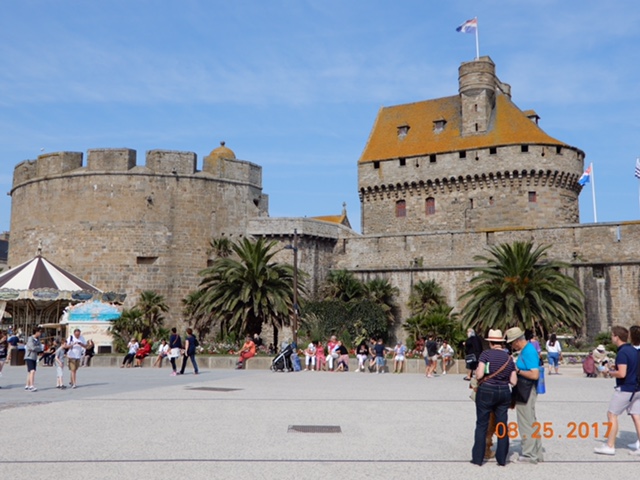
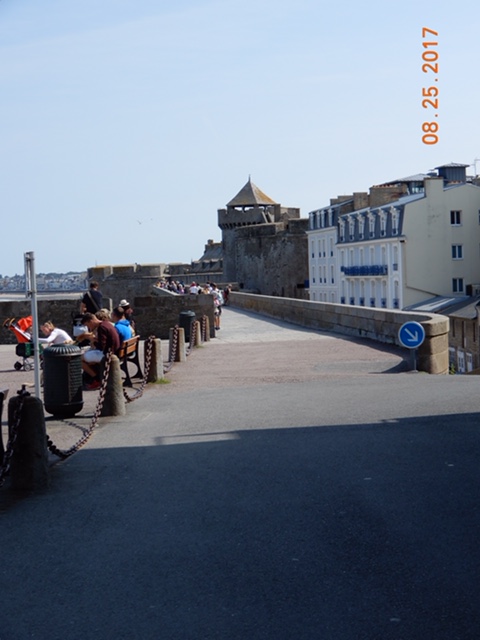
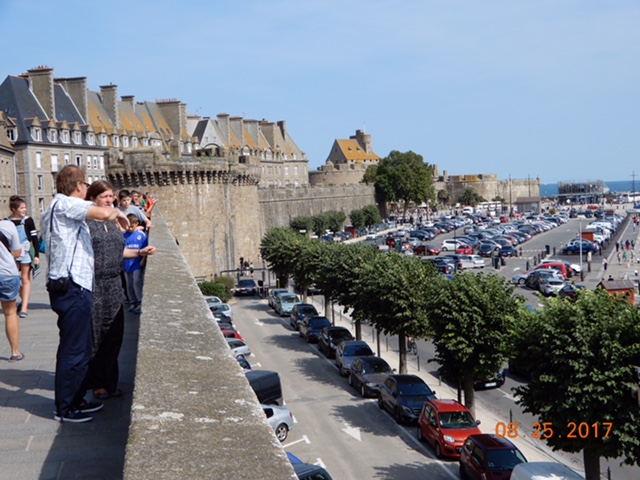
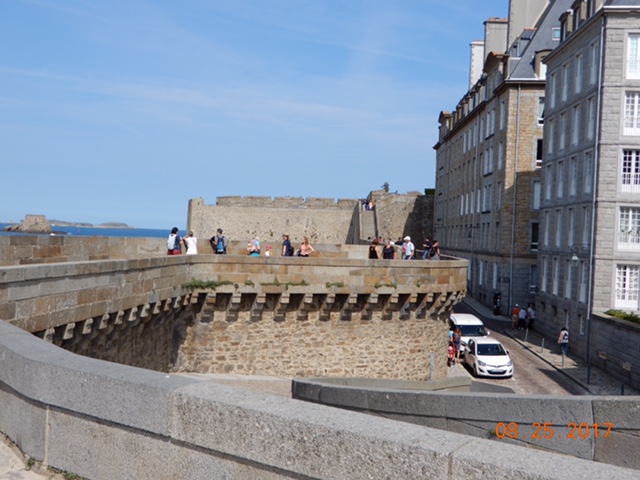
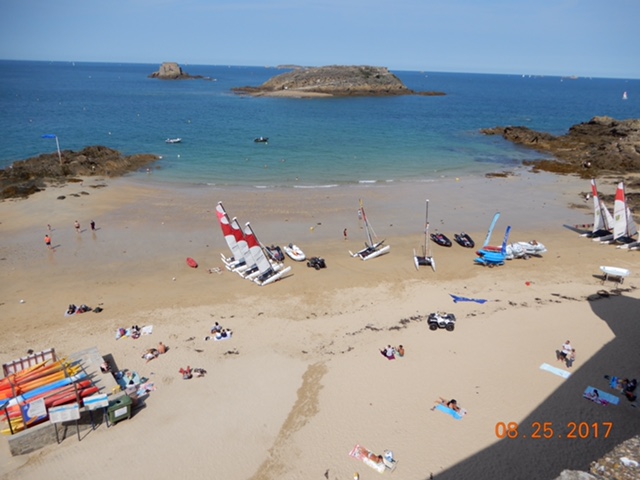
We took the 30 minute walk into San Malo on Friday, circumnavigating the busy harbor and entering the city through the Grand Gate. San Malo knocked our socks off. It is a compact walled city that occupies a small spit of land jutting out into the sea. It has mast-filled marinas on the land side of the city and sandy beaches on the English Channel side.
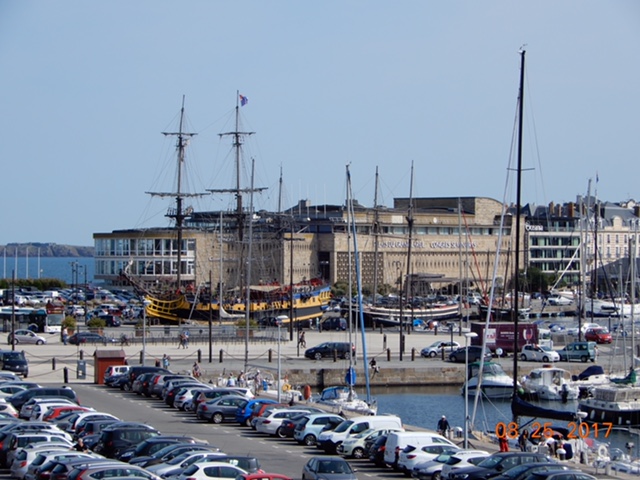
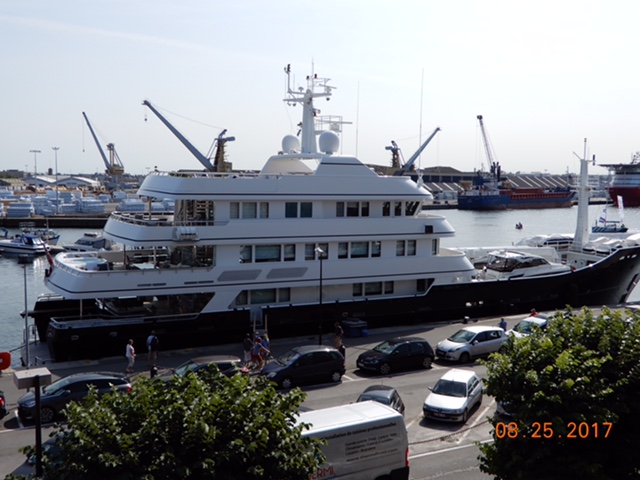
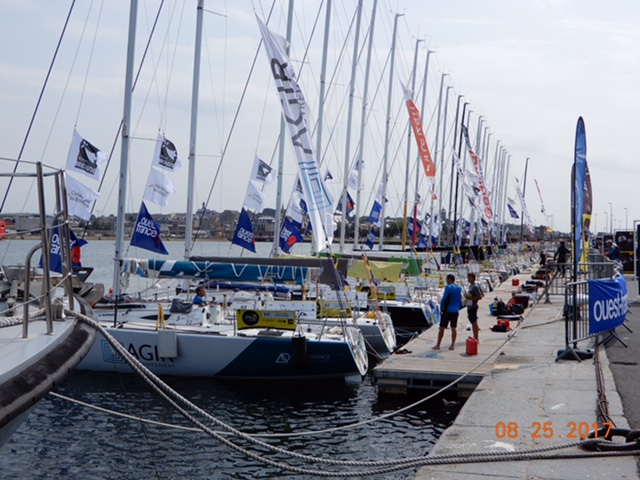
Approaching the city we walked the marina and saw a variety of ships. Among many, many others, we saw two replica corsairs, a four-storied yacht registered to the Cayman Islands and 24 Figaro-class, 2-man crew sailing ships preparing for a 6-day, 6-stage race around the coast of Britanny.
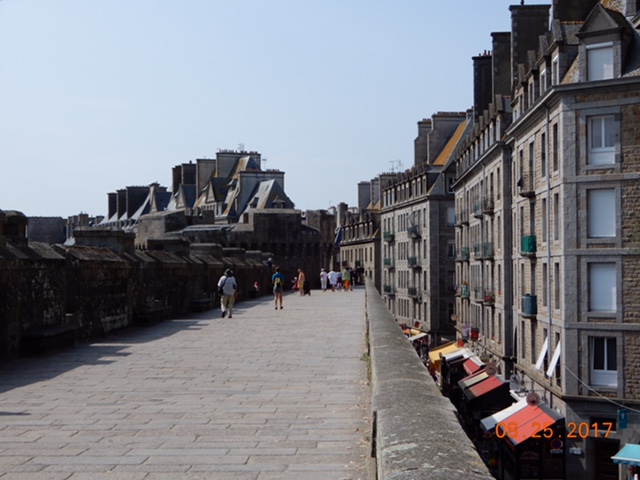
A walkway on the top of the ramparts takes you all the way around the city with gorgeous views on both sides of the wall. From a distance the city rooflines appear to be of uniform height and colour with Mansard-style roofs. A single tall church spire reaches up from the middle of town. Two fortified islands – Petit-Be and Grand Be – are accessible when the tides are low. A famous author from San Malo – Francois Rene de Chateaubriand – is buried on Grand Be. (I hate to admit it but the only Chateaubriand I am familiar with is the cut of beef.)
The town inside the walls has narrow cobbled streets, handsome stone-work exteriors on refurbished buildings and a restored cathedral with beautiful stained glass windows. The cathedral spire – one of the first casualties of the battle at San Malo – was not restored until 1971.
The cathedral has a unique bronze alter with the symbols of the four evangelists on each corner; a lion, an eagle, a man and a bull. The tomb of Jacques Cartier, the explorer who claimed Canada for France, is in a side chapel of the cathedral and a plaque commemorating the blessing of his first voyage in 1535 is in floor of the nave. There were lots of tourists and lots of shops and restaurants catering to them and yet it did not distract from the ambiance of the city.
We returned to our pitch very pleased we had decided to visit San Malo.
Sunday, 8/20/17
We left Ypres Sunday morning with Jumieges, France as our goal. Seventeen years ago when we were in Rouen for a week, we had come across the ancient abbey of Jumieges and we had a hankering to see it again. The Abbey was consecrated in the presence of William the Conqueror and his wife Mathilda in 1067 and despite such an auspicious start, it had several ups and downs during its long history and was finally destroyed during the French Revolution. Today it is another of the romantic ruins that dot the European landscape.
We found a nice camping in the town of Jumieges and about 600 meters from the abbey. We did some laundry, had much desired showers and felt human again. Then we walked through the village of Jumieges to visit the abbey. Since it was early evening the abbey was closed, but an open air classical concert was playing on the grounds, and as we walked the walled boundary of the abbey taking pictures, we got to listen to the music.
We don’t often meet camping Americans, so when we do its kind of a big deal. Another couple, Bill and Sarah from Virginia, had rented a VW camper and were on a 3 month trip around Europe. We spent a couple of hours swapping stories and enjoyed hearing American accents. Interestingly enough, they were on their way to visit WWI battle sites while we were on our way to visit the WWII D-Day beaches.
The next morning we left Jumieges after deciding we had seen plenty of ruined abbeys and we didn’t want to take half a day touring that one.
8/21/17 – We Love The French!
Monday was a day of trials and tribulations.
We were following the meanders of the river Seine as she flowed to the sea at Honfleur/Le Havre when Bruce mentioned we were down to a quarter tank and needed to get gas (diesel). The first station we came across was an unattended one; no employees, just pay and pump. Past experiences with this type of station requires a debit card rather than a credit card. No problem, Bruce inserted his card and made ready to pump gas. Only the machine rejected his card. We tried my card and the machine rejected it too. We stood at the pump looking askance at it and thinking about panicking.
Our bank requires us to renew our overseas usage every three months. That meant a call to the bank (collect is accepted if you can find a landline that gets through to the international operator – but that is another story) so we could continue to use our bank debit cards. After a HUGE amount of difficulty I had managed to contact our bank while we were still in the UK to clear ourselves for another three months. Or so I thought.
The previous evening while walking Jumieges we had stopped at the bank and withdrew some cash from the ATM with no problem so we knew the card worked last night. Why wasn’t it working at the station? An occupied car was parked at the station and the driver saw that we were having troubles. He came over and using his card checked to make sure the machine was working: yes it was. Then we tried our debit card again and once again it was rejected. Bruce was getting pissed and I was freaking out. The man asked if we had any cash so we gave him €40 and, using his card, he pumped €40 worth of diesel for us. Yay! Merci beaucoup!! But why the hell weren’t our cards working?
Now that we had fuel we continued along until we could find a gas station with an attendant and try our cards there. Eventually we found one, added €20 more to the tank and learned our cards were working – it was evidently that one station’s peculiarity. My stress level began to decrease to manageable portions.
We drove on to Honfleur, a port town made famous by many Impressionist artists in the early 1900s. We were anxious to see the famous quays and houses. It has been a long time since we were in Europe and I cannot remember the masses of people flocking to the same places we want to see. I am serious about this, 2000 was a long time ago, true, but I can’t remember the crowding of streets like we have seen this trip. I know it is summer, but we have spent 2 summers in Europe and I don’t remember this.
Honfleur harbor
The quays
Ancient harbor house
We had lunch here
Anyway, Honfleur was overloaded with people and the day was very overcast, muting the colors the Impressionists found so alluring. We found a slightly secluded spot at the harbor and had lunch before we braved the town center to continue our drive to Ouistreham, the eastern start of the Operation Overlord road tour.
We had just cleared Honfleur when we started hearing a faint sound like metal clanging against metal. We couldn’t for the life of us figure it out, but in very short order the sound was increasing and sounding horribly like two big pieces of metal ripping into each other. It was really quite scary. We thought it might have to do with the clutch because it seemed to be tied in with shifting gears, and yet the clutch had good pressure. Then we thought it might be the clutch cover plate pulled loose and hitting something. What we did know was that it was getting worse by the minute. As it happened we were in the industrial area of the town we were in and we saw a Citroen dealer with what looked like mechanic’s bays. We pulled in. It being France, we arrived during their two hour lunch break and had to wait for their return. When they did return they said they were not equipped to help us but directed us to a Hymer dealer in Pont l’Eveque, a short distance away. They gave us the address and we returned to Willie where we punched said address into the GPS and came up with results 250km away(!!!) There was no way we or the van were going to make that. Tami in hand, we went back to the salespersons and asked if that was right. They must have spent 15 minutes figuring out a way to get us to the Hymer place by inputting a nearby address that would get us there. All this for a couple of foreigners who were not going to benefit them in any way.
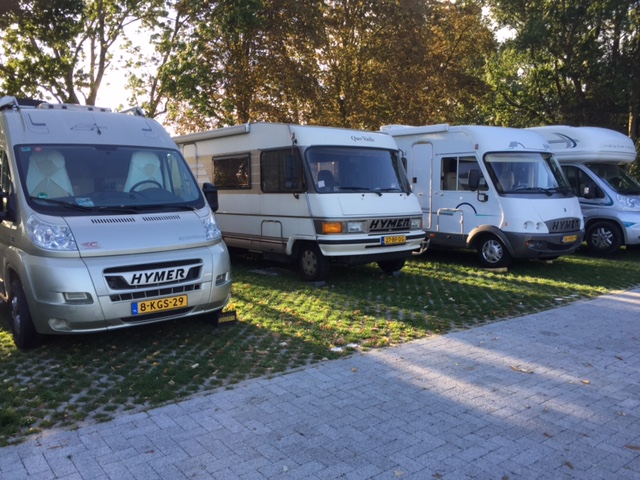
The actual destination, a Hymer dealership, was 15 km away and we crept to it. We saw a lot of beautiful Hymer motorhomes there but they weren’t interested in swapping. We asked about mechanics and once again, this was a dealership, not a full service dealership/garage, however, literally across the street was a mechanic. Thanking them we clanged our way across the street. We persuaded the office mechanic to come listen to our problem. The language barrier was pretty high but once he drove it around the parking lot and heard the sounds he thought it might be a fluid problem. We couldn’t imagine that. Another young mechanic came out and listened and the two had a conference about what, we had no idea, but the upshot was they took Willie into a bay and started pumping him with transmission fluid. They put in 2 litres (we have no idea what the capacity is but 2 litres is almost a half gallon) then took it out of the bay to drive and check it out. The sound was gone and the gearing and clutch worked beautifully.
They saved our asses.
We gave the young mechanic a €20 bill because he was awesome and walked into the office to see how much we owed. Another €20 bill and we were on our way.
There is a myth that the French are snobs and are unfriendly and hate everyone. We have had two car catastrophes in France, one was a blown engine 17 years ago, and today’s almost catastrophe where we could have lost a transmission. Both times the French have gone out of their way to help us. We can’t say enough good about them. They may at times find us to be unrefined or maybe a little silly, but when it comes down to it they are more than willing to help.
We stopped at a supermarket for some quick supplies. Returning to the motorhome we saw police surrounding the van. WTF??? As clearly as possible, given the language barrier – they spoke some English, we spoke very little French – they explained they believed an immigrant had climbed (or tried) behind our bikes for a little illegal hitchhiking. We had heard of this ruse before and thanked them for stopping it. Later though, after we had some time to think about it, we realized there is no way for anyone to hide under our bike cover behind the bikes because the space is filled with the “guest room,” spare chairs and wind guards. We think they saw the bulge behind the bikes and made assumptions. At any rate, we had to extra guests.
Continuing towards Ouistreham, searching out another Aires, we came across a camping on a canal and pulled in, emotionally exhausted.
8/22-23/17 Operation Overlord
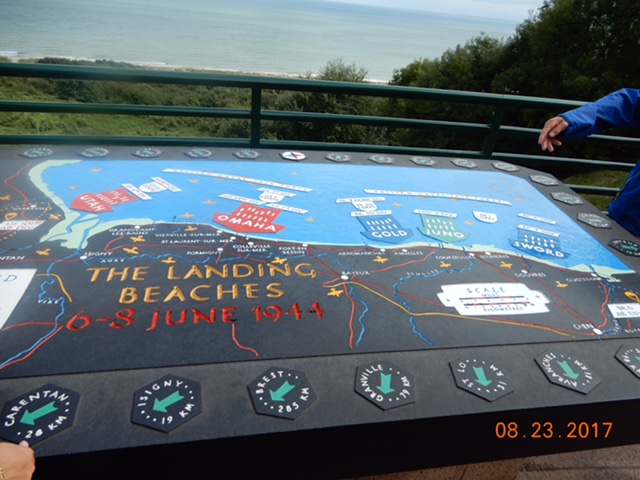
The Normandy Invasion of 1944 is still very much present along the coast where the five landings occurred. Sword, Gold, Juno, Omaha and Utah beaches were the designated names for the sectors along a 50 mile coastline. We have followed the Operation Overlord trail two different times on past visits to Europe and it still fascinates us.
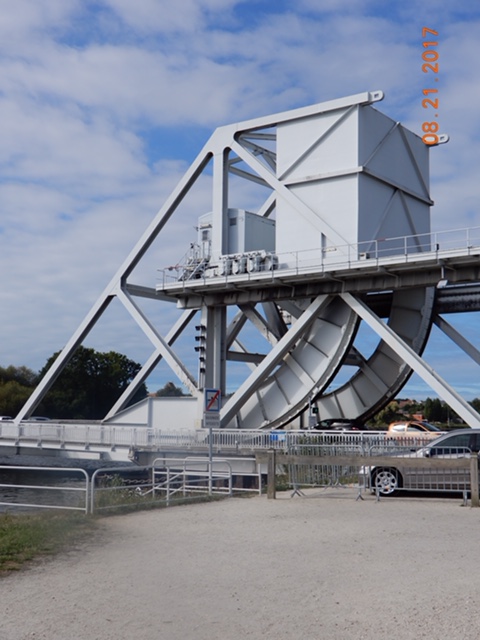
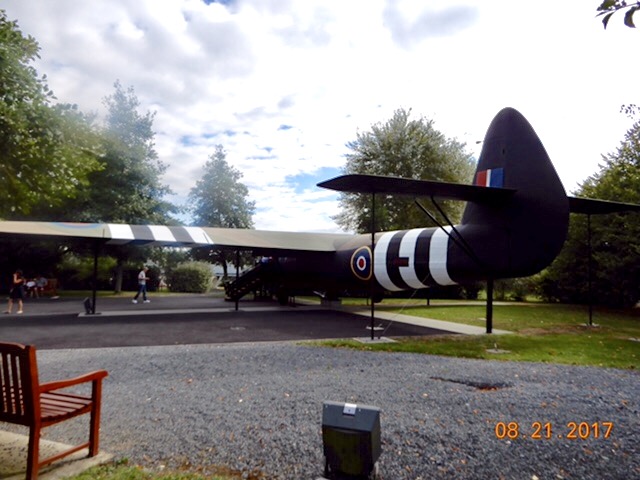
We started our invasion tour on the eastern front at Pegasus Bridge where, on the night of June 5-6, British gliders landed just outside Ouistreham on a narrow split of land between the Orne river and a canal, and captured the bridge within 10 minutes of landing.
Landing area facing bridge
The monuments show where gliders landed
As with all landings along the 50 mile stretch of coastline, this event is well documented at a museum and with signboards explaining the operation. The “landing strip” where the 3 gliders touched down is a very tight space; I don’t understand how they that landed on that strip of land without landing on top of each other.
I’ll bet that when you think of gliders, you think of the sleek one or two man gliders we occasionally see in the sky or on film; elegant, quiet, long-winged aircraft flying gracefully through the skies. The British Horsa gliders used on D-Day were monsters capable of carrying 28 soldiers at once. Those were the soldiers who overwhelmed the Germans at Pegasus Bridge within 10 minutes of landing and in the process freed Ranville, the first liberated town of the battle.
Our next stop was Arromanches-les-Bains, part of the Gold Beach invasion. Once a foothold was achieved on D-Day a place to bring equipment to the continent was imperative. Arromanches became the location of an artificial port, Mulberry Harbor, a prefabricated port towed across the English Channel in sections and assembled at Arromanches. Mulberry Harbor was used for 10 months after D-Day and over 2.5 million men, 500,000 vehicles and 4 million tons of supplies landed there until it was decommissioned. You can still see remnants of the harbor in the bay.
We had been to the museum in the town itself, but up on a hill overlooking the harbor is Arromanches Cinema 360, a movie Theater with a very good 30 minute movie about the 100 days of the Normandy invasion. It uses British, American, French and German film to tell its story on 9 screens in a 360* theater. That hilltop also has remains of German bunkers overlooking the beach below.
That night we stopped at our second Aire just outside of Colleville-sur-mer where the American Military Cemetery is. We prepared for our visit to the cemetery by watching the movie, “Saving Private Ryan.” The opening and closing sequences of the movie were filmed at the cemetery. I said it when we first saw the movie in 1999 and I say it again: if women were in charge of the world we would never send our babies into the the killing fields of war.
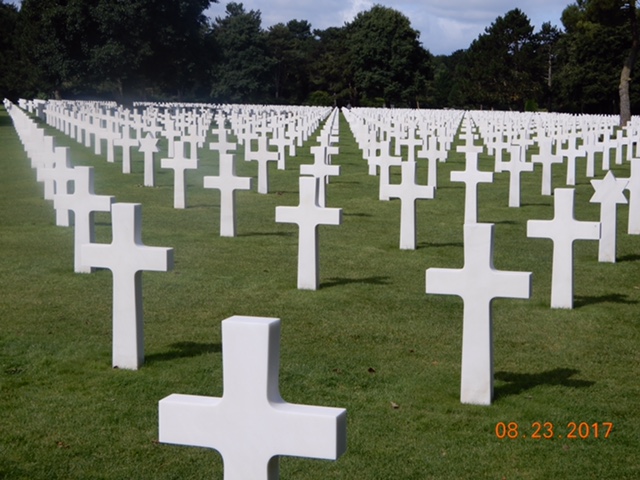
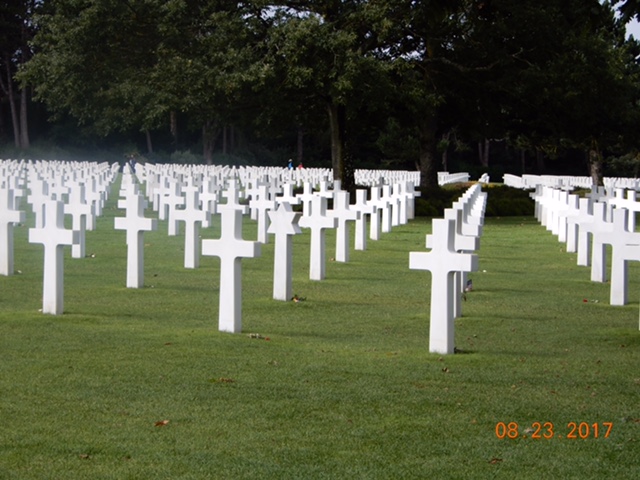
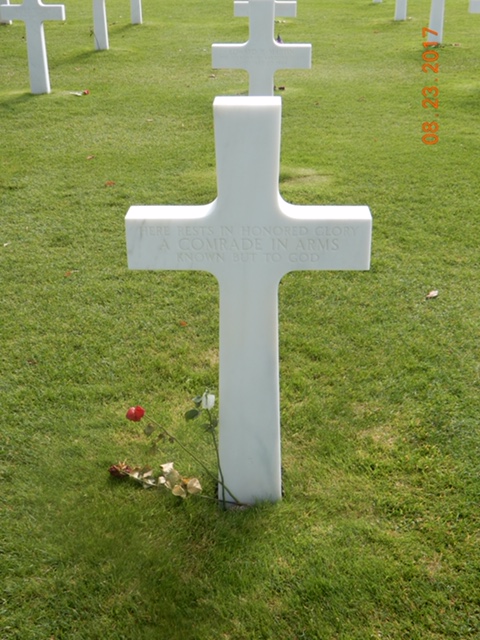
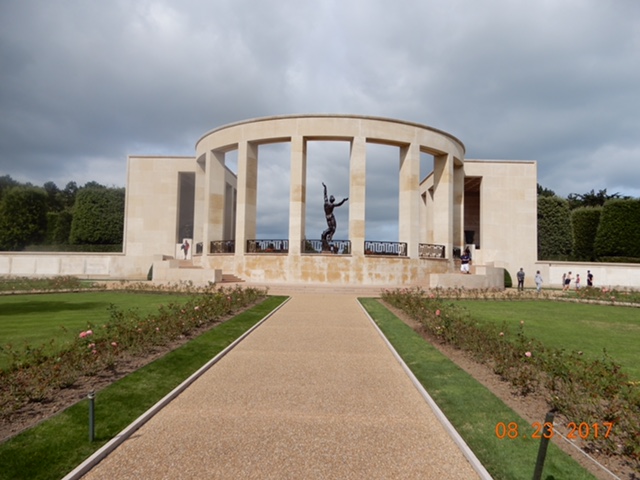
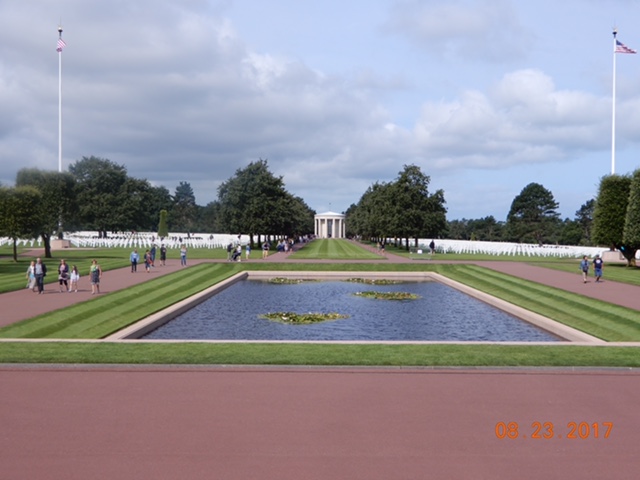
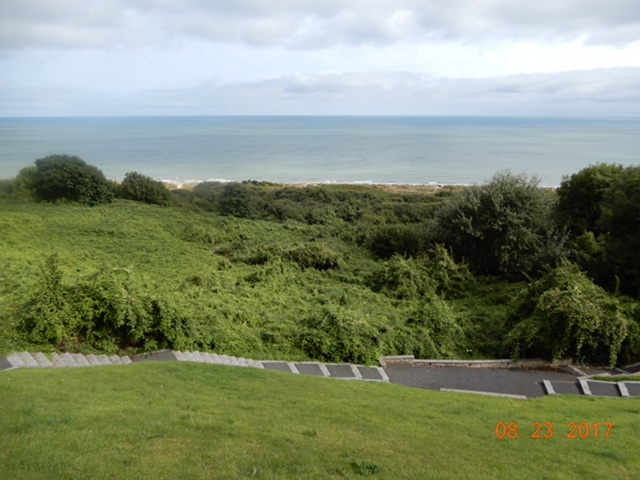
We have visited the American Cemetery twice previously and the 9,387 crosses make quite the statement about the costs of war. The cemetery covers 172 acres overlooking Omaha beach and grounds are serenely beautiful, as if to try and make up for the horror that overtook each soldier who died far from home and is buried there.
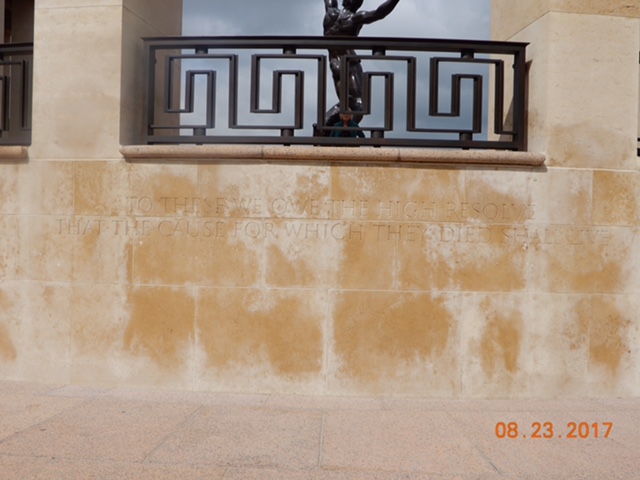
“To these we owe the highest resolve. That the cause for which they died shall live.”
These men died so that the nations of the world could live in liberty, free from tyranny. I think that quote is an appropriate epitaph.
We have experienced our first Aire of this trip. An Aire is a designated parking place for motorhomes. The Continent is full of them. While in England, we ordered books from Vicarious Books, listing all Aires for France and Spain.
We are still in Belgium but we were told of this aire by a camping that was full and we could not get into.
Let me back up a bit:
In the morning we returned the plumbing parts we could not install, due to lack of proper tools, and began our return trek to reach the Normandy coast. Having seen a great deal of what the continent has to offer a traveling tourist, we were on the lookout for new-to-us places to see. Just NW of Lille, France is the Belgian town of Ypres, made famous for several battles in WWI and for the 500,000 men who lost their lives in one battle alone. The Fields of Flanders are the lands around Ypres.
Ypres is the French name for the town – the Flemish name is Ieper (that is a capital I -not a small L. I say that because our map made the name look like leper, which I chose to call it for a bit). The English speaking soldiers had trouble pronouncing the name and nicknamed the town Wiper. (It wasn’t until I read this little factoid that I realized my mistake.)
Ypres/Ieper/Wiper was along our path to France so we decided to give it a look. We found a camping that looked promising and plugged it into Tami. After a long day’s drive over smaller roads than we preferred, we arrived at the camping. It was in a perfect location for visiting the town. Unfortunately it was full with no openings until the following Wednesday – this was Friday. The camp host did direct us to the aire. This particular aire has 16 spaces for motorhomes at a cost of €8/24 hrs including electricity and a toilet dump. If you need water to fill your tanks, add €1/100 gals. It’s a great deal and still only 3km into town. What it doesn’t have is a shower but we could easily go 2 days at a time without one, then pop into a regular camping for the shower/laundry bit. I can’t say how often we will do this but its great to know it is as successful an option as it is.
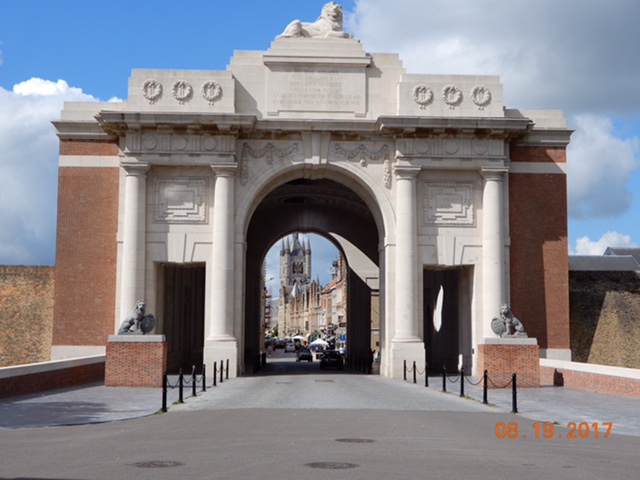
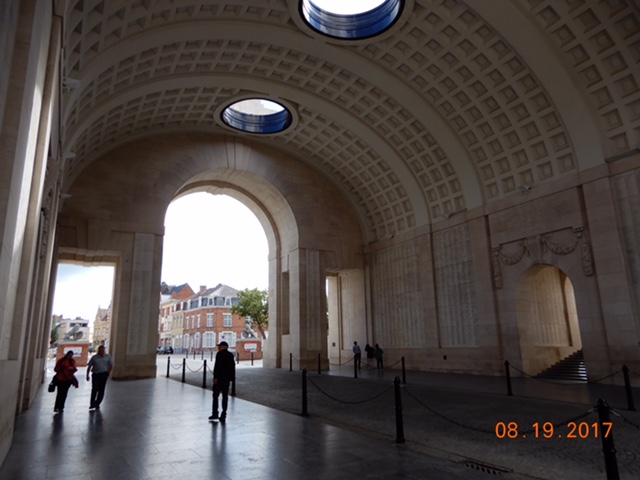
The city still commemorates the WWI fallen with a nightly tribute at the Menin Gate Memorial to the Missing. At 8:00 pm each night, traffic through the Gate is stopped while the “Last Post” is sounded by the local fire brigade. Imagine…a fire company that not only fights fires but also includes musicians in the force – how wonderful is that? The tribute is in honor of the memory of British Empire troops who fought and died there protecting the city. One hundred years later and the Belgians still honor the fallen soldiers of the British Commonwealth. I am impressed.
We went into town late Saturday morning since we intended to stay until after the Last Post ceremony. We rode our bikes the easy 3km into town and parked them near the massive Menin Gate, a historically important entry to the town center. This Menin Gate was constructed after WWI and dedicated in 1927. It records the names of 54,896 soldiers of the British Commonwealth who died at the Ypres Salient and whose bodies were not recovered.
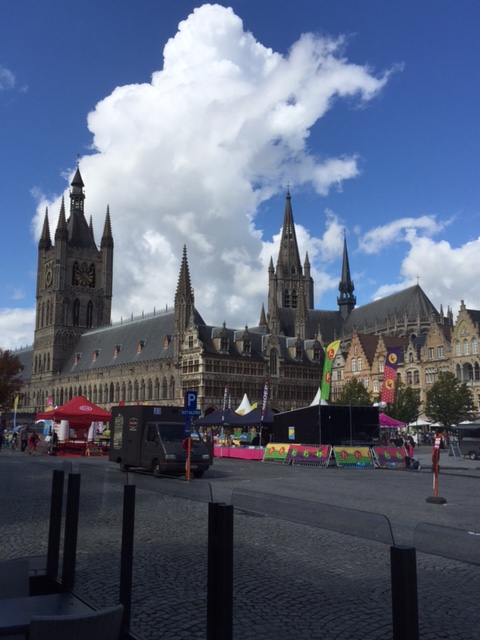
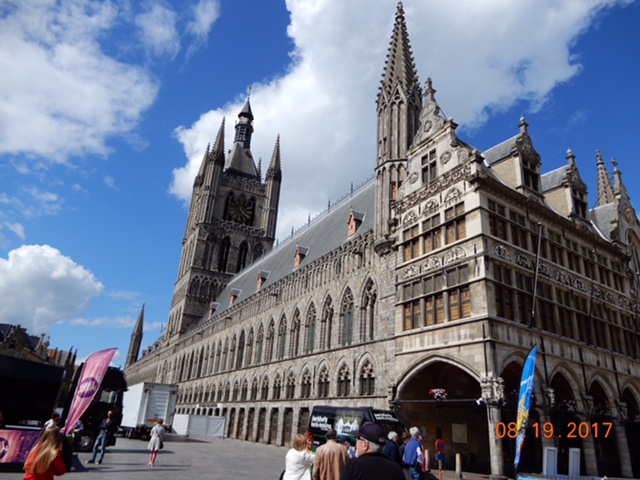
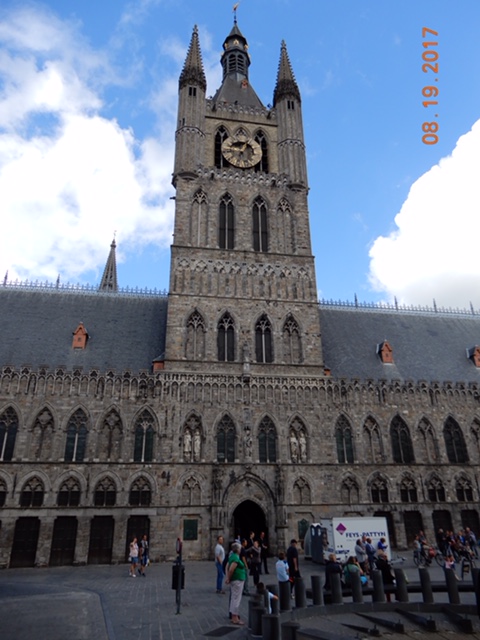
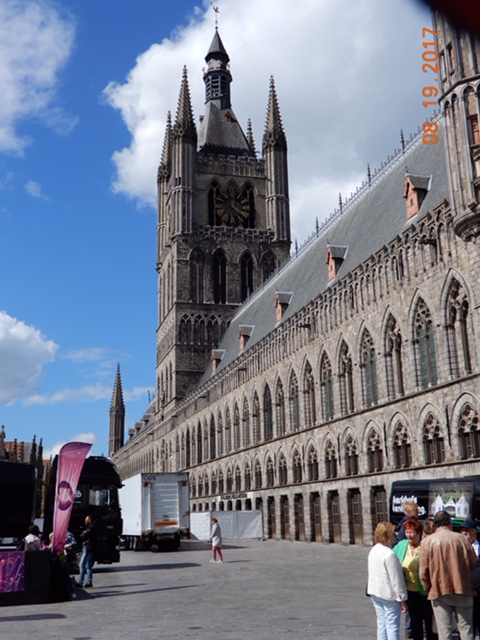
Ieper has a long long history starting with the Roman occupation in the first century BC. In the Middle Ages Ieper was a prosperous Flemish city and was mentioned in The Canterbury Tales. In the 13th century the Cloth Hall was built. It was one of the largest commercial building in the Middle Ages and served as a market and warehouse for the city’s linen industry.
In WWI the city and the surrounding area was pounded into the ground by artillery during the course of the battles that took place in the area.
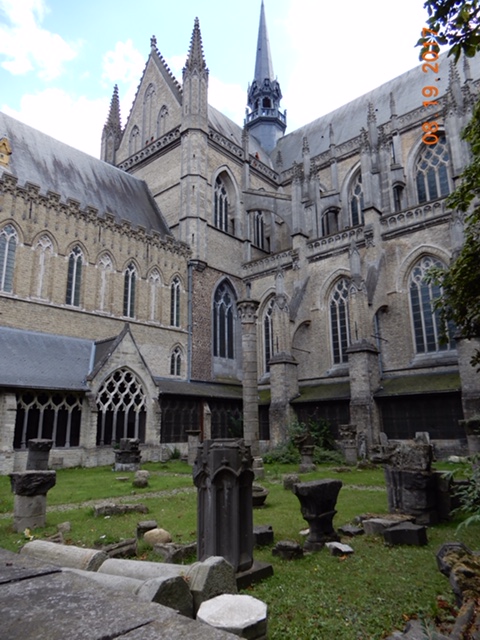
A massive rebuild was necessary when the war was over and much of it was accomplished by 1922 as attested to by dates on the buildings we saw. The Cloth Hall and St Martins Cathedral were built as exact copies of the original medieval buildings destroyed.
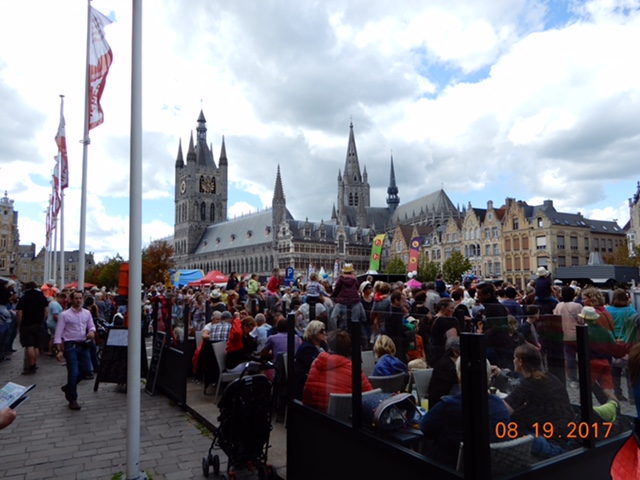
We walked through the Menin Gate, down the street and into the market square where we were confronted with the Cloth Hall – easily the largest and most impressive ancient secular building we have ever seen. To think the original building was built 800 years ago and didn’t belong to the Church was to realize the wealth of the city. The Cloth Hall contains the Flanders Fields Museum, that gives the history of WWI’s impact on Ieper and the immediate area. We had every intention of going through it but were so taken in by the rest of the city that by the time we returned to the museum, it was closed.
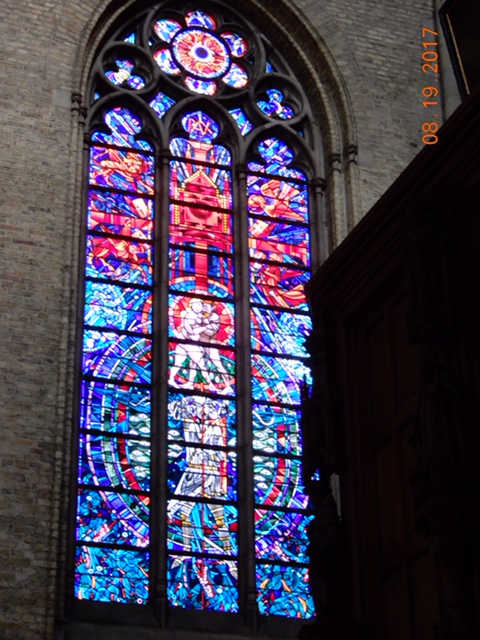
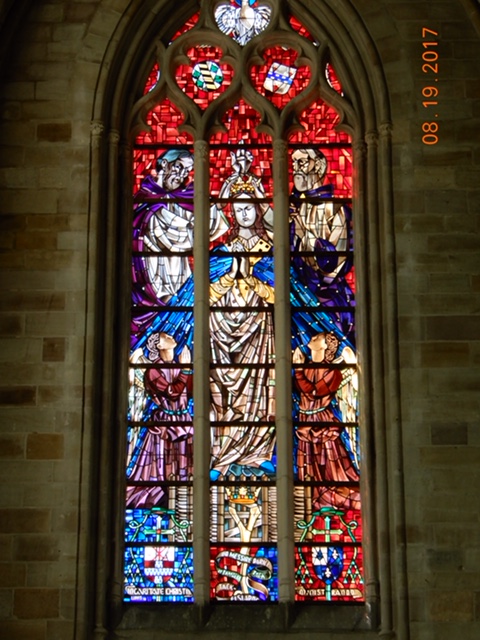
Right next door was the cathedral, also rebuilt after the war. The cathedral was an interesting study in stained glass window styles; ancient vs modern with a greater use of rich blues and subject matter that reminded us of the Chagall stained glass windows we have seen.
That Saturday the market square was hosting a music extravaganza, the Ketnet Zomertour, a festival geared specifically to children 10 and under. Ketnet is evidently a TV show for young children and, if today’s event is any indication, it is wildly popular. A large music stage was set up and food and souvenir booths were spread all around the square. As the day progressed the square filled with families singing and dancing and enjoying the event. They kinda got in the way of our picture taking, but the enthusiasm was hard to resist.
We wandered around the inner city marveling at the complete remake of a city destroyed in the same century we were born in.
Then we walked the Ramparts, the fortifications that have protected the city for 1000 years. The latest incarnation was designed by Vauban, the French military genius, in 1680. Today the rampart walk follows the river across the Lille Gate, past one of the many WWI cemeteries in the area, along a lovely green belt and ending at the Menin Gate. We stopped for a bit to watch the “22nd International Kayak Water Polo Tournament” being played on 4 courses in the river amid founts of splashing water as kayak teams grappled for the ball and goals.
At 7:00 pm we positioned ourselves at the Menin Gate to make sure we had a good spot when the ceremony began at 8:00. At 7:30 barriers went up to halt traffic. Around 7:45 the Ieper fire brigade and a nearby youth marching band marched through the Gate to take position as honor guard. At 8:00 pm, three buglers made their entrance and played the Last Post – a bugle call often played at military funerals. It was followed by a moment of silence, the laying of memorial wreaths and then Reveille is played at the closing of the ceremony. This ceremony has been done nightly since 1928, with the exception of the four years during WWII when Germany occupied the country. Immediately upon the surrender of the Germans, the ceremony was begun again.
It is a respectful event and very, very impressive.
Monday morning 8:00 am we boarded the DFDS Ferry line from Dover to Dunkirk. We arrived at 11:00 am Paris time, having gained an hour by crossing another longitudinal line from Greenwich prime meridian.
Dover Castle overlooking harbor
White Cliffs of Dover
Willie waiting in line to board
We were on our way to a camping store outside Eindhoven, NL but we were not interested in making a deadhead run there. We looked at our map of Belgium and decided to forgo Bruges, as lovely a town as you could want to see, because we have visited it twice on past trips. Ghent, is only a few kilometres further and we had not yet been there, so that is where we set our sights.
After spending 2+months driving on the left hand side of the road, we were back to right hand roads and it was more of an adjustment than we expected. We were fine along straightaways, but roundabouts and left and right turns took a moments’ thought to make sure we ended up in the proper lane.
We chose one of the national highways for the 121km drive to Ghent. The national highways, while not as fast as the autobahns (European equivalent of American freeways), are a pretty efficient way to get from one point to another. They are also pretty boring; there is little picturesque to see on a track of land set aside for main highways. I prefer the roads that – on printed maps – are the next size down from the national highways, Bruce just doesn’t want to be driving in the bushes.
With little drama, we made it to Camping Blaarmeersen, located in a large sports park in Ghent.
We are both still suffering from our individual maladies: Bruce’s cold and my hyperextended knee so we got ourselves settled and rested the afternoon away. After a tasty dinner of baked turkey breast, baby courgettes (zucchini), new baby potatoes and a mixed green salad, we hopped on our bikes, for the first time in a couple of months (we were scared to death of bike riding on the little lanes of Britain). We rode along a lovely water sports canal that would take us into Ghent 3-5 km away. We were trying to decide whether or not to take the bus into town but the ride helped us decide to take the bikes.
Just before leaving on our bike ride, we learned we had no electrical power to our rig and neither did our neighbors. Previous to our arrival someone had driven into and knocked over a pole that looked like it had two air raid sirens on it that decidedly needed electricity. We were assured that an electrician was on his way out to fix it. When we returned from our bike ride we were told the electrician was unable to repair the power but they would surely have it up and running in the morning. We elected to stay in our pitch for the evening, we like our location. We needed to defrost our refrigerator anyway.
The next morning we awoke to a steady rain interspersed with thunder, lightening and heavy downpours. I began campaigning that we move to a new location. With all the rain and lightening I couldn’t imagine an electrician braving such elements to fix a shorted out electrical box.
We grabbed our rain gear and headed for the office where a young lady helped us pick a different pitch that to our delight was even better than the one we were leaving. We moved during a break in the rain and as soon as we settled in, the rain came in earnest and stayed all day. So much for visiting Ghent on Tuesday.
Wednesday the rain was gone and the sun was shining. It was time to go a-touring. We jumped on our bikes and rode to town.
We had read that Ghent was a well kept secret. With Bruges so near and so popular on the tourist trail, Ghent was often overlooked.
St. Michaels
St.Baafsplein
Sights around town
Sights around town
Ghent had its beginnings in 630 when a missionary bishop founded St. Bavo’s Abbey at the confluence of two rivers. In the Middle Ages the marshlands were no good for farming but were excellent for sheep raising and Ghent grew very rich with the wool trade, becoming for a while, second in size only to Paris. Holy Roman Emperor Charles V was born in Ghent in 1500. That distinction didn’t stop the citizens of the city from refusing to pay taxes to him. In retaliation he rescinded all rights and privileges and the city fell on hard times. The 1800s saw the city regain some of its power by becoming the first industrialized city in Europe.
Today Ghent is known as a university town with over 70,000 students who keep the town lively.
The historic city Center has many sights to see.
The Roeland Bell
Belfry and Cathedral Tower
The belfries of Flanders
One is the Belfry, a UNESCO World Heritage Site. The belfries of Flanders and France were the symbols of freedom, power and urban prosperity. They were also the most secure places in the city. They often housed a city’s archives and vaults. Ghent’s Belfry symbolizes the city’s independence and contains the alarm bells which serves to protect its citizens. The Roeland Bell is the name of the alarm bells hanging in the belfry since the 14th century. The original large bell was taken down, melted and formed into a carillon of 40 bells. The largest of the 40 bells –renamed Roeland, cracked in 1914. It was taken down, repaired and now stands place of honor near St. Nicholas’ Church in the square.
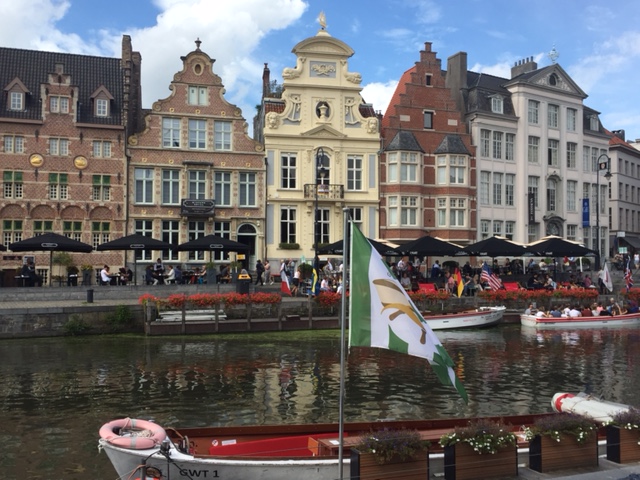
Flanking the river Leie are two quays, the Graslei and Kornlei. Once upon a time Ghent had a grain staple right: all grain that entered Flanders had to come through Ghent’s port. All boats that came into the port had to leave one fourth of their cargo as payment to use the riverways. The resulting wealth built beautiful buildings along the quays.
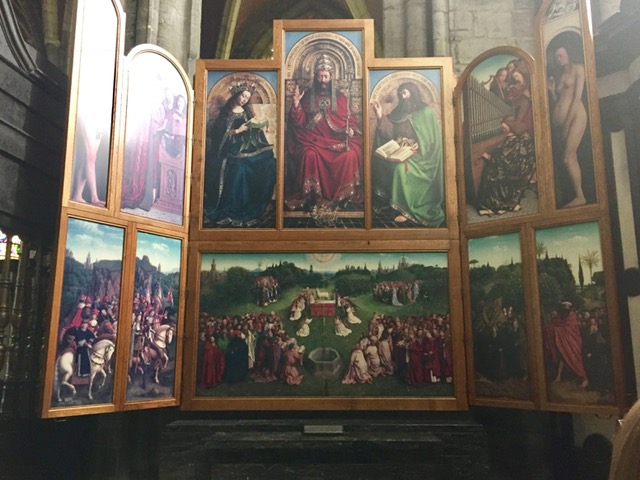
Ghent Altarpiece copy
St Bavo’s Cathedral is a couple of blocks away from the river and is in possession of the Ghent Altarpiece, painted by the Flemish brothers Van Eyck and unveiled in 1432. “The Adoration of the Mystic Lamb” is a 20-oak panel painting telling stories of the Bible. It is exquisite. I was able to take photos of a copy of the alterpiece but it does no justice to the original whose painted panels are bright and clear and almost glow.
High Altar
St. Peter
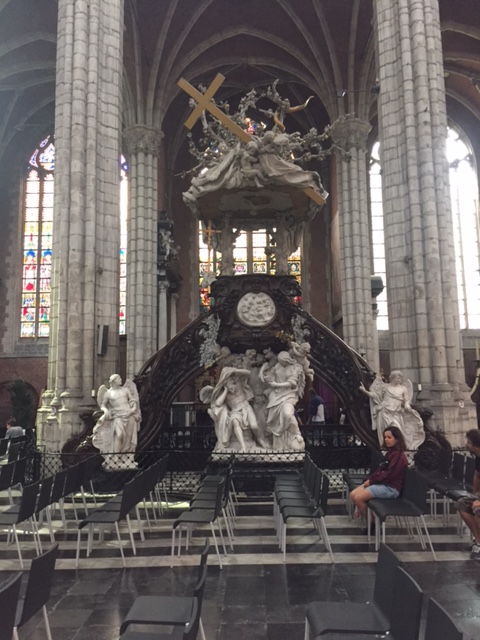
St. Bavo’s Rococo pulpit
St Bavo’s is a magnificent cathedral with many marble statues, oversized paintings of religious scenes and a Rococo style pulpit that is made of oak and gilded wood and white and black marble that is carved into larger than life size religious figures. It is the most over-the-top pulpit I can remember ever seeing. The cathedral is amazing and one of the more ornate ones we’ve seen in the Protestant north.
We had only spent four hours walking about the town but my knee was giving out on me so we decided to end our day earlier than planned. We missed a lot but at least we did get to see a new city.
We have come to a difficult decision. We are going to end this trip in October. We said when we came over that we would go home when it wasn’t fun anymore. We were able to see a lot of new ground in the U.K, but we have seen so much of continental Europe in our last two trips, that this trip was feeling repetitive. The Schengen dilemna has added to our frustration. And lastly, we are beginning to miss our house and friends. We couldn’t see extending the trip for another six months just to see Croatia. That means our itinerary is going to change – again. We are not going to Croatia, instead we will concentrate on western France, northern Spain and Portugal, new territory for us.
Thursday – 8/3/17
(Itinerary – Kensington Palace, Albert Hall, V&A Museum, Natural History Museum)
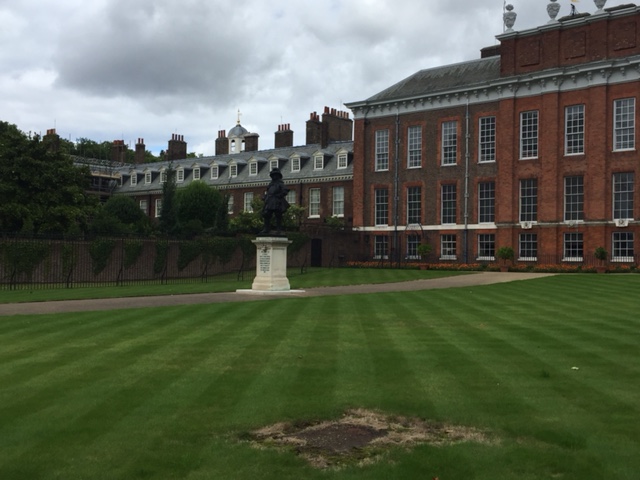
I must confess I hold a fascination for the British Royal Family. Prince Charles is 3 months younger than me and since I was a child I was aware of his existence; I can remember thinking I could be his princess – a thought that undoubtedly occurred to millions of young girls his age. As he and I grew up I watched his romances and ultimately his marriage to and divorce from Diana. I followed the tragedy of Diana’s death and, like so many others, worried for their sons. I was – and am – enchanted with the Duke and Duchess of Cambridge and their little family. When Kensington Palace – the home of both Diana and Prince William – showed up on the London Pass we knew we were going.
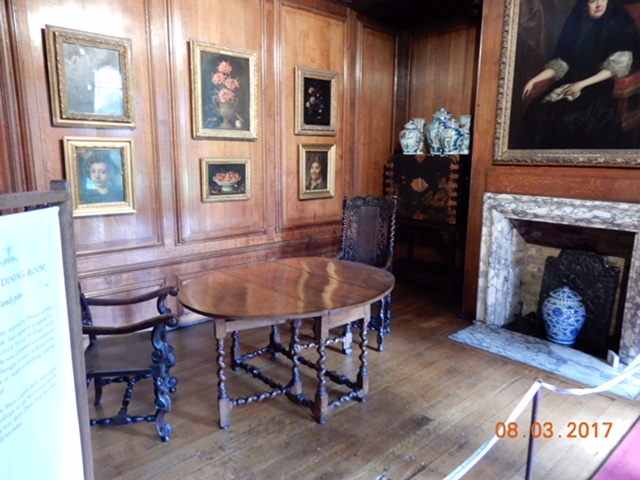
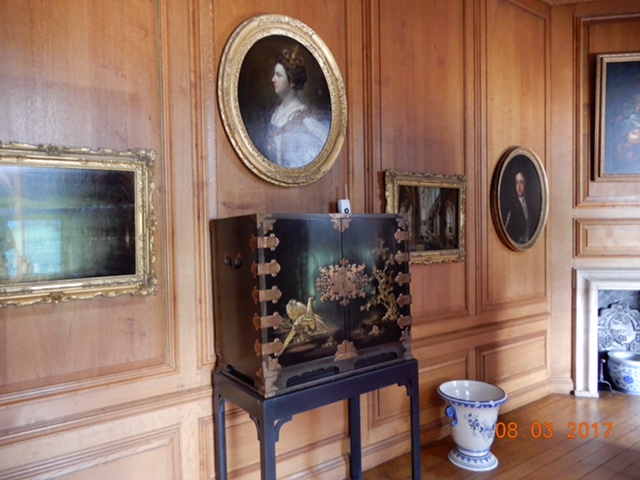
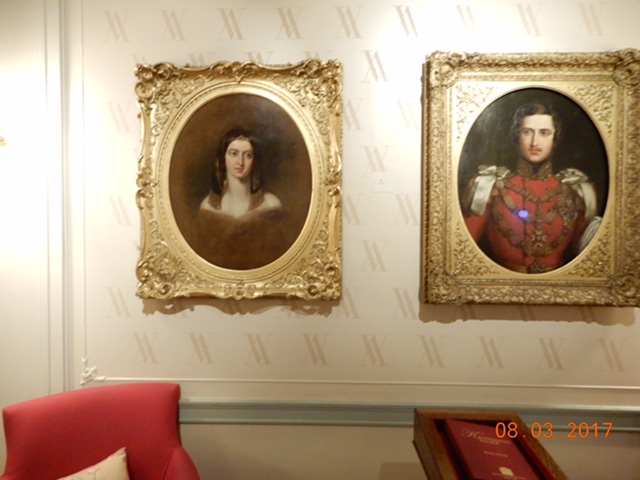
A small portion of the Palace is open to the public – no, we didn’t get to visit Kate and Williams apartment – but we did get a taste of the sumptuous living past kings and queens enjoyed. The tour was a mini-lesson in British royal history with exhibits on Queen Mary II – the Mary half of William and Mary, the last Stuart monarchs: The Georgian era of the 1700s with King George II’s State Apartments on display: Queen Victoria and Prince Albert and their mushy love affair: and an exhibition on Diana and her fashion story.
Queen Mary’s dining roomThe Queens sitting room
Queen Mary’s life was more interesting than her state apartments, but I won’t go into that story.
Court dress in 1700’s
Kensington Gardens from King’s Apts.
Grand staircase
Painted walls
The King’s State Apartments were over the top with painted murals on walls and ceilings. The grand staircase was eye catching (understatement here) with, I’m sure, the goal to impress important visitors.
It was a very popular exhibit
She often made notes to designers
The Travolta dance dress
Business suit
Wallpaper in hallway to toilets
Diana’s exhibit displayed several of the dresses and suits she wore during her life and showed the development of her fashion sense. I remember when she wore several – more than several – of the dresses on display. The dress she wore when she danced with John Travolta at the White House was on display. Several of the dresses she wore for famous photo shoots were on display.
I’ve been to Elvis’ Graceland and I have seen some of the costumes he wore during his shows. I remember thinking the tailoring was lousy. Up close the costumes look cheaply made. Not so with Diana’s clothes. It must have been a huge confidence builder to don these gorgeous frocks and go out in public.
The last exhibition we visited was Victoria Revealed. Her apartments contained lots of mementos reflecting her life with Albert, with whom she appeared to be obsessed. Love letters were on display and little gifts of affection that had been exchanged. They must have had a rollicking sex life because they kept having children – this by a woman who purportedly was not fond of children; they got in the way of her time with Albert.
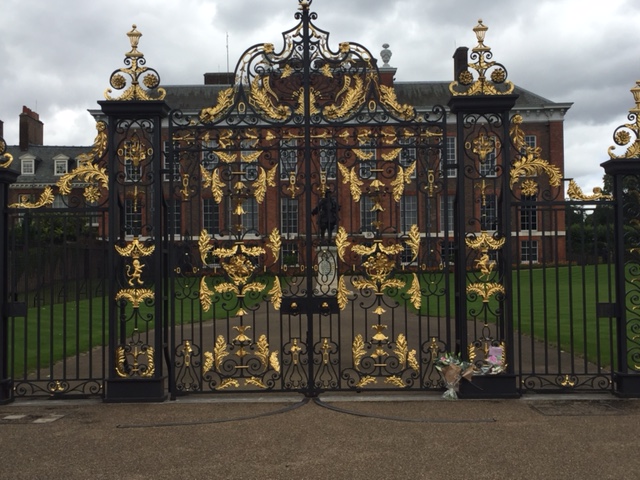
Outside the palace at one of the entrances stand the Golden Gates, where the floral tributes to Diana were displayed at the time of her death. A single bouquet and note marking the 20th anniversary of her death this month lay at the base of the gates.
We were off to Albert Hall and walking along the edge of Kensington Gardens when we stopped to watch a flying trapeze school. Youngsters were trying their hand at swinging the bars while safely connected to a harness and rope. I saw that several of the waiting children were quite young and I thought of Shannon’s 8 yr old daughter, who appears to be very adventurous, and wondered if she would enjoy trying that. I widened my range of vision to my left and I saw a man with two children I recognized. It was Shannon’s husband James and their kids! It almost seemed that my thoughts had made them materialize out of thin air! We hadn’t met James yet but that didn’t stop me from hollering out to them and marching off in their direction. Bruce, who hadn’t yet seen them, thought I’d gone bonkers (again) and wondered where I was going.
After formal introductions, James and kids walked us to the Albert Hall, sharing with us information about this neighborhood that James had grown up in.
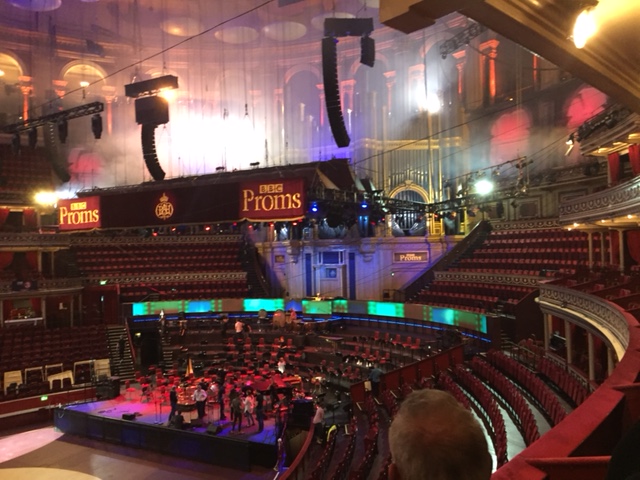
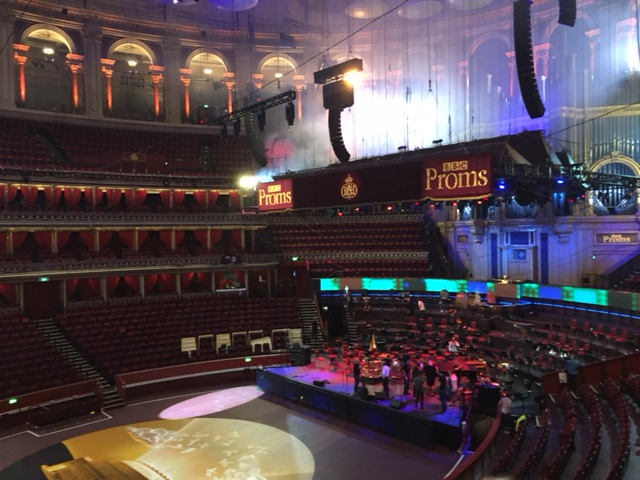
What a famous venue Albert Hall is. It lies in the university/museum district on land that Prince Albert was able to purchase with profits made from the Great Exhibition of 1851. His idea was to create colleges of science and technology in the area. After his death, the construction projects continued and were combined with memorials to Albert including the Royal Albert Hall.
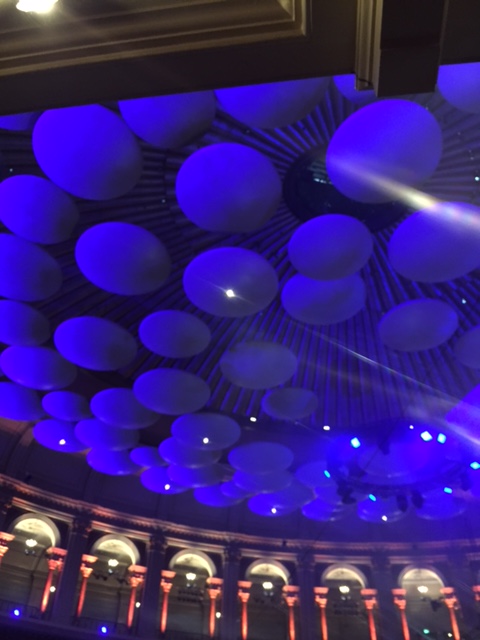
After four years of construction, using 6 million bricks and 80,000 terra-cotta blocks, the Hall was opened in 1871. Almost immediately acoustical problems in the form of a strong echo became apparent leading to several attempts over the next 100 years to solve. In 1969 large fiberglass sound-diffusing discs were install in the ceiling which evidently solved the echo problem. The Hall holds the second largest pipe organ in the British Isles with 9,997 pipes. The hall holds slightly less than 6000 people, so the concerts are rather intimate compared to some venues.
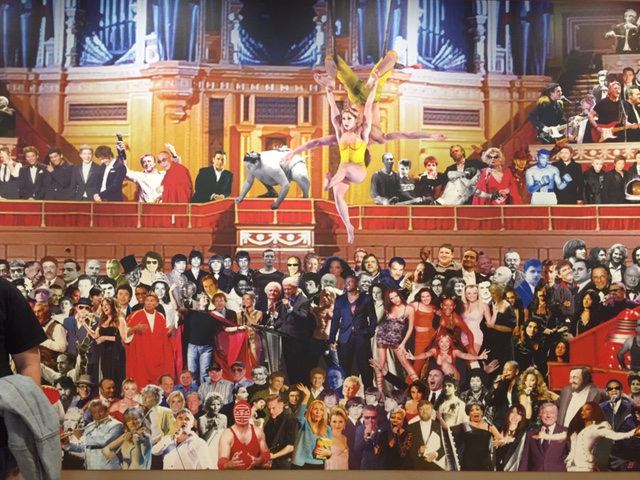
Who hasn’t performed at Albert Hall? From contemporary to classical to rock to hip hop, I think it must be comparable to Carnegie Hall in that everyone with any talent dreams of performing there. Currently the BBC Proms – an eight week summer season of daily orchestral classical music concerts is taking place. Amazingly, this summer event has been going on since 1895 (obviously not sponsored by the BBC way back then) so locally they are quite well known. While on our tour we got to listen to musicians warming up for that evening’s concert. By the by, Proms is short for promenade concerts – outdoor concerts originally performed in London gardens where the audience could stroll about while listening.
After our Albert Hall tour, we walked past the Museum of Natural History and the Victoria and Albert Museum – both on our list, but not to be visited that day.
Friday – 8/4/17
(Itinerary: Temple Church, Monument, Shakespeare’s Globe, Museum of London)
Friday morning we took the tube to Charing Cross to track down Benjamin Franklin House, at 36 Craven Street, the only surviving house in which he lived. Franklin lived in the house for 17 years as a diplomat for Pennsylvania before the colony became a member of the United States of America. He was actually a border at the widowed Mrs. Stevenson’s house but with his wit and charm soon became the de facto head of household.
The house is a Georgian style home originally built as a lodging house. I’m sure it still survives because of the English respect for old things, unlike the U.S. where the old is replaced with the new as often as possible.
Craven Street has an outlet to the Strand, an enormously major thoroughfare in the City of Westminster in central London, that runs from Trafalgar Square to Temple Bar where it becomes Fleet Street inside the City of London.
After a previous attempt to visit, we were going to see the Temple Church consecrated in 1185 by the Knights Templar, the soldier monks who gained fame and power by protecting pilgrims during the Crusades. It was built to be their English headquarters. While this church has been in London for a loooong time, it gained international fame by playing a role in the book/movie The Da Vinci Code.
The church is round, modeled after Jerusalem’s church of the Holy Sepulchre, and contains the effigies of Templar knights. The Knights Templar had the most interesting history right up until they were wiped out by King Phillip of France in the early 1300s. This is the second surviving Templar church Bruce and I have visited, the other one is in Metz, France.
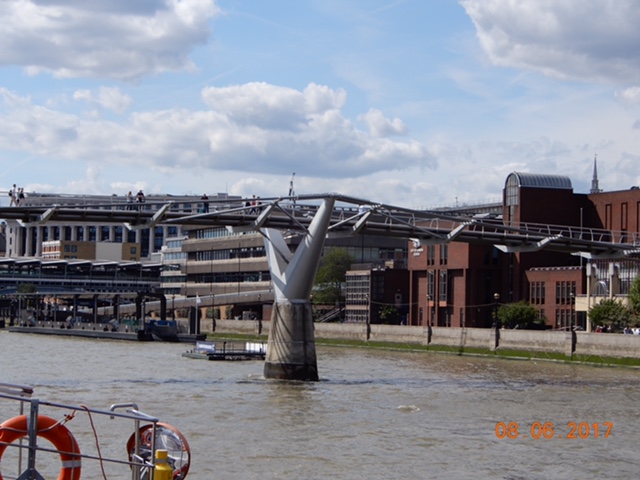
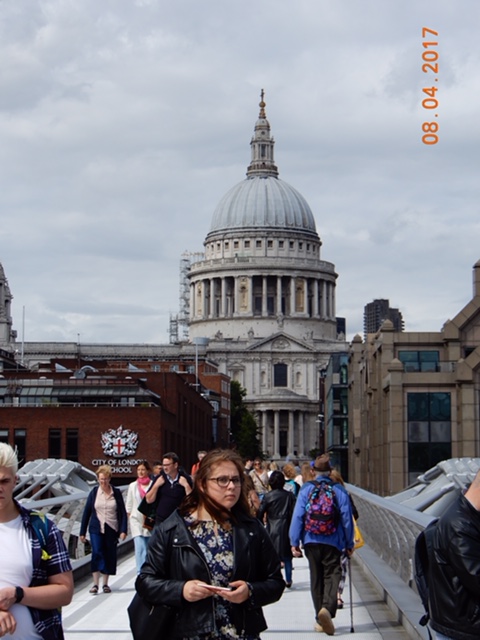
We continued along Fleet Street, famous as a printing and publishing area with some newspaper buildings preserved and the name synonymous with the newspaper trade. We were on our way to Millennium Bridge, the pedestrian-only bridge crossing the Thames that gained fame in my eyes for being so overloaded on its opening day that it began to sway and twist, giving the walkers quite the ride.
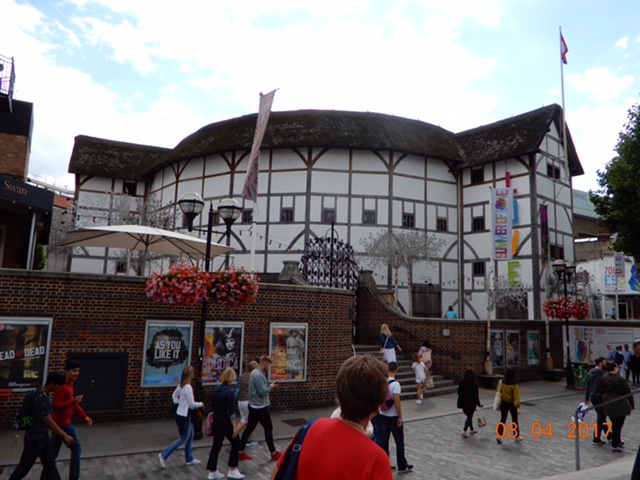
Millenium footbridgeShakespeare’s GlobeSt. Paul’s from Millenium Bridge
We found and crossed the bridge – with no noticeable vibrations – making our way to Shakespeare’s Globe, the reconstructed Elizabethan playhouse associated with Shakespeare. We had hoped to take a tour of the theater but a play was underway and we couldn’t go in. So, it was back across the Millennium Bridge and up to the Museum of London.
The Museum of London is a museum to be taken in small parts. It is the largest urban history museum in the world. It has over six million objects organized in chronological galleries dating from pre-history to current era. We got no further than the Roman era before we were exhausted and overwhelmed. It is an unbelievably interesting museum but to visit it at the end of a busy day was a mistake. Humbled, we left the museum and walked to St. Paul’s Underground Station to return home.
Saturday – 8/5/17 (Itinerary: Windsor Castle)
On Saturdays, our local bus goes to Windsor. Windsor was another attraction included with the London Pass so we set aside Saturday for our Windsor visit as soon as we learned of the bus.
Windsor Castle was built by William the Conquerer and since 1100 has been the royal residence of all the reigning monarchs. It is the longest continuously occupied palace in Europe.
The bus left our camping at 10:40 and the return bus left Windsor at 3:10. We figured that gave us plenty of time to see the castle and the town.
We didn’t count on the bus trip taking an hour to get there. And we didn’t figure on crowds as eager as us to visit the castle. The bus let us off right at the castle entrance and into a throng of people jockeying to get in lines to enter. We were a bit shocked; Tower of London, in the middle of the city, didn’t have lines this long.
We saw a second, somewhat shorter line to the right of the entrance and thought perhaps it was for ticket holders so we walked over to an employee to ask. Unfortunately, that line was for tours only. The gentleman told us that, what with summer recess just begun, we had picked the 6th busiest day of the year to come visit. He continued that we probably had an hour wait just to get through the gates, if however, we were looking for some good photo ops of the exterior of the castle we should head down the street towards the “Long Walk” where we would find plenty.
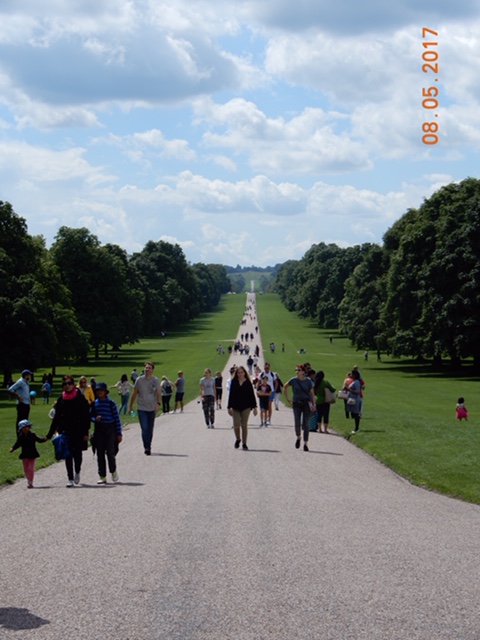
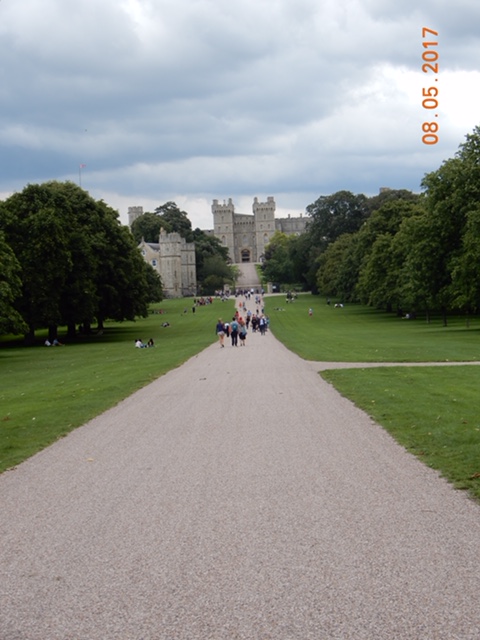
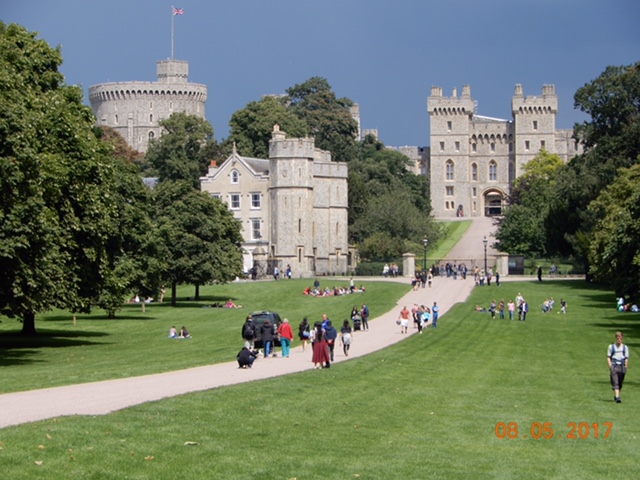
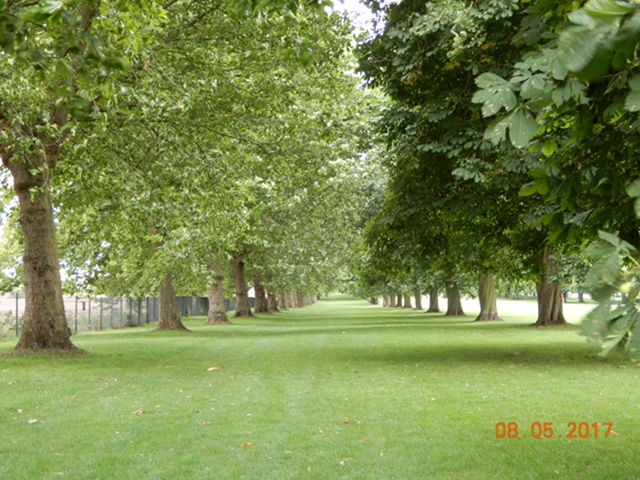
We had no idea what this “long walk” was but we followed signs to it and entered Windsor Great Park, a huge green space with a loong straight driveway leading up to castle gates. As it turned out, this was an almost three mile long approach to the castle the queen uses when she comes to stay. Two rows of mature trees flank the Long Walk and a large bronze equestrian statue of George III stands atop a small hill at the opposite end. We could almost see the statue from the palace gate. Windsor Great Park was originally a royal hunting grounds and a herd of deer still roams about as a reminder of the parks’ historic use.
The park is very popular; people walked their dogs, had picnics under the trees and strolled the 3 mile long walk. We walked part of the way and were able to take some photos of the castle before we re-entered the town to take the Thames cruise offered in our London Pass.
High Street, Eton
Windsor shopping mall
Interior of shopping
That cruise turned out to be a hoax. That’s not really fair of me, we didn’t read the fine print, otherwise we would have known the cruise fee was intact with a small discount for Pass holders. By this time, we were feeling thwarted by the whole day and stubbornly chose not to pay the cruise price. We probably could have gotten some great camera shots of the castle had we decided to go, but c’est la vie.
We spent the rest of our time walking around the towns of Windsor and Eaton across the river, before we returned to the bus stop and went home.
It was a nice day, but not what we had hoped.
Sunday – last day of London Pass
Everyone in the world who tells time can thank the British for giving us Greenwich Mean Time from which to base local time. GMT is based on the Prime Meridian – point 0 longitude – located at Greenwich Observatory. I’m sure everyone reading this has heard of GMT and the prime meridian (and if you haven’t, you should question your educational system.). Where we live, the time zone is GMT-8, meaning it is 8 hours behind London, England local time. There is a mathematical equation to determine this, but since I’m sure it was covered in your education, I won’t go into it.
I have always been curious about Greenwich Observatory and the prime meridian. On previous visits to London I neglected to visit Greenwich in the mistaken belief that Greenwich was too far removed for a London tourist to be able to conveniently visit. That is what comes of using the underground only to move around the city – I cannot get my bearings. In fact I was hoping we could use the bus system this trip just so we would be above ground as we moved from point to point. That didn’t happen for a couple of reasons; time and mastery of the system.
Anyhow, Sunday we decided to take the hop on, hop off river boat cruise to Greenwich. We made our transfers on the Tube to get us to a starting point on the river boat when I saw that the tube line we were on would take us to Northern Greenwich. Because our days always start out late, I suggested we may save time if we continue on the tube to that station and return from Greenwich via the river.
The problem with that idea was we do not know the geography of the area. As it turned out, North Greenwich was a time-eating 2 miles away when you knew where you were going. We didn’t, and when we asked for directions we were given wrong ones.
The time we hoped to save by staying on the tube was eaten by our ignorance. We did walk past an arena called the 02 and watched people climbing the outside of the structure. A Star Wars exhibition was showing at the venue:
Unable to figure out how to get to the observatory by walking, we expedited our process by taking a ferry across the Thames to the Greenwich Pier. A small carnival – or what we in the states would think of as a carnival – was dockside with a couple of traditional rides: a beautiful carrousel and a tower contraption called a Helter Skelter. A user climbs up inside the tower and slides down the outside. I don’t know how much of a thrill ride it is, but it certainly does attract the eye.
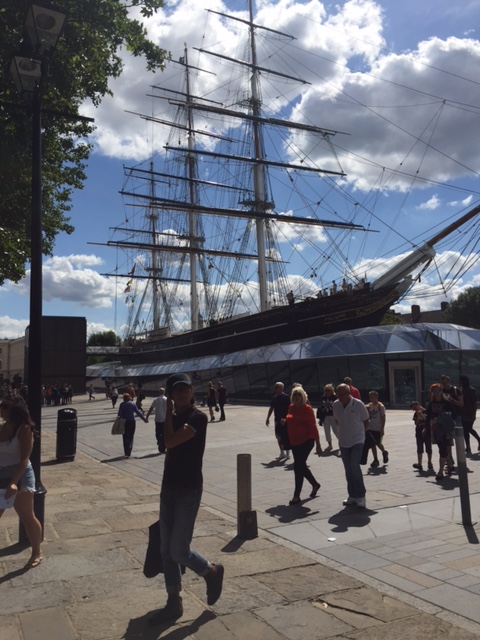
The clipper ship the Cutty Sark, is drydocked at the Greenwich Pier. She was one of the last, and one of the fastest tea clippers to be built before steam engines became the new generation of shipbuilding. She is now a museum ship, and – surprise! – was an attraction on our London Pass.
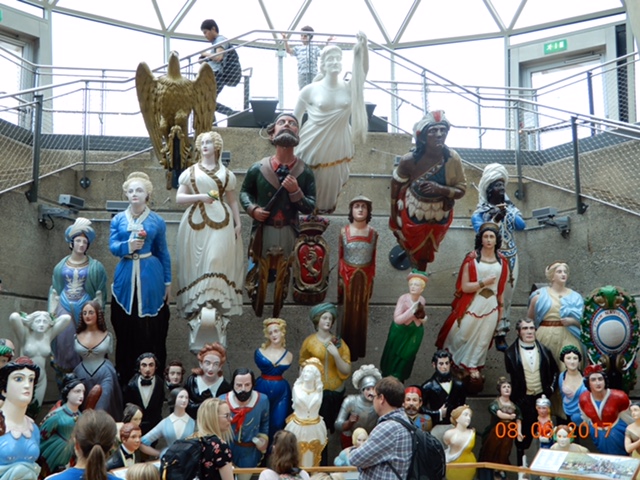
The Clipper Ship Cutty SarkShip Figureheads at Cutty Sark museum
After touring the Cutty Sark we made our way to Greenwich Park and walked up the steep hill to the Observatory. Like Windsor Park yesterday, there were hordes and hordes of people in the park, making it a bit of a challenge to get to the top.
The Prime Meridian
We stopped for a photo at the line marking the east and west sides of the Prime Meridian and it was a good thing we did so, because the more picturesque photo opp at the Observatory itself had a ridiculously long, slow moving queue. I waited about 10 minutes with no forward movement before I bailed out. We went through the museum that told all about the development of naval chronometers in order for sailors to know where they were while at sea. It was all interesting but we had a dinner date with our young friends and had to return to the river cruise boat in order to meet them at Trafalger Square.
We were walking down that steep hill when I took an odd step and jarred my right knee.
Tower of London
London Bridge
Millenium Eye
Parliament from river
Boudicca – Celtic queen who fought Romans
We reached the pier, got on our river boat and began the cruise to Westminster Pier, near Parliament. From there we walked up Whitehall, completing the walk from our first day when we were distracted by the Horse Guard Gate.
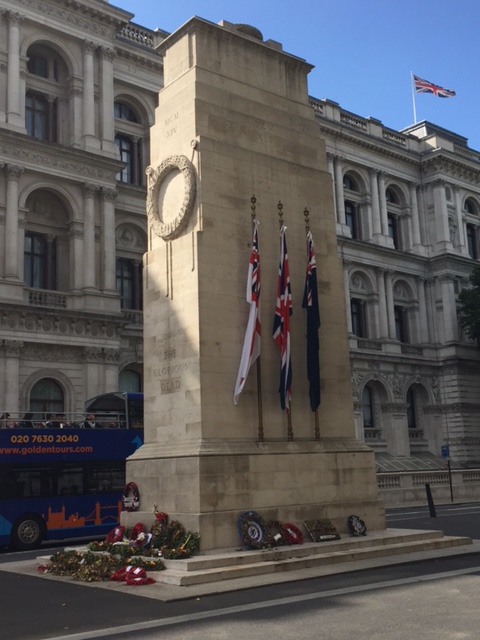
We passed the Cenotaph, the UK’s official national war monument, where the Queen lays a wreath each year marking the National Day of Rememberance. I was amazed at how small it is. I expected it to be much larger like the Wellington Arch near Hyde Park.
We met up with James and Shannon and the children at our appointed time and they treated us to a lovely dinner at a little Mexican restaurant near Charing Cross. We are really glad to have been able to spend as much time with them as we did, although we do need a chance to spend more time knowing James. There is always next time.
By the time we returned to the camping we realized we were pretty tired. Bruce felt a cold coming on, and my knee was getting more and more tender.
The next morning we were at a full stop. Bruce’s cold had arrived and I could barely walk. Instead of going into London to visit the museums we had planned on seeing: the V&A, the British Natural Museum, the British Library, the British Museum and the National Gallery, we spent the next four days recovering from colds and hyperextended knees. We made an experimental short trip into Uxbridge on Thursday for a grocery and cold medication run and to see how my knee held up. The results were mixed but we decided to return to London on Friday and see a couple of museums. We made it through the Victoria and Albert (V&A) but could go no further. Our museum fixes will have to be met in other countries. Fortunately there are some pretty fantastic museums in many cities we expect to visit.
Saturday, 8/12/17 we decided not to push my knee or Bruce’s cold endurance. Instead treated ourselves to a movie. We went to see “Dunkirk” in an IMAX theater. It was very well done. The last movie we saw in England was “Gladiator.” Gladiator won the academy award for best movie, maybe Dunkirk will too.
We’ve completed our British Isles leg. Tomorrow we leave London for Dover and expect to take the ferry to Dunkirk on Monday. We need to make a run back to the Netherlands to a camping supply store near Eindhoven to purchase a couple of necessary plumbing parts for the van. We have been unable to find them anywhere else. Then we will begin our 5-6 week journey to Croatia via France, Germany, Austria and Slovenia.
Friday we arrived at Wyatts Covert Caravan Club in Denham, a suburb of London that, at 18 miles out, was outside London’s Low Emissions Zone, a requirement we needed to heed since our camper is older than the 2001 minimum age limit allowed within the Zone. Since we were going to be staying at least a week at this location, we set up our “Guest Room” and spread out a bit.
Saturday we tested ourselves on the rapid transit by busing into Uxbridge, buying our Oyster card and learning how to use it.
The Oyster Card is probably the cheapest way to get around the London rapid transit system of trains, underground and buses. We used one 17 years ago and knew it was the best way to go but that was all we remembered. FYI you can buy one at the ticket booths just outside the Tube’s turnstiles. Ask an employee to help you; we found them all to be very friendly and helpful.
A local bus stops at the campground and delivers us to the Uxbridge Tube station. A 20-25 minute ride takes us into the heart of London where we can decide which stop or transfer will take us to our desired destination. It’s pretty easy, once you get the hang of it. (I do wish Americans took more advantage of rapid transit, it has a lot of advantages.) The only problem to this means of getting to and from the camping is the local bus’s last return to the camping is 2:30pm – far too early to get in a day’s sightseeing and use it for a return. The solution is to take bus #331 to Denham and walk the 1.1. miles up a hill to the camping, about a 25 minute walk.
When we got to the Uxbridge Tube Station on Saturday, no subway trains were running. Since this was our trial run day, this caused us mild consternation. We learned our station would be closed through the weekend (!) and we would need alternative plans to reach the city. We could take the train from Denham into the city but we needed to learn how to do that. Bus #331 took us to Denham Station where we bought a day pass that could be used on trains, buses and tube.
Then we walked up the hill and back to the camping.
We had a date on Sunday to spend time with an old friend of the younger generation, Shannon, an expat living in London with her British husband and two young children whom we have had the pleasure of watching grow via FB.
We actually had no trouble getting into London, and with the instructions Shannon gave us to navigate the buses, we met up with her without mishap. Well, actually not completely without mishap. While awaiting our bus a pigeon decided to poop on Bruce, and poop it did! Bruce’s hat, hair, jacket and pants got in on the action. Shannon’s daughter said it is good luck; in that case Bruce is a very lucky man!
The last time we saw Shannon was in 2008 during a stopover in London awaiting our flight home after a five month trip touring Eastern Europe. A lot had changed in both our lives. She is the proud mother of two darling children, ages 8 and 5. She and James – her husband – recently purchased a home in Islington – a multi storied attached house that is similar to the brownstones in Boston. It was built in the 1880s and has all the charm one would expect of that era.
In the times we spent with Shannon we knew her to be an accomplished cook and our day with her proved the point. She fed us a divine dinner of shrimp and steak tacos with grilled peppers and portabello mushrooms. As much as we prepare our own meals on this trip, we are not equipped to cook such an outstanding meal and it was greatly enjoyed.
Dinner is served
And she made a trifle!
While washing Bruce’s “good luck blessing” he borrowed a shirt from another old friend, Isaac.
We used the afternoon to catch up on each other and we were so pleased to finally meet the kids. James was on a business trip, not to return until Wednesday, so we were unable to meet him.
Playing with a selfie stick
Monday 7/31/17
Monday was walkabout London day. While still at home we purchased the London Pass, a multi day entry pass to many of the tourist sights in London, such as Westminster Abbey, Tower of London, St. Paul’s, Kensington Palace, the Hop on, Hop off tour bus and River Cruise and about 60 other places. We bought the six continuous-day pass on the theory that we are old and tired, and could spread out the sights we wanted to see over 6 days rather than the popular three-day pass. (This turned out to be a mistake because instead of getting exhausted after three days of go-go-go, we stretched it to six.) Using the list of attractions the pass allows us entry, we developed a 6-day itinerary to make our best use of it.
Day One was to be Trafalgar Square, the Royal Mewes, Piccadilly, Buckingham Palace, Parliament House and Westminster Abbey.
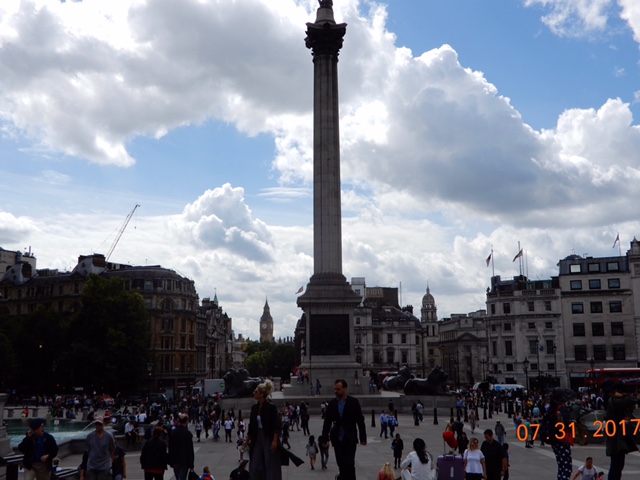
We got off the Tube at Charing Cross and walked out of the station into the immense Trafalgar Square with its mighty column topped by a statue of Admiral Nelson, hero of the Battle of Trafalgar which defeated Napoleon’s navy.
Base of Nelson’s Column
National Gallery
Nelson’s Lion
Four gigantic bronze lions guard the base of Nelson’s Column. Two large water fountains flank the square and 4 plinths (statue bases) stand guard at the four corners of the square. Two plinths hold bronze statues of famous military figures, a third has an equestrian statue of King George IV while the fourth plinth remained empty for 150 years due to inadequate funding, before the city hit on the idea of filling it with contemporary sculptures that change periodically.
Fourth Plinth
Busker
Currently a giant thumb holds place of honor. Buskers complete for tourists’ coins and the whole square is as busy as a hive of bees.
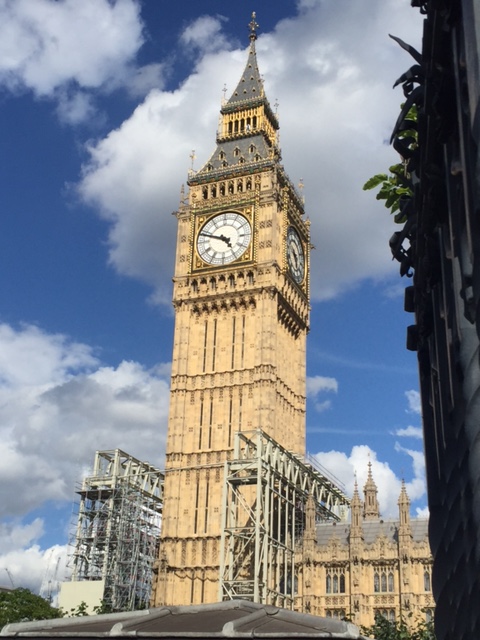
Looking down Whitehall, one of the major boulevards that flows into the square, one can see the Parliament tower that contains Big Ben. We decided to visit Parliament and began a walk down Whitehall.
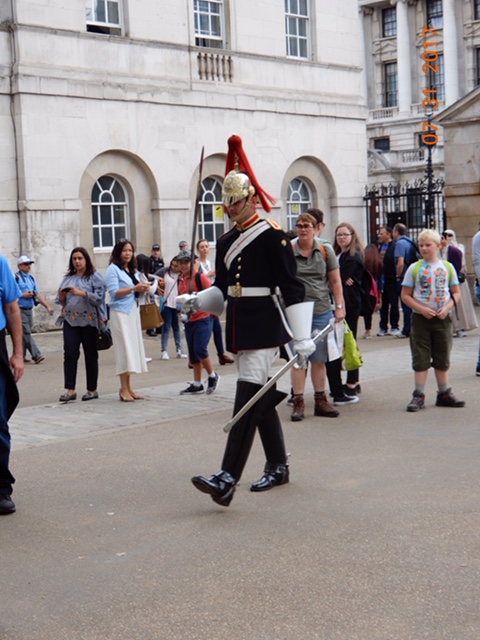
We didn’t get very far, on our right we saw tourists gathering around iron gates and we decided to investigate. We were at the Horse Guard, the official entry to Buckingham Palace and St. James. Guards have stood guard at the gate since King Charles II in 1660.
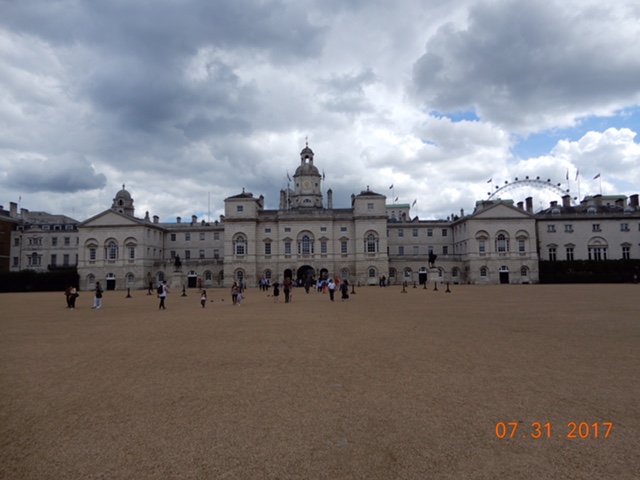
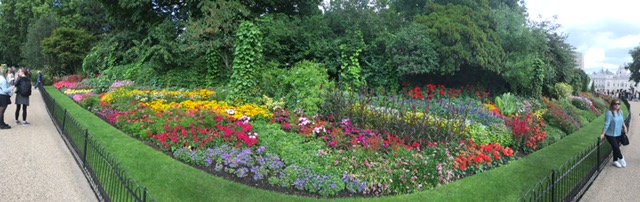
At the time, we didn’t realize where we were but there was a walkway through the gate and off we went. Crossing a huge parade ground – which happens to be the site of the Trooping the Colour on the Queen’s official birthday in June – we continued towards a colorful flower bed that was the entrance into St. James Park.
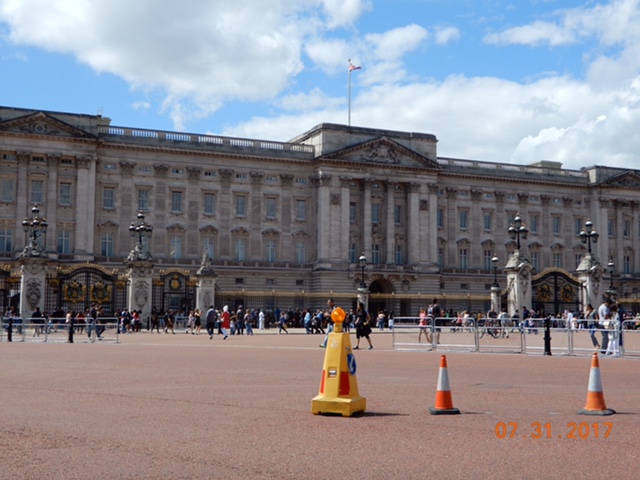
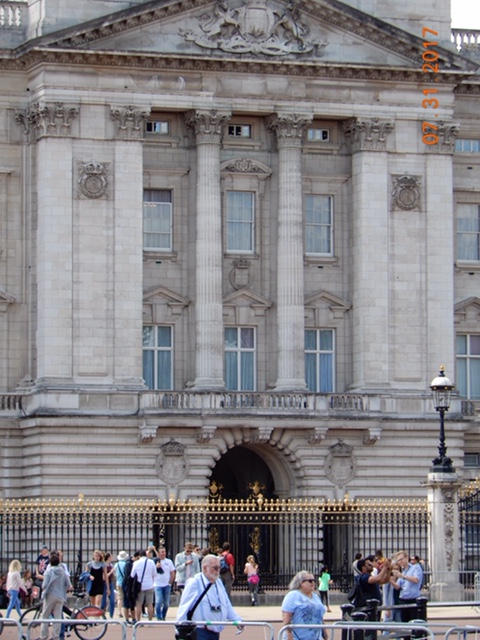
St. James is the oldest of London’s eight Royal Parks. Along with the flower beds and a small lake, the 57 acre park has groves of lovely mature London plane trees whose branches created a leafy roof of welcome shade on hot and sunny days. Walking paths took us to children’s play areas, small food stalls, around the lake with its varied waterfowl, and finally to the gates of Buckingham Palace.
Buckingham PalacwFamous balcony where royals come out to view us commoners
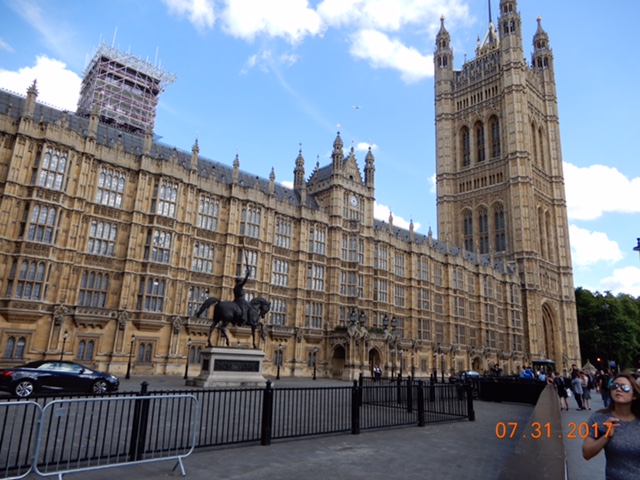
We were completely off course by then so we searched for and found Birdcage Walk which took us past Queen Anne’s Gate and the Horse Guards Barracks and eventually we reached Parliament Square.
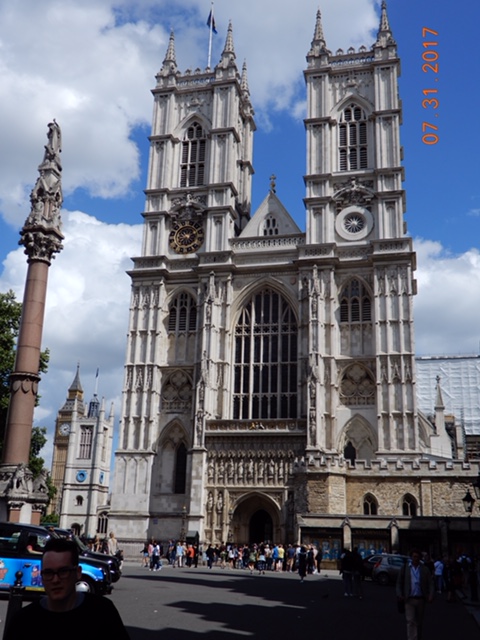
Our approach took us right in front of Westminster Abbey’s western façade: the famous double towered entrance.
Along with a lot of other tourists we admired the abbey and debated starting our London Pass by using it to enter the abbey. It was mid afternoon and we decided against it since a day would be wasted on only one entry. We determined to return on another day when the clock was running. As we were passing the entry gate, a woman stopped us and asked if we would like entry tickets to the abbey. She had purchased tickets for her parents but they had returned to their hotel room and she had spares. So off we went into the abbey and we had just extended our pass by another day.
How one can adequately describe a 1000 year old abbey? First off, it survived Henry VIII’s Dissolution of the Abbeys by being granted cathedral status by that very king.
Every king and queen has been crowned in the abbey since William the Conqueror in 1066. Several kings and queens are buried there, including the Tudor sisters, Queen Mary and Queen Elizabeth I. Mary, Queen of Scots is buried there as are several kings. Geoffrey Chaucer, author of Canterbury Tales, is buried in the abbey as is Issac Newton and Charles Darwin. National figures including generals, admirals, politicians, doctors and scientists as well as members of the aristocracy are buried there.
King Henry VII and Queen Elizabeth of York
Tomb of unknown Warrior
It is chock full of memorials and effigies of distinguished personages. The famous Poets Corner, near Chaucer’s resting place has memorials and burials of poets, authors and musicians, most of whom are known in literary circles.
The tomb of The Unknown Warrior, and unidentified British soldier from WWI, lies in the floor just inside the great west door. It is the only grave in the abbey on which it is forbidden to walk.
Seventeen royal weddings have taken place in the abbey, the latest being in 2011 when Prince William married Kate Middleton. A lot of us watched that wedding on TV.
We must have spent about two hours touring the abbey and when we finished, we walked to Parliament but learned we were too late to tour the government building with any level of thoroughness.
Ready to go home, we got back on the Tube to Uxbridge, took bus #331 to Dunham and walked the 25 minutes uphill to the camping where we made a chicken salad dinner and collapsed into bed.
Getting to and from London from our camping is a lengthy affair: the earliest bus to leave from the camping is 9:40 am. It takes about 20-25 minutes to reach Uxbridge, the nearest tube station. From Uxbridge its another 25-30 minutes to reach London. We don’t get out of the tube stations until a little before 11am.
Reversing that procedure coming home and adding the 25 minute walk at the end makes for a long day.
Tuesday 8/1/17: (itinerary was Tower of London, St. Paul’s, Temple Church, Monument to London Fire, and Museum of London.)
Instead of taking the Tube to Tower Hill we got off at Bank, in the middle of the City of London business district where we were blown away by the juxtaposition of old classic architecture and modern glass-covered skyscrapers. It reminded us somewhat of La Defense in Paris, the modern business district with groundbreaking architecture.
It was not what we were expecting and we slowly wandered down streets towards the Thames gawking at the high rises and comparing them to the staid stone classic Victorian architecture that survived the London Blitz of WWII. Londoners seem to like to name their skyscrapers: there is the Gherkin, the Cheese-grater, the Wilkie-talkie and the Shard.
We reached the Thames west of the Tower of London, way behind schedule and walked along the river spotting the HMS Belfast, a retired WWII battleship, and the reconstruction of Sir Francis Drake’s galleon, the Golden Hind. Lots of touring cruise ships motored along the river carrying tourists up and down the Thames. The Tower Bridge proudly spanned the river, its two towers holding the suspension cables and the drawbridge.
It is summer and school is out. This means there are tourists everywhere. The Tower of London was no exception. At least with our London Pass we didn’t need to wait in lines but were escorted to the front of the gateway and made our way inside.
We took in the half hour historic Beefeater Tour, telling us of Traitors Gate, the legend of the ravens, the location of the scaffolding were Ann Boleyn was beheaded and the chapel were she and several others are buried.
The Beefeaters have their own story to tell: actually they are Yeomen Warders who are retired from the Armed Forces. They must be former warrant officers with at least 22 years of service. They must also hold the Long Service and Good Conduct medal. Our Beefeater looked no older than our son Berkeley, so he must have started early to accomplish all that. We saw the first -and only- woman Yeoman Warder as she led a changing of guard at the tower jewels.
The White Tower
Ornamental cannon
Armor of kings
Horse armor
Wooden heads of kings
Dragon built entirely of weapons
We walked through the White Tower – the castle fortress built by William the Conqueror and the home of kings for 500 years. Today it holds a museum of royal armory.
I have forgotten to mention other sites we’ve visited in Britain that are UNESCO World Heritage but I’ll add here that London Tower is on the list.
St. Paul’s front
Dome from Paternoster Square
A tree on the church grounds
Outline of chapter house of Old St. Paul’s that was burned down in the Great London Fire
Our next stop was St. Paul’s Cathedral. The Great London Fire in 1666 burned down 80 percent of the City of London including the Old St Paul’s Cathedral that had stood on the grounds since 1275. Sir Christopher Wren, one of England’s greatest architects, was tasked with rebuilding 52 churches after the fire including his masterpiece, St. Paul’s. Until 1967 St. Paul’s dome made the church the highest building in London. We thought our London Pass covered the entry fee into the cathedral but we couldn’t find it in our documentation. We were extremely disappointed but we plan to use the Pass before we paid entry costs into places so we passed on paying the £18/per person to visit the interior.
By now it was nearly 4:30 pm, the witching hour for peak times on the transit systems. Between 4-7:00pm the rates increase as commuters head for home. On Monday we learned about the increased charges so today (Tuesday) we decided we would wait until 7 before heading home. We were hungry so we stopped at a little bistro next to the cathedral and shared an artisan pizza as we passed the time.
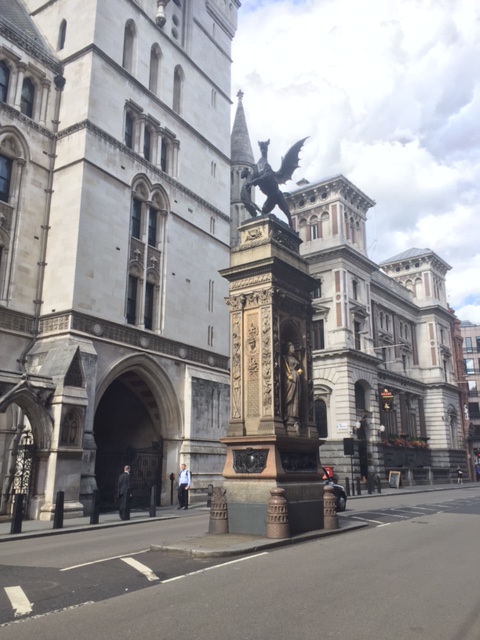
Temple Bar – relocated at entrance to Paternoster Square behind St. Paul’sOriginal location of, and memorial to, Temple Bar on Fleet Street
Heading towards a subway station, we walked through Temple Bar, a repositioned gateway into the City of London, into Paternoster Square, an open square surrounded by buildings containing important the London Stock Exchange and several international investment banks. A HUGE television is set up in the middle of the square with deck chairs facing it. We sat for a few minutes catching up on live news of the day presented by BBC. It was our first tv viewing since we left over 3 months ago.
We were pretty tired by the time we reached Uxbridge station and decided to call a cab to take us to the camping. It was a very smart move and one we would use repeatedly for the remainder of our visit.
Wednesday 8/2/17– rainy day. (Itinerary: The London Bridge Experience, Tower Bridge Experience, Tate Modern, Shakespeare’s Globe)
By Wednesday we were so off track from our itinerary that we sort of gave up on it.
Because it was raining we decided indoor things were our best option. The Pass had an attraction called London Bridge Experience that boasted a run-through of London Bridge’s history from pre-Roman times to the present. I love history and it was indoors and Bruce was up for that. We also received entry to the London Tombs – “voted London’s scariest attraction.” That didn’t particularly interest us but it came with the Experience. We should have known from the way they advertised it that this was a gimmick attraction rather than serious or even semi-serious jaunt into history, but we didn’t.
Our first clue this wasn’t going to go well was when we had to wait 25 minutes in an outdoor queue under the current London Bridge – at least we were protected from the rain -while they (it’s always “they” isn’t it?) chose not to share with us the reason for delay. Finally we got inside and were given a spiel about what to expect. We moved from room to room highlighting different important times in the Bridge’s history with young (very good) actors portraying different people from the history of London. Finally we got to the Tombs part of the attraction which was meant to scare the bejeezus out of us. If you have gone to Coeur d Alene’s Halloween extravaganza Scarywood, you know what the bejeezus is, so after experiencing Scarywood, the Tombs fell flat.
So much for that. If I were rating the Experience on Yelp, I’d give it no more than 2 stars.
We finally figured out how to properly use the London Pass app and did learn that St. Paul’s was free entry to those holding the Pass. After the disappointing London Bridge Experience, and because of the rain, we bypassed the Tower Bridge Experience and Shakespeare’s Globe and chose to go to St. Paul’s due to it’s proximity to us.
Between Westminster Abbey and St. Paul’s, we hit a goldmine in religious architecture.
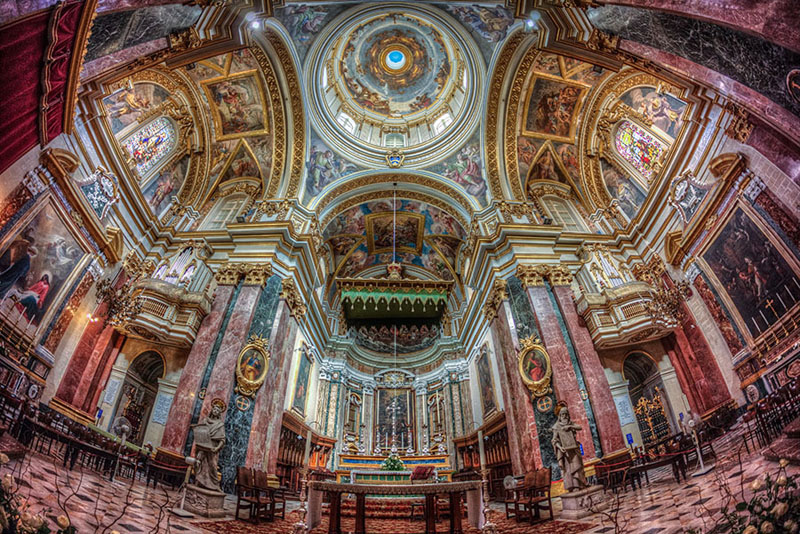
Neither church allowed photography within the edifice which is a shame because both of the interiors have so much to offer. Whereas Westminster is crowded with monuments and memorials, St. Paul’s feels relatively open and airy. The dome in St. Paul’s is probably its most famous feature and the interior view is just as impressive as the exterior. With the exception of one photo I sneaked in St. Paul’s, I borrowed photos of both churches off the internet to share.
Looking up at dome of St. Paul’sThe nave of St. Paul’sLooking down from Whisper gallery walkway under St. Paul’s Dome.






































 Bruce N' Peg