Wednesday, 8/16/17 – Ghent, Belgium:
Monday morning 8:00 am we boarded the DFDS Ferry line from Dover to Dunkirk. We arrived at 11:00 am Paris time, having gained an hour by crossing another longitudinal line from Greenwich prime meridian.


We were on our way to a camping store outside Eindhoven, NL but we were not interested in making a deadhead run there. We looked at our map of Belgium and decided to forgo Bruges, as lovely a town as you could want to see, because we have visited it twice on past trips. Ghent, is only a few kilometres further and we had not yet been there, so that is where we set our sights.
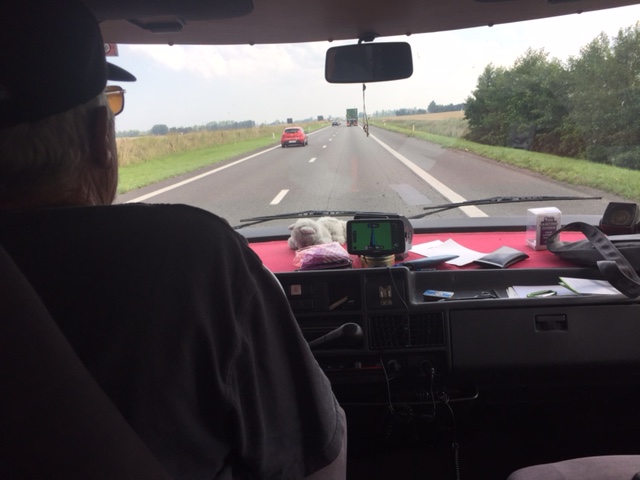
After spending 2+months driving on the left hand side of the road, we were back to right hand roads and it was more of an adjustment than we expected. We were fine along straightaways, but roundabouts and left and right turns took a moments’ thought to make sure we ended up in the proper lane.
We chose one of the national highways for the 121km drive to Ghent. The national highways, while not as fast as the autobahns (European equivalent of American freeways), are a pretty efficient way to get from one point to another. They are also pretty boring; there is little picturesque to see on a track of land set aside for main highways. I prefer the roads that – on printed maps – are the next size down from the national highways, Bruce just doesn’t want to be driving in the bushes.
With little drama, we made it to Camping Blaarmeersen, located in a large sports park in Ghent.
We are both still suffering from our individual maladies: Bruce’s cold and my hyperextended knee so we got ourselves settled and rested the afternoon away. After a tasty dinner of baked turkey breast, baby courgettes (zucchini), new baby potatoes and a mixed green salad, we hopped on our bikes, for the first time in a couple of months (we were scared to death of bike riding on the little lanes of Britain). We rode along a lovely water sports canal that would take us into Ghent 3-5 km away. We were trying to decide whether or not to take the bus into town but the ride helped us decide to take the bikes.
Just before leaving on our bike ride, we learned we had no electrical power to our rig and neither did our neighbors. Previous to our arrival someone had driven into and knocked over a pole that looked like it had two air raid sirens on it that decidedly needed electricity. We were assured that an electrician was on his way out to fix it. When we returned from our bike ride we were told the electrician was unable to repair the power but they would surely have it up and running in the morning. We elected to stay in our pitch for the evening, we like our location. We needed to defrost our refrigerator anyway.
The next morning we awoke to a steady rain interspersed with thunder, lightening and heavy downpours. I began campaigning that we move to a new location. With all the rain and lightening I couldn’t imagine an electrician braving such elements to fix a shorted out electrical box.
We grabbed our rain gear and headed for the office where a young lady helped us pick a different pitch that to our delight was even better than the one we were leaving. We moved during a break in the rain and as soon as we settled in, the rain came in earnest and stayed all day. So much for visiting Ghent on Tuesday.
Wednesday the rain was gone and the sun was shining. It was time to go a-touring. We jumped on our bikes and rode to town.
We had read that Ghent was a well kept secret. With Bruges so near and so popular on the tourist trail, Ghent was often overlooked.


Ghent had its beginnings in 630 when a missionary bishop founded St. Bavo’s Abbey at the confluence of two rivers. In the Middle Ages the marshlands were no good for farming but were excellent for sheep raising and Ghent grew very rich with the wool trade, becoming for a while, second in size only to Paris. Holy Roman Emperor Charles V was born in Ghent in 1500. That distinction didn’t stop the citizens of the city from refusing to pay taxes to him. In retaliation he rescinded all rights and privileges and the city fell on hard times. The 1800s saw the city regain some of its power by becoming the first industrialized city in Europe.
Today Ghent is known as a university town with over 70,000 students who keep the town lively.
The historic city Center has many sights to see.


One is the Belfry, a UNESCO World Heritage Site. The belfries of Flanders and France were the symbols of freedom, power and urban prosperity. They were also the most secure places in the city. They often housed a city’s archives and vaults. Ghent’s Belfry symbolizes the city’s independence and contains the alarm bells which serves to protect its citizens. The Roeland Bell is the name of the alarm bells hanging in the belfry since the 14th century. The original large bell was taken down, melted and formed into a carillon of 40 bells. The largest of the 40 bells –renamed Roeland, cracked in 1914. It was taken down, repaired and now stands place of honor near St. Nicholas’ Church in the square.
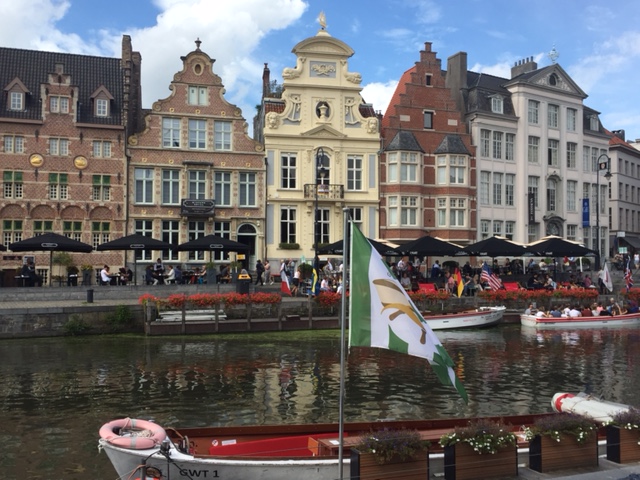
Flanking the river Leie are two quays, the Graslei and Kornlei. Once upon a time Ghent had a grain staple right: all grain that entered Flanders had to come through Ghent’s port. All boats that came into the port had to leave one fourth of their cargo as payment to use the riverways. The resulting wealth built beautiful buildings along the quays.
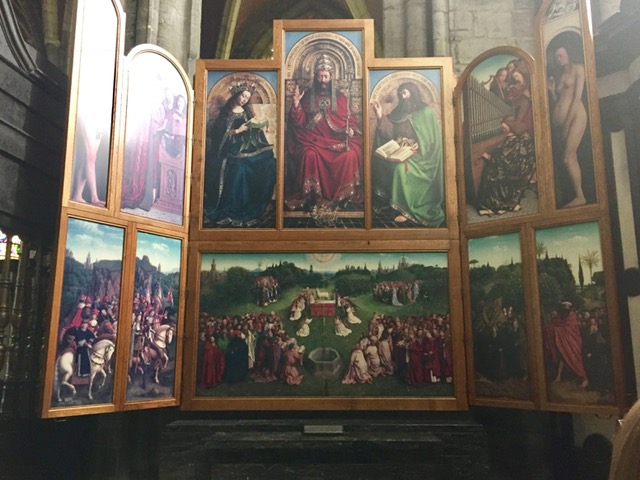
St Bavo’s Cathedral is a couple of blocks away from the river and is in possession of the Ghent Altarpiece, painted by the Flemish brothers Van Eyck and unveiled in 1432. “The Adoration of the Mystic Lamb” is a 20-oak panel painting telling stories of the Bible. It is exquisite. I was able to take photos of a copy of the alterpiece but it does no justice to the original whose painted panels are bright and clear and almost glow.


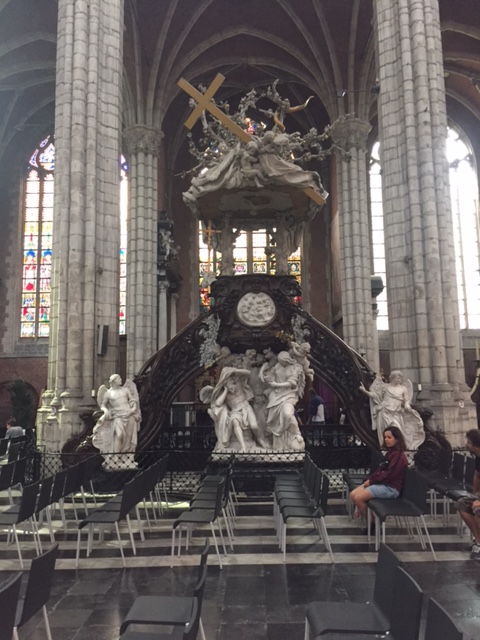
St Bavo’s is a magnificent cathedral with many marble statues, oversized paintings of religious scenes and a Rococo style pulpit that is made of oak and gilded wood and white and black marble that is carved into larger than life size religious figures. It is the most over-the-top pulpit I can remember ever seeing. The cathedral is amazing and one of the more ornate ones we’ve seen in the Protestant north.
We had only spent four hours walking about the town but my knee was giving out on me so we decided to end our day earlier than planned. We missed a lot but at least we did get to see a new city.
We have come to a difficult decision. We are going to end this trip in October. We said when we came over that we would go home when it wasn’t fun anymore. We were able to see a lot of new ground in the U.K, but we have seen so much of continental Europe in our last two trips, that this trip was feeling repetitive. The Schengen dilemna has added to our frustration. And lastly, we are beginning to miss our house and friends. We couldn’t see extending the trip for another six months just to see Croatia. That means our itinerary is going to change – again. We are not going to Croatia, instead we will concentrate on western France, northern Spain and Portugal, new territory for us.
 Bruce N' Peg