Sunday, 8/20/17
We left Ypres Sunday morning with Jumieges, France as our goal. Seventeen years ago when we were in Rouen for a week, we had come across the ancient abbey of Jumieges and we had a hankering to see it again. The Abbey was consecrated in the presence of William the Conqueror and his wife Mathilda in 1067 and despite such an auspicious start, it had several ups and downs during its long history and was finally destroyed during the French Revolution. Today it is another of the romantic ruins that dot the European landscape.


We found a nice camping in the town of Jumieges and about 600 meters from the abbey. We did some laundry, had much desired showers and felt human again. Then we walked through the village of Jumieges to visit the abbey. Since it was early evening the abbey was closed, but an open air classical concert was playing on the grounds, and as we walked the walled boundary of the abbey taking pictures, we got to listen to the music.
We don’t often meet camping Americans, so when we do its kind of a big deal. Another couple, Bill and Sarah from Virginia, had rented a VW camper and were on a 3 month trip around Europe. We spent a couple of hours swapping stories and enjoyed hearing American accents. Interestingly enough, they were on their way to visit WWI battle sites while we were on our way to visit the WWII D-Day beaches.
The next morning we left Jumieges after deciding we had seen plenty of ruined abbeys and we didn’t want to take half a day touring that one.
8/21/17 – We Love The French!
Monday was a day of trials and tribulations.
We were following the meanders of the river Seine as she flowed to the sea at Honfleur/Le Havre when Bruce mentioned we were down to a quarter tank and needed to get gas (diesel). The first station we came across was an unattended one; no employees, just pay and pump. Past experiences with this type of station requires a debit card rather than a credit card. No problem, Bruce inserted his card and made ready to pump gas. Only the machine rejected his card. We tried my card and the machine rejected it too. We stood at the pump looking askance at it and thinking about panicking.
Our bank requires us to renew our overseas usage every three months. That meant a call to the bank (collect is accepted if you can find a landline that gets through to the international operator – but that is another story) so we could continue to use our bank debit cards. After a HUGE amount of difficulty I had managed to contact our bank while we were still in the UK to clear ourselves for another three months. Or so I thought.
The previous evening while walking Jumieges we had stopped at the bank and withdrew some cash from the ATM with no problem so we knew the card worked last night. Why wasn’t it working at the station? An occupied car was parked at the station and the driver saw that we were having troubles. He came over and using his card checked to make sure the machine was working: yes it was. Then we tried our debit card again and once again it was rejected. Bruce was getting pissed and I was freaking out. The man asked if we had any cash so we gave him €40 and, using his card, he pumped €40 worth of diesel for us. Yay! Merci beaucoup!! But why the hell weren’t our cards working?
Now that we had fuel we continued along until we could find a gas station with an attendant and try our cards there. Eventually we found one, added €20 more to the tank and learned our cards were working – it was evidently that one station’s peculiarity. My stress level began to decrease to manageable portions.
We drove on to Honfleur, a port town made famous by many Impressionist artists in the early 1900s. We were anxious to see the famous quays and houses. It has been a long time since we were in Europe and I cannot remember the masses of people flocking to the same places we want to see. I am serious about this, 2000 was a long time ago, true, but I can’t remember the crowding of streets like we have seen this trip. I know it is summer, but we have spent 2 summers in Europe and I don’t remember this.


Anyway, Honfleur was overloaded with people and the day was very overcast, muting the colors the Impressionists found so alluring. We found a slightly secluded spot at the harbor and had lunch before we braved the town center to continue our drive to Ouistreham, the eastern start of the Operation Overlord road tour.
We had just cleared Honfleur when we started hearing a faint sound like metal clanging against metal. We couldn’t for the life of us figure it out, but in very short order the sound was increasing and sounding horribly like two big pieces of metal ripping into each other. It was really quite scary. We thought it might have to do with the clutch because it seemed to be tied in with shifting gears, and yet the clutch had good pressure. Then we thought it might be the clutch cover plate pulled loose and hitting something. What we did know was that it was getting worse by the minute. As it happened we were in the industrial area of the town we were in and we saw a Citroen dealer with what looked like mechanic’s bays. We pulled in. It being France, we arrived during their two hour lunch break and had to wait for their return. When they did return they said they were not equipped to help us but directed us to a Hymer dealer in Pont l’Eveque, a short distance away. They gave us the address and we returned to Willie where we punched said address into the GPS and came up with results 250km away(!!!) There was no way we or the van were going to make that. Tami in hand, we went back to the salespersons and asked if that was right. They must have spent 15 minutes figuring out a way to get us to the Hymer place by inputting a nearby address that would get us there. All this for a couple of foreigners who were not going to benefit them in any way.
The actual destination, a Hymer dealership, was 15 km away and we crept to it. We saw a lot of beautiful Hymer motorhomes there but they weren’t interested in swapping. We asked about mechanics and once again, this was a dealership, not a full service dealership/garage, however, literally across the street was a mechanic. Thanking them we clanged our way across the street. We persuaded the office mechanic to come listen to our problem. The language barrier was pretty high but once he drove it around the parking lot and heard the sounds he thought it might be a fluid problem. We couldn’t imagine that. Another young mechanic came out and listened and the two had a conference about what, we had no idea, but the upshot was they took Willie into a bay and started pumping him with transmission fluid. They put in 2 litres (we have no idea what the capacity is but 2 litres is almost a half gallon) then took it out of the bay to drive and check it out. The sound was gone and the gearing and clutch worked beautifully.
They saved our asses.
We gave the young mechanic a €20 bill because he was awesome and walked into the office to see how much we owed. Another €20 bill and we were on our way.
There is a myth that the French are snobs and are unfriendly and hate everyone. We have had two car catastrophes in France, one was a blown engine 17 years ago, and today’s almost catastrophe where we could have lost a transmission. Both times the French have gone out of their way to help us. We can’t say enough good about them. They may at times find us to be unrefined or maybe a little silly, but when it comes down to it they are more than willing to help.
We stopped at a supermarket for some quick supplies. Returning to the motorhome we saw police surrounding the van. WTF??? As clearly as possible, given the language barrier – they spoke some English, we spoke very little French – they explained they believed an immigrant had climbed (or tried) behind our bikes for a little illegal hitchhiking. We had heard of this ruse before and thanked them for stopping it. Later though, after we had some time to think about it, we realized there is no way for anyone to hide under our bike cover behind the bikes because the space is filled with the “guest room,” spare chairs and wind guards. We think they saw the bulge behind the bikes and made assumptions. At any rate, we had to extra guests.
Continuing towards Ouistreham, searching out another Aires, we came across a camping on a canal and pulled in, emotionally exhausted.
8/22-23/17 Operation Overlord
The Normandy Invasion of 1944 is still very much present along the coast where the five landings occurred. Sword, Gold, Juno, Omaha and Utah beaches were the designated names for the sectors along a 50 mile coastline. We have followed the Operation Overlord trail two different times on past visits to Europe and it still fascinates us.
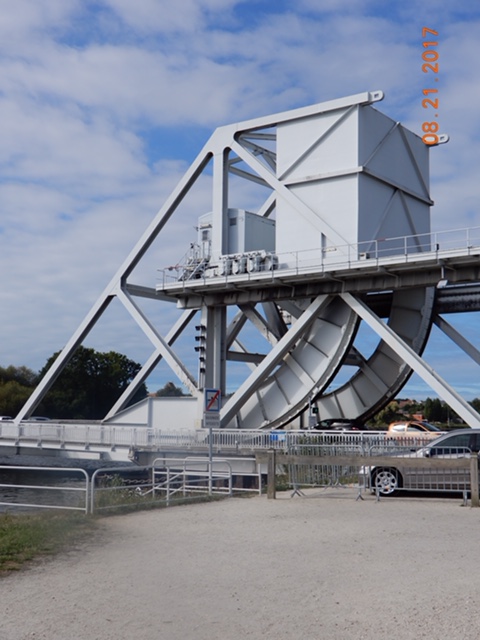
We started our invasion tour on the eastern front at Pegasus Bridge where, on the night of June 5-6, British gliders landed just outside Ouistreham on a narrow split of land between the Orne river and a canal, and captured the bridge within 10 minutes of landing.


As with all landings along the 50 mile stretch of coastline, this event is well documented at a museum and with signboards explaining the operation. The “landing strip” where the 3 gliders touched down is a very tight space; I don’t understand how they that landed on that strip of land without landing on top of each other.
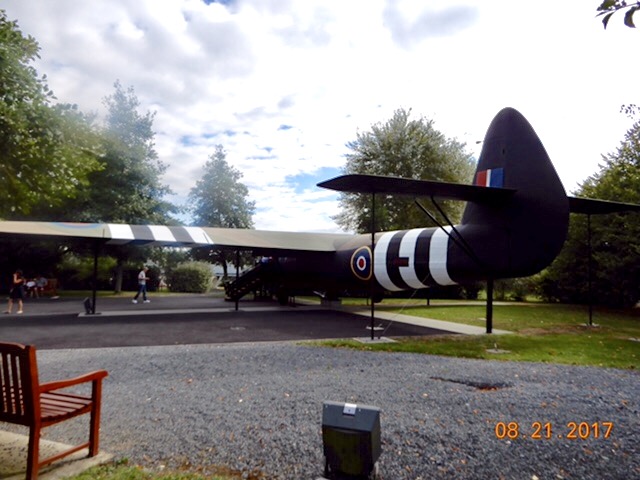
I’ll bet that when you think of gliders, you think of the sleek one or two man gliders we occasionally see in the sky or on film; elegant, quiet, long-winged aircraft flying gracefully through the skies. The British Horsa gliders used on D-Day were monsters capable of carrying 28 soldiers at once. Those were the soldiers who overwhelmed the Germans at Pegasus Bridge within 10 minutes of landing and in the process freed Ranville, the first liberated town of the battle.
Our next stop was Arromanches-les-Bains, part of the Gold Beach invasion. Once a foothold was achieved on D-Day a place to bring equipment to the continent was imperative. Arromanches became the location of an artificial port, Mulberry Harbor, a prefabricated port towed across the English Channel in sections and assembled at Arromanches. Mulberry Harbor was used for 10 months after D-Day and over 2.5 million men, 500,000 vehicles and 4 million tons of supplies landed there until it was decommissioned. You can still see remnants of the harbor in the bay.


We had been to the museum in the town itself, but up on a hill overlooking the harbor is Arromanches Cinema 360, a movie Theater with a very good 30 minute movie about the 100 days of the Normandy invasion. It uses British, American, French and German film to tell its story on 9 screens in a 360* theater. That hilltop also has remains of German bunkers overlooking the beach below.
That night we stopped at our second Aire just outside of Colleville-sur-mer where the American Military Cemetery is. We prepared for our visit to the cemetery by watching the movie, “Saving Private Ryan.” The opening and closing sequences of the movie were filmed at the cemetery. I said it when we first saw the movie in 1999 and I say it again: if women were in charge of the world we would never send our babies into the the killing fields of war.
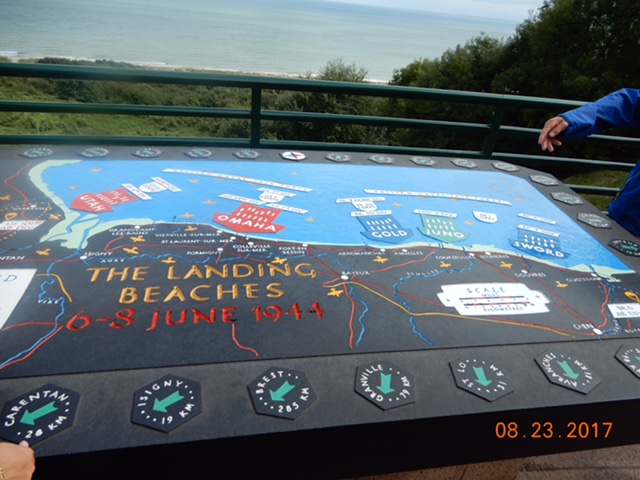
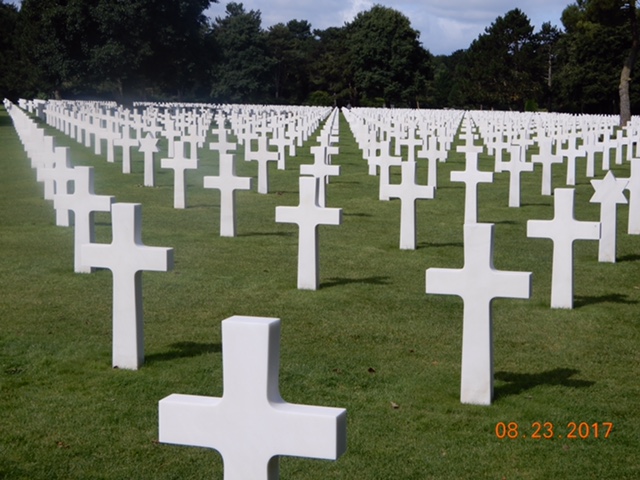
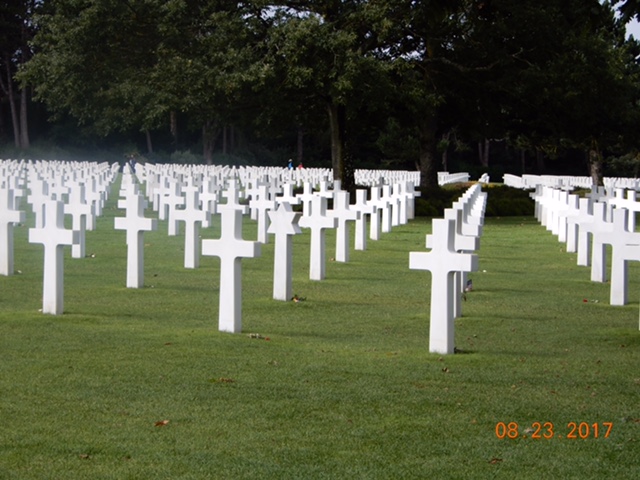
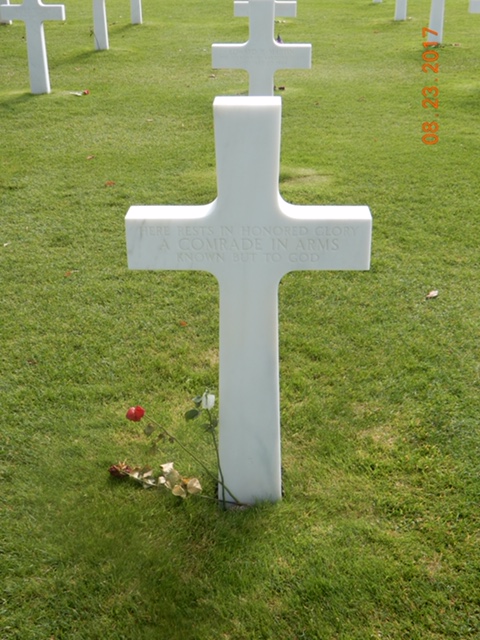
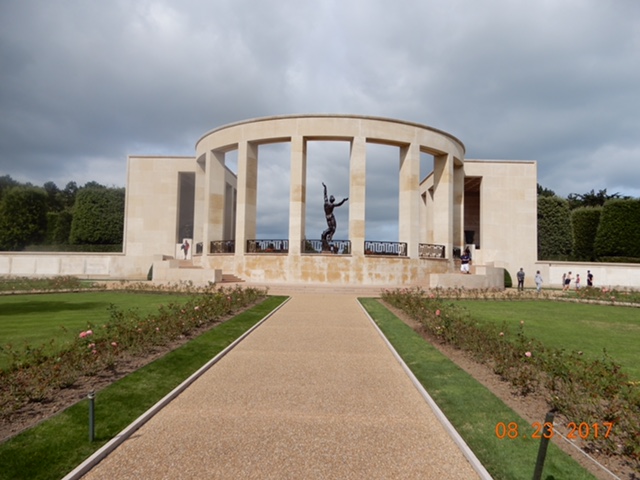
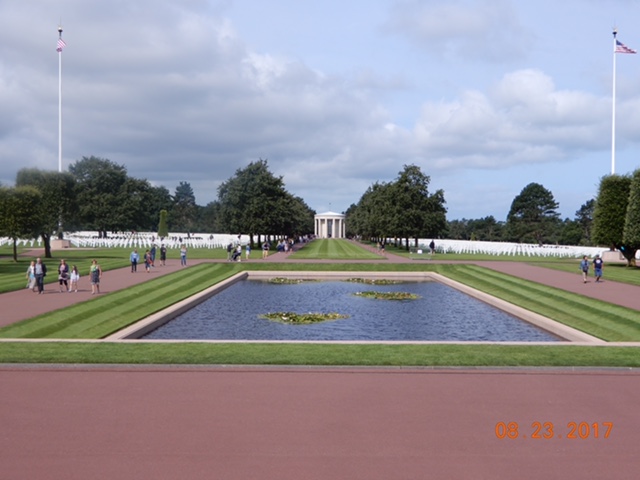
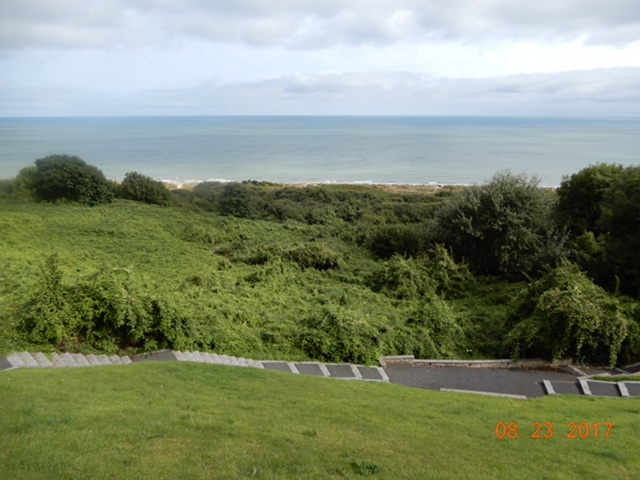
We have visited the American Cemetery twice previously and the 9,387 crosses make quite the statement about the costs of war. The cemetery covers 172 acres overlooking Omaha beach and grounds are serenely beautiful, as if to try and make up for the horror that overtook each soldier who died far from home and is buried there.
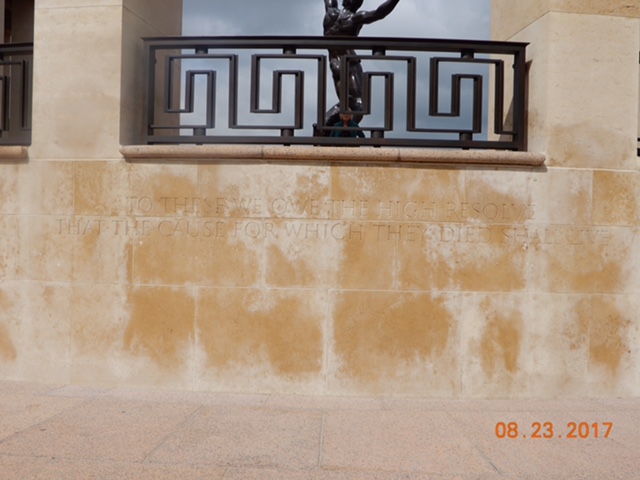
“To these we owe the highest resolve. That the cause for which they died shall live.”
These men died so that the nations of the world could live in liberty, free from tyranny. I think that quote is an appropriate epitaph.
 Bruce N' Peg