Thursday – 8/3/17
(Itinerary – Kensington Palace, Albert Hall, V&A Museum, Natural History Museum)
I must confess I hold a fascination for the British Royal Family. Prince Charles is 3 months younger than me and since I was a child I was aware of his existence; I can remember thinking I could be his princess – a thought that undoubtedly occurred to millions of young girls his age. As he and I grew up I watched his romances and ultimately his marriage to and divorce from Diana. I followed the tragedy of Diana’s death and, like so many others, worried for their sons. I was – and am – enchanted with the Duke and Duchess of Cambridge and their little family. When Kensington Palace – the home of both Diana and Prince William – showed up on the London Pass we knew we were going.
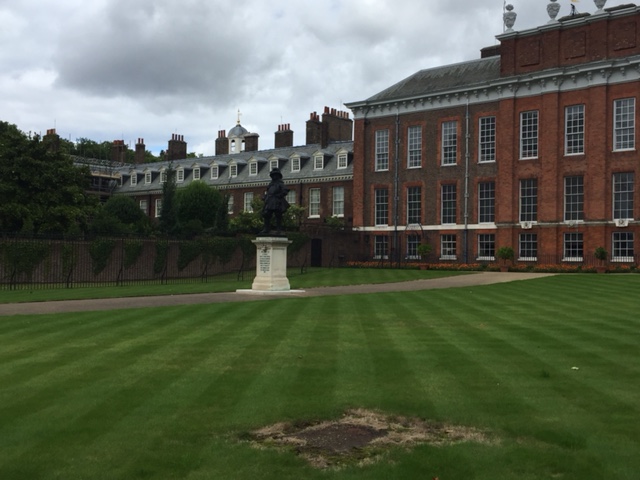
A small portion of the Palace is open to the public – no, we didn’t get to visit Kate and Williams apartment – but we did get a taste of the sumptuous living past kings and queens enjoyed. The tour was a mini-lesson in British royal history with exhibits on Queen Mary II – the Mary half of William and Mary, the last Stuart monarchs: The Georgian era of the 1700s with King George II’s State Apartments on display: Queen Victoria and Prince Albert and their mushy love affair: and an exhibition on Diana and her fashion story.
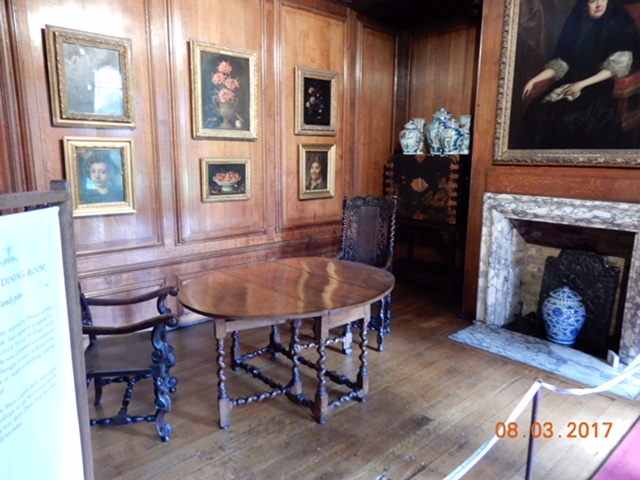
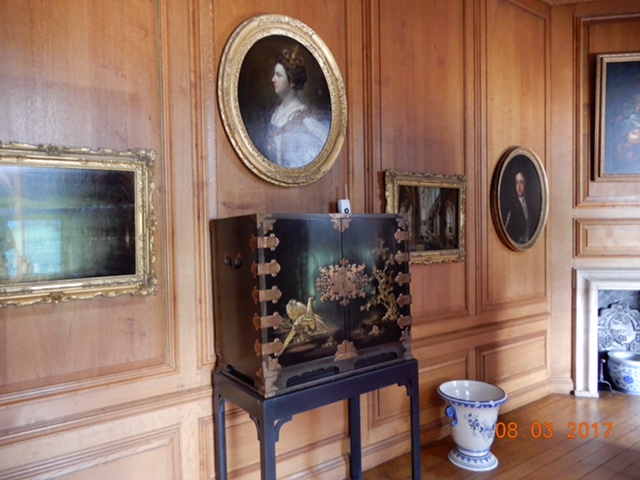
Queen Mary’s life was more interesting than her state apartments, but I won’t go into that story.


The King’s State Apartments were over the top with painted murals on walls and ceilings. The grand staircase was eye catching (understatement here) with, I’m sure, the goal to impress important visitors.


Diana’s exhibit displayed several of the dresses and suits she wore during her life and showed the development of her fashion sense. I remember when she wore several – more than several – of the dresses on display. The dress she wore when she danced with John Travolta at the White House was on display. Several of the dresses she wore for famous photo shoots were on display.
I’ve been to Elvis’ Graceland and I have seen some of the costumes he wore during his shows. I remember thinking the tailoring was lousy. Up close the costumes look cheaply made. Not so with Diana’s clothes. It must have been a huge confidence builder to don these gorgeous frocks and go out in public.
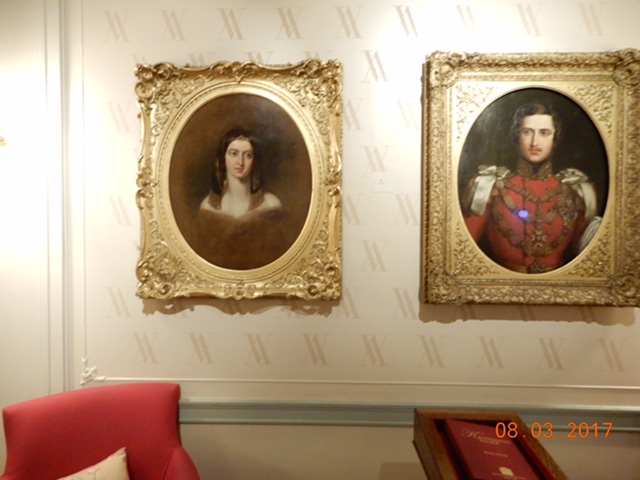
The last exhibition we visited was Victoria Revealed. Her apartments contained lots of mementos reflecting her life with Albert, with whom she appeared to be obsessed. Love letters were on display and little gifts of affection that had been exchanged. They must have had a rollicking sex life because they kept having children – this by a woman who purportedly was not fond of children; they got in the way of her time with Albert.
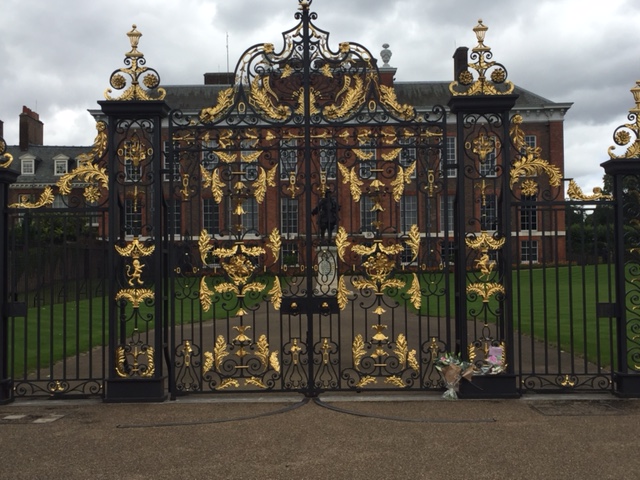
Outside the palace at one of the entrances stand the Golden Gates, where the floral tributes to Diana were displayed at the time of her death. A single bouquet and note marking the 20th anniversary of her death this month lay at the base of the gates.
We were off to Albert Hall and walking along the edge of Kensington Gardens when we stopped to watch a flying trapeze school. Youngsters were trying their hand at swinging the bars while safely connected to a harness and rope. I saw that several of the waiting children were quite young and I thought of Shannon’s 8 yr old daughter, who appears to be very adventurous, and wondered if she would enjoy trying that. I widened my range of vision to my left and I saw a man with two children I recognized. It was Shannon’s husband James and their kids! It almost seemed that my thoughts had made them materialize out of thin air! We hadn’t met James yet but that didn’t stop me from hollering out to them and marching off in their direction. Bruce, who hadn’t yet seen them, thought I’d gone bonkers (again) and wondered where I was going.
After formal introductions, James and kids walked us to the Albert Hall, sharing with us information about this neighborhood that James had grown up in.

What a famous venue Albert Hall is. It lies in the university/museum district on land that Prince Albert was able to purchase with profits made from the Great Exhibition of 1851. His idea was to create colleges of science and technology in the area. After his death, the construction projects continued and were combined with memorials to Albert including the Royal Albert Hall.
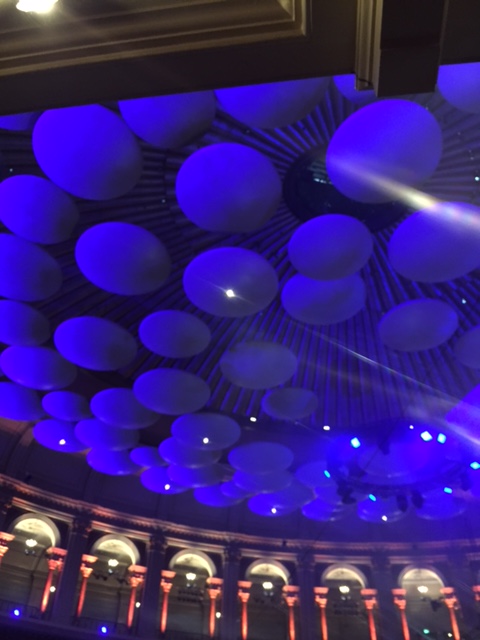
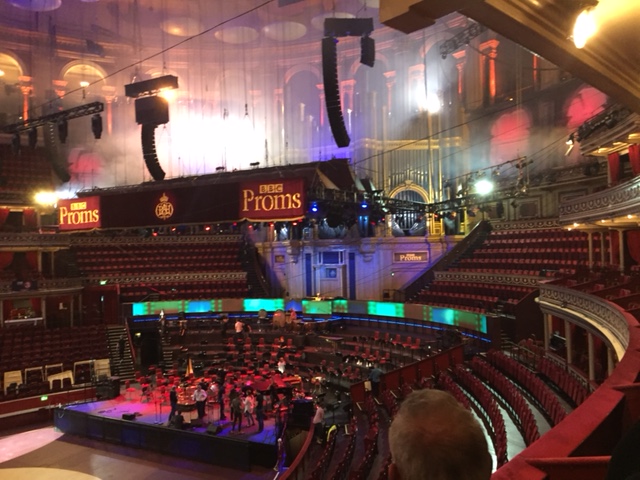
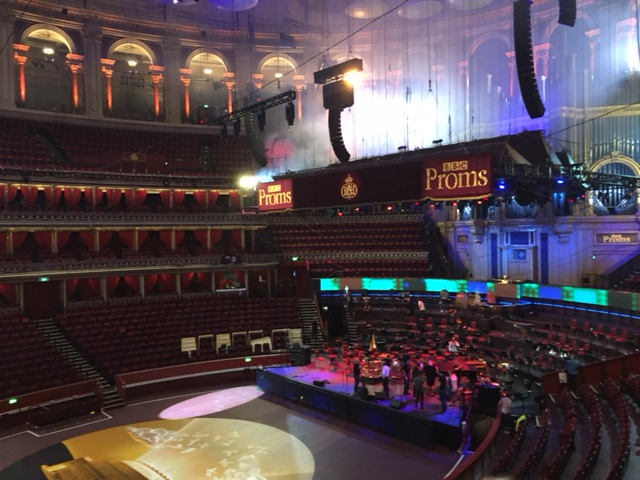
After four years of construction, using 6 million bricks and 80,000 terra-cotta blocks, the Hall was opened in 1871. Almost immediately acoustical problems in the form of a strong echo became apparent leading to several attempts over the next 100 years to solve. In 1969 large fiberglass sound-diffusing discs were install in the ceiling which evidently solved the echo problem. The Hall holds the second largest pipe organ in the British Isles with 9,997 pipes. The hall holds slightly less than 6000 people, so the concerts are rather intimate compared to some venues.
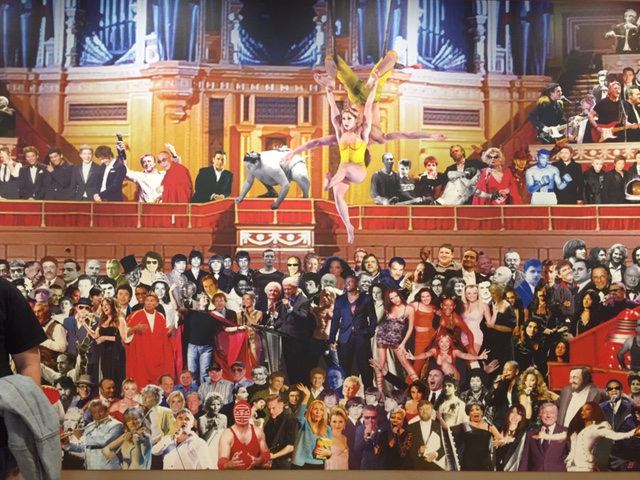
Who hasn’t performed at Albert Hall? From contemporary to classical to rock to hip hop, I think it must be comparable to Carnegie Hall in that everyone with any talent dreams of performing there. Currently the BBC Proms – an eight week summer season of daily orchestral classical music concerts is taking place. Amazingly, this summer event has been going on since 1895 (obviously not sponsored by the BBC way back then) so locally they are quite well known. While on our tour we got to listen to musicians warming up for that evening’s concert. By the by, Proms is short for promenade concerts – outdoor concerts originally performed in London gardens where the audience could stroll about while listening.
After our Albert Hall tour, we walked past the Museum of Natural History and the Victoria and Albert Museum – both on our list, but not to be visited that day.
Friday – 8/4/17
(Itinerary: Temple Church, Monument, Shakespeare’s Globe, Museum of London)
Friday morning we took the tube to Charing Cross to track down Benjamin Franklin House, at 36 Craven Street, the only surviving house in which he lived. Franklin lived in the house for 17 years as a diplomat for Pennsylvania before the colony became a member of the United States of America. He was actually a border at the widowed Mrs. Stevenson’s house but with his wit and charm soon became the de facto head of household.


The house is a Georgian style home originally built as a lodging house. I’m sure it still survives because of the English respect for old things, unlike the U.S. where the old is replaced with the new as often as possible.
Craven Street has an outlet to the Strand, an enormously major thoroughfare in the City of Westminster in central London, that runs from Trafalgar Square to Temple Bar where it becomes Fleet Street inside the City of London.


After a previous attempt to visit, we were going to see the Temple Church consecrated in 1185 by the Knights Templar, the soldier monks who gained fame and power by protecting pilgrims during the Crusades. It was built to be their English headquarters. While this church has been in London for a loooong time, it gained international fame by playing a role in the book/movie The Da Vinci Code.


The church is round, modeled after Jerusalem’s church of the Holy Sepulchre, and contains the effigies of Templar knights. The Knights Templar had the most interesting history right up until they were wiped out by King Phillip of France in the early 1300s. This is the second surviving Templar church Bruce and I have visited, the other one is in Metz, France.
We continued along Fleet Street, famous as a printing and publishing area with some newspaper buildings preserved and the name synonymous with the newspaper trade. We were on our way to Millennium Bridge, the pedestrian-only bridge crossing the Thames that gained fame in my eyes for being so overloaded on its opening day that it began to sway and twist, giving the walkers quite the ride.
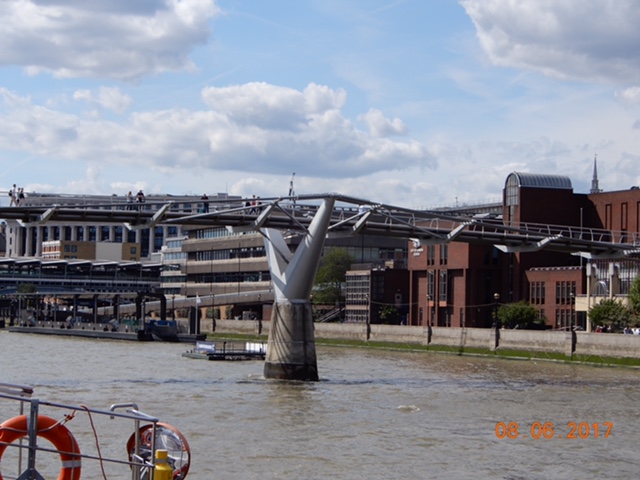
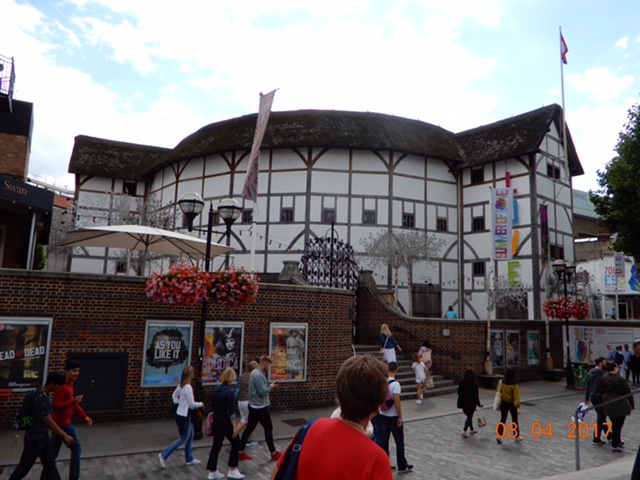
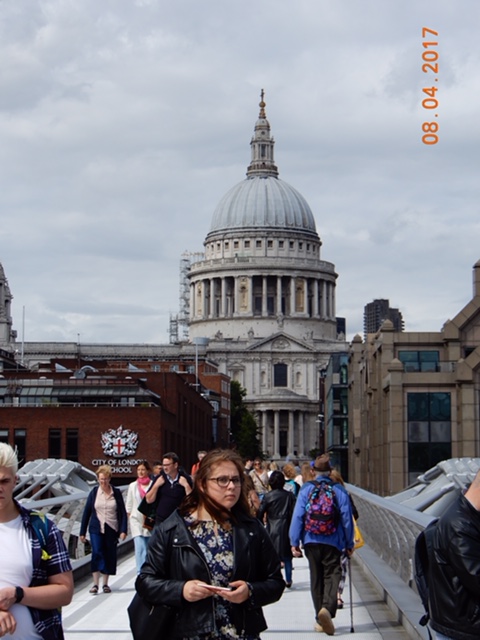
We found and crossed the bridge – with no noticeable vibrations – making our way to Shakespeare’s Globe, the reconstructed Elizabethan playhouse associated with Shakespeare. We had hoped to take a tour of the theater but a play was underway and we couldn’t go in. So, it was back across the Millennium Bridge and up to the Museum of London.
The Museum of London is a museum to be taken in small parts. It is the largest urban history museum in the world. It has over six million objects organized in chronological galleries dating from pre-history to current era. We got no further than the Roman era before we were exhausted and overwhelmed. It is an unbelievably interesting museum but to visit it at the end of a busy day was a mistake. Humbled, we left the museum and walked to St. Paul’s Underground Station to return home.
Saturday – 8/5/17 (Itinerary: Windsor Castle)
On Saturdays, our local bus goes to Windsor. Windsor was another attraction included with the London Pass so we set aside Saturday for our Windsor visit as soon as we learned of the bus.

Windsor Castle was built by William the Conquerer and since 1100 has been the royal residence of all the reigning monarchs. It is the longest continuously occupied palace in Europe.
The bus left our camping at 10:40 and the return bus left Windsor at 3:10. We figured that gave us plenty of time to see the castle and the town.
We didn’t count on the bus trip taking an hour to get there. And we didn’t figure on crowds as eager as us to visit the castle. The bus let us off right at the castle entrance and into a throng of people jockeying to get in lines to enter. We were a bit shocked; Tower of London, in the middle of the city, didn’t have lines this long.
We saw a second, somewhat shorter line to the right of the entrance and thought perhaps it was for ticket holders so we walked over to an employee to ask. Unfortunately, that line was for tours only. The gentleman told us that, what with summer recess just begun, we had picked the 6th busiest day of the year to come visit. He continued that we probably had an hour wait just to get through the gates, if however, we were looking for some good photo ops of the exterior of the castle we should head down the street towards the “Long Walk” where we would find plenty.
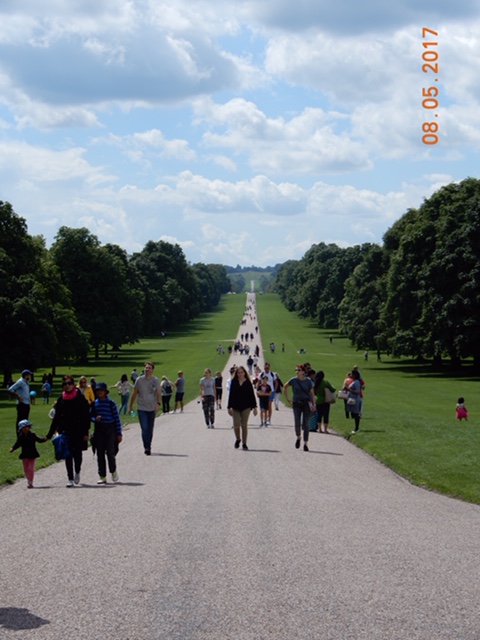
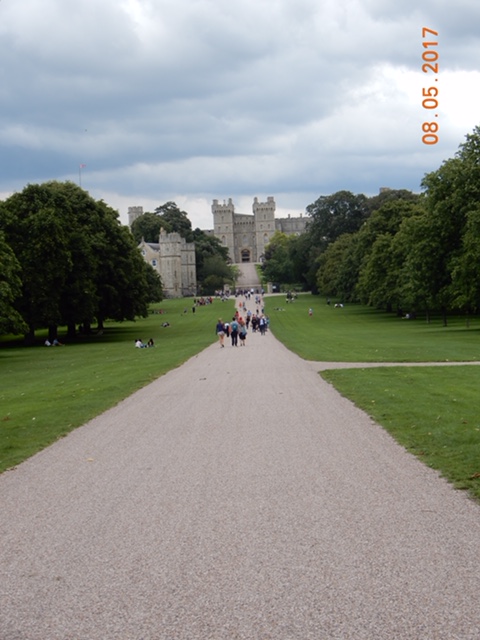
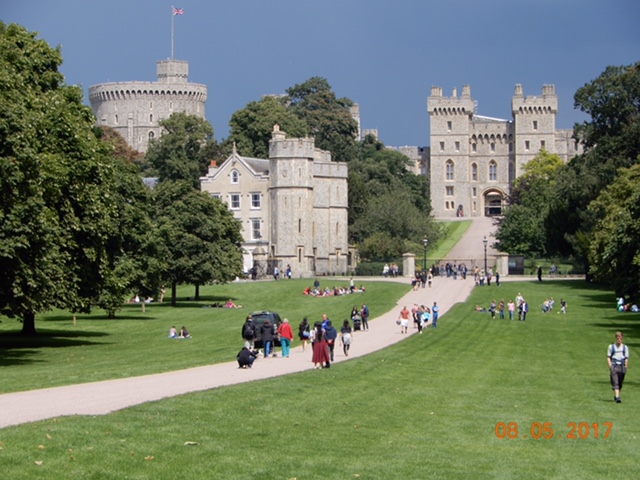
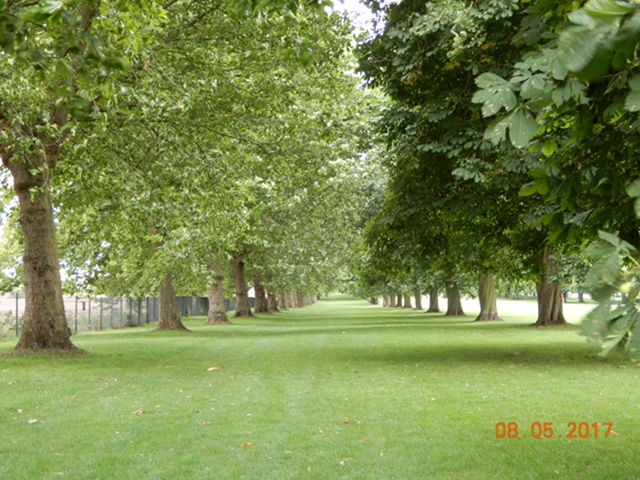
We had no idea what this “long walk” was but we followed signs to it and entered Windsor Great Park, a huge green space with a loong straight driveway leading up to castle gates. As it turned out, this was an almost three mile long approach to the castle the queen uses when she comes to stay. Two rows of mature trees flank the Long Walk and a large bronze equestrian statue of George III stands atop a small hill at the opposite end. We could almost see the statue from the palace gate. Windsor Great Park was originally a royal hunting grounds and a herd of deer still roams about as a reminder of the parks’ historic use.
The park is very popular; people walked their dogs, had picnics under the trees and strolled the 3 mile long walk. We walked part of the way and were able to take some photos of the castle before we re-entered the town to take the Thames cruise offered in our London Pass.


That cruise turned out to be a hoax. That’s not really fair of me, we didn’t read the fine print, otherwise we would have known the cruise fee was intact with a small discount for Pass holders. By this time, we were feeling thwarted by the whole day and stubbornly chose not to pay the cruise price. We probably could have gotten some great camera shots of the castle had we decided to go, but c’est la vie.
We spent the rest of our time walking around the towns of Windsor and Eaton across the river, before we returned to the bus stop and went home.
It was a nice day, but not what we had hoped.
Sunday – last day of London Pass
Everyone in the world who tells time can thank the British for giving us Greenwich Mean Time from which to base local time. GMT is based on the Prime Meridian – point 0 longitude – located at Greenwich Observatory. I’m sure everyone reading this has heard of GMT and the prime meridian (and if you haven’t, you should question your educational system.). Where we live, the time zone is GMT-8, meaning it is 8 hours behind London, England local time. There is a mathematical equation to determine this, but since I’m sure it was covered in your education, I won’t go into it.
I have always been curious about Greenwich Observatory and the prime meridian. On previous visits to London I neglected to visit Greenwich in the mistaken belief that Greenwich was too far removed for a London tourist to be able to conveniently visit. That is what comes of using the underground only to move around the city – I cannot get my bearings. In fact I was hoping we could use the bus system this trip just so we would be above ground as we moved from point to point. That didn’t happen for a couple of reasons; time and mastery of the system.
Anyhow, Sunday we decided to take the hop on, hop off river boat cruise to Greenwich. We made our transfers on the Tube to get us to a starting point on the river boat when I saw that the tube line we were on would take us to Northern Greenwich. Because our days always start out late, I suggested we may save time if we continue on the tube to that station and return from Greenwich via the river.
The problem with that idea was we do not know the geography of the area. As it turned out, North Greenwich was a time-eating 2 miles away when you knew where you were going. We didn’t, and when we asked for directions we were given wrong ones.
The time we hoped to save by staying on the tube was eaten by our ignorance. We did walk past an arena called the 02 and watched people climbing the outside of the structure. A Star Wars exhibition was showing at the venue:


Unable to figure out how to get to the observatory by walking, we expedited our process by taking a ferry across the Thames to the Greenwich Pier. A small carnival – or what we in the states would think of as a carnival – was dockside with a couple of traditional rides: a beautiful carrousel and a tower contraption called a Helter Skelter. A user climbs up inside the tower and slides down the outside. I don’t know how much of a thrill ride it is, but it certainly does attract the eye.


The clipper ship the Cutty Sark, is drydocked at the Greenwich Pier. She was one of the last, and one of the fastest tea clippers to be built before steam engines became the new generation of shipbuilding. She is now a museum ship, and – surprise! – was an attraction on our London Pass.
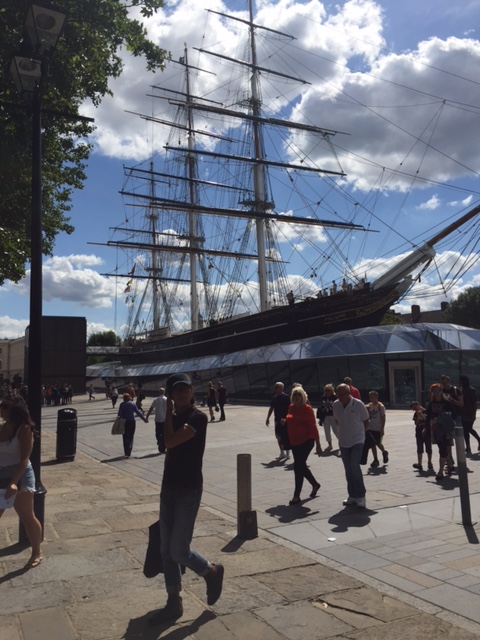
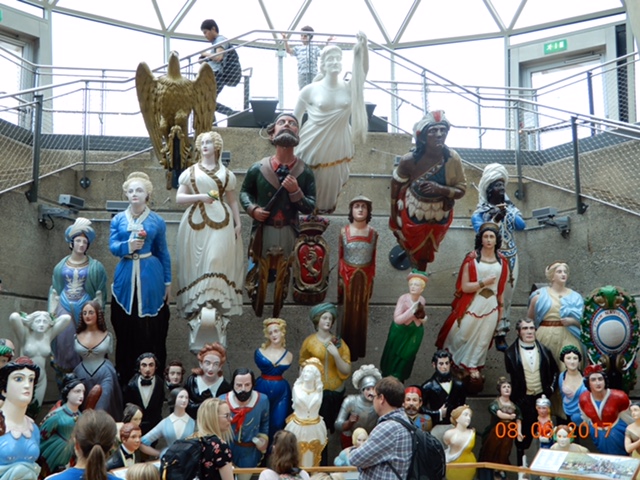
After touring the Cutty Sark we made our way to Greenwich Park and walked up the steep hill to the Observatory. Like Windsor Park yesterday, there were hordes and hordes of people in the park, making it a bit of a challenge to get to the top.

We stopped for a photo at the line marking the east and west sides of the Prime Meridian and it was a good thing we did so, because the more picturesque photo opp at the Observatory itself had a ridiculously long, slow moving queue. I waited about 10 minutes with no forward movement before I bailed out. We went through the museum that told all about the development of naval chronometers in order for sailors to know where they were while at sea. It was all interesting but we had a dinner date with our young friends and had to return to the river cruise boat in order to meet them at Trafalger Square.
We were walking down that steep hill when I took an odd step and jarred my right knee.


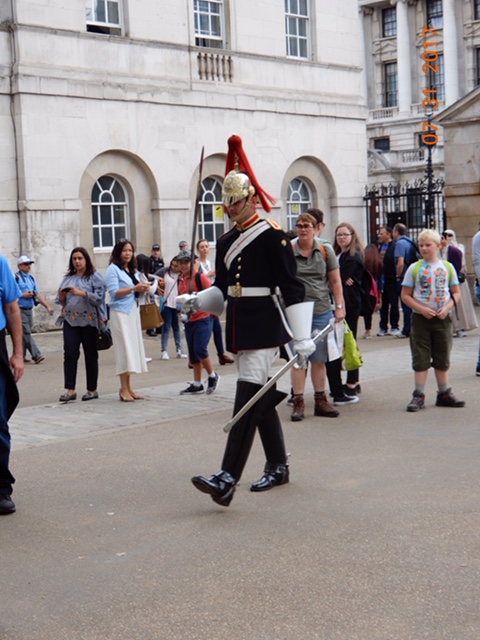
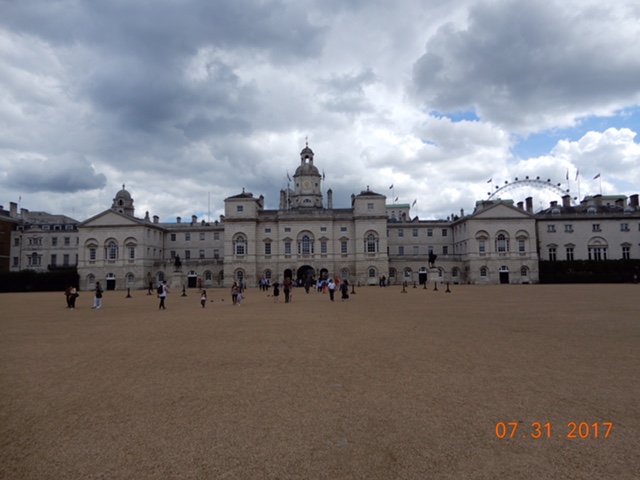
We reached the pier, got on our river boat and began the cruise to Westminster Pier, near Parliament. From there we walked up Whitehall, completing the walk from our first day when we were distracted by the Horse Guard Gate.
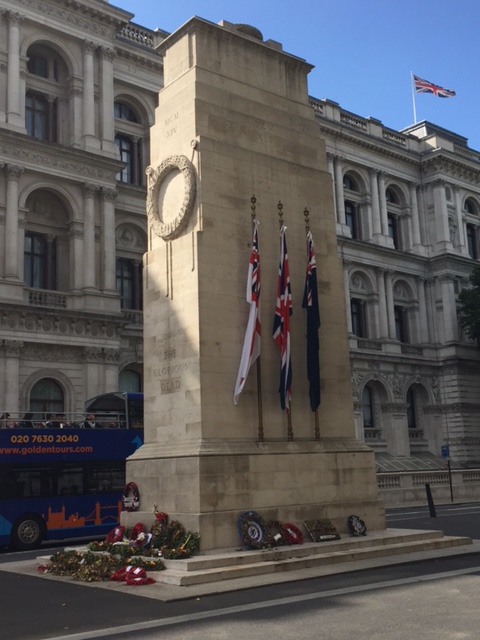
We passed the Cenotaph, the UK’s official national war monument, where the Queen lays a wreath each year marking the National Day of Rememberance. I was amazed at how small it is. I expected it to be much larger like the Wellington Arch near Hyde Park.
We met up with James and Shannon and the children at our appointed time and they treated us to a lovely dinner at a little Mexican restaurant near Charing Cross. We are really glad to have been able to spend as much time with them as we did, although we do need a chance to spend more time knowing James. There is always next time.
By the time we returned to the camping we realized we were pretty tired. Bruce felt a cold coming on, and my knee was getting more and more tender.
The next morning we were at a full stop. Bruce’s cold had arrived and I could barely walk. Instead of going into London to visit the museums we had planned on seeing: the V&A, the British Natural Museum, the British Library, the British Museum and the National Gallery, we spent the next four days recovering from colds and hyperextended knees. We made an experimental short trip into Uxbridge on Thursday for a grocery and cold medication run and to see how my knee held up. The results were mixed but we decided to return to London on Friday and see a couple of museums. We made it through the Victoria and Albert (V&A) but could go no further. Our museum fixes will have to be met in other countries. Fortunately there are some pretty fantastic museums in many cities we expect to visit.
Saturday, 8/12/17 we decided not to push my knee or Bruce’s cold endurance. Instead treated ourselves to a movie. We went to see “Dunkirk” in an IMAX theater. It was very well done. The last movie we saw in England was “Gladiator.” Gladiator won the academy award for best movie, maybe Dunkirk will too.
We’ve completed our British Isles leg. Tomorrow we leave London for Dover and expect to take the ferry to Dunkirk on Monday. We need to make a run back to the Netherlands to a camping supply store near Eindhoven to purchase a couple of necessary plumbing parts for the van. We have been unable to find them anywhere else. Then we will begin our 5-6 week journey to Croatia via France, Germany, Austria and Slovenia.





























 Bruce N' Peg