7/26/17 Glastonbury:
King Arthur, ley lines, the Goddess Mother, crystals and a rockin’ music festival are what Glastonbury is famous for today, but it has a wealth of archeological evidence of human occupancy dating back thousands of years.
Historically, the Somerset area around Glastonbury was a tidal wetlands almost at sea level and navigated by boat. People have been draining the wetlands since before the Norman Conquest and there are a number of public works that currently maintain the drainage.
Mythology and legendary stories have come down to us from times when the area was still a wetland with islands of higher ground where settlements grew. One of these legends is that of King Arthur.
I have been fascinated with the Arthurian Saga for decades and have read more than my fair share of books about Arthur, Guinevere, Lancelot and the Knights of the Round Table. I’m not going to delve deeply here other than to say the Glastonbury Tor is said to be the Isle of Avalon.
Tor is an Old English word for hill and the 500 ft tall conical clay-based hill is the iconic landmark of Glastonbury.


In legend the Isle of Avalon was a pre-Christian religious community celebrating the Mother Goddess. After his final battle in which he was mortally wounded, Arthur is said to have been taken to the mythical Isle of Avalon, where he was to remain until the land needed him again.
Jump forward to the Christian Era and Glastonbury gained fame from the legends of Joseph of Arimathea and the arrival of Christianity to Britain. Joseph came to Glastonbury by boat and landed at Wearyall Hill where he thrust his hawthorn staff into the ground and it grew into the original Holy Thorn Tree whose descendants still grow on the hill.
The Glastonbury Abbey became the richest abbey in the country using this and the Arthurian legend as a means to gain donations from wealthy citizens. None of that wealth or notoriety saved the Abbey when Henry VIII began the Dissolution and in fact the wealth was the direct means of the abbey’s destruction.
Today, the New Age culture has invaded the town. The Goddess is depicted everywhere, and to the casual observer, meditation centers and crystals and sacred wells are the order of the day.


It’s like being in Haight-Ashbury in the 1960s and we almost get a sense of déjà vu.
I have to admit there is a sense of peacefulness here and if I lived here I would probably become an advocate of Goddesses and crystals and who knows what else.
We are camping at The Isle of Avalon, a campground with a 15 minute walk into town. Location, location! The first day of our arrival it was raining so hard we spent the afternoon at the camping doing much needed laundry. On our second day the weather cleared and we walked the streets of Glastonbury, taking in the shops and people watching. There are a lot of dreadlocks, patchouli oil scent and colorful cottons being worn here.
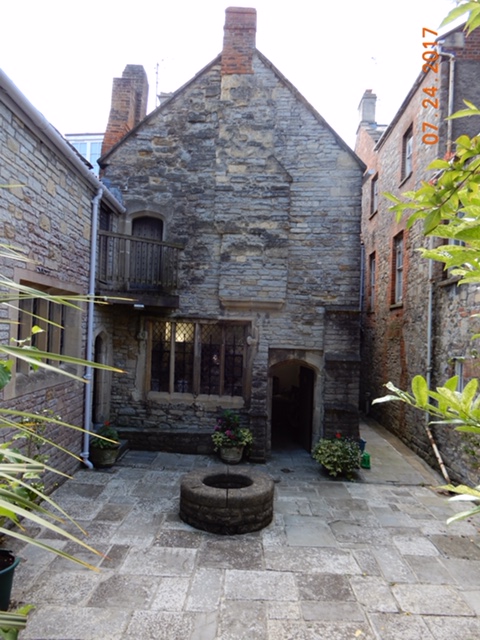
We found the Lake Village Museum showcasing a small community that thrived in the wetlands over 2000 years ago and was rediscovered in the early 1900s. The museum is housed in the Tribunal, a medieval townhouse on High Street.


Further down the street was the St Margaret’s Chapel and Almshouse dating back to the 13th century. The monks of Glastonbury Abbey built it as a hospital for pilgrims. After the Dissolution (boy – Henry VIII really had it in for the monasteries. We’ve been witness to the aftermath all over Britain.) the hospital was dismantled and later 2 rows of five almshouses were added for the town’s poor men. One row still stands, the other was demolished in 1957 (!) and the foundations were incorporated in the courtyard garden.


The third day was sunny and warm. We walked up the Tor – a steep, hot climb – and enjoyed the fantastic 360* view offered. We joined many people, including a meditation class and children flying kites. The remains of a 14th century chapel stands at the summit and the shade it offered was welcomed. We could see Glastonbury at the base of the tor, we could see the town of Street, 2 miles further away. We could see Wearyall Hill and the Holy Thorn Tree at its summit and we could see the small cathedral city of Wells about 7 miles away.


At the base of the Tor is the Chalice Well, another legend-filled location. Returning to Arthurian legends, the Holy Grail is said to have been buried here and the iron tinged waters from the spring are supposed to have healing properties. In reality, the Chalice Well Gardens – according to the brochure – is a Living Sanctuary; a place to sooth the soul and revive the spirits. The well water flows from its source at the Lion head fountain through several pools and “rooms” of different garden plantings ranging from the profusion of flowering plants in the upper gardens terracing down to the shaded Yew trees and finally the lower lawns. It is very restful and shaded and cool and inviting.
Having recovered from our hot Tor hike in the cool of the Chalice Gardens, we continued to the Abbey. Most abbeys we have visited have been set apart and in their own grounds. Glastonbury’s main gate opens onto Magdalene Street – in the heart of the town. With the gates closed and without the large banners proclaiming the Abbey’s presence it almost could almost be mistaken for another store front. Behind the gates lies a 36 acre beautifully tended park the ruins stand in.
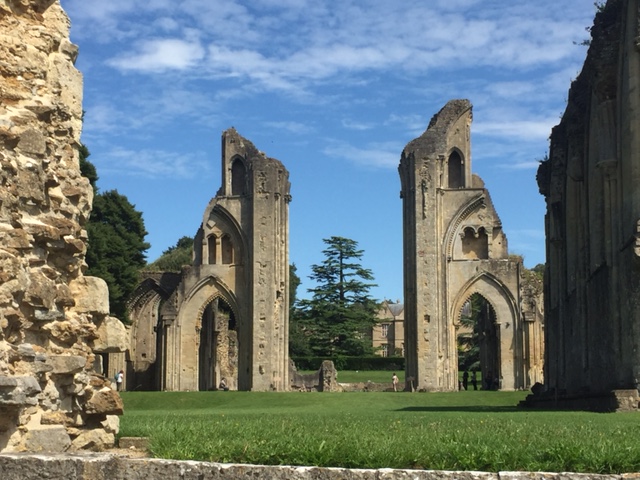
The abbey ruins have been photographed so often I’m willing to bet many people have seen them even if they were not sure what or where they were.
The abbey was the earliest Christian monastic site in Britain and by 1068 it was the wealthiest abbey in all of England with a worth placed at £846 (there has been a bit of inflation in the last 1050 years!)


A huge fire in the 11th century burned the whole thing to the ground leaving the monks penniless but resolute. In 1139 they devised a method to reel in the pounds by “discovering” King Arthur and Guinevere’s grave on the monastery grounds “proving” Glastonbury was the Isle of Avalon and making it a place of pilgrimage. Soon the cash was rolling in and they were able to rebuild the abbey to magnificent proportions.
The whole thing came crashing down in 1539 when the last abbot resisted the King and was found guilty of treason. He was hung, drawn and quartered on the top of the Tor (shades of Mel Gibson’s William Wallace), his abbey was dismantled and anything of value was sold off to the highest bidder. What was left is what we see today, a romantic look at days gone by and the legends contained within.
Thursday, July 27, we drive to Street to get new tires on the van and visit the Clark Village Outlet Stores; I’m looking for sandals. Friday we head for London Town.





















 Bruce N' Peg