7/5/17 St. Andrews
Having crossed the border into Scotland, we had two places on the top of list of places to see: Edinburgh and St. Andrews. While it has never held much fascination for us, we know people who love the game of golf. Having come so far, there was no way we were not going to visit St. Andrews.
St. Andrews is consider the “home of golf” because it was being played there as far back as the early 1400s. It is also home to a university that goes back even further than its golfing origins.
We arrived in the late morning and were able to park right across from the links course.


I want to tell you… this place radiated reverence. I am not a fan of golf – except to watch on tv when nothing else is on – and yet there was something about being on a golf course that is 500+ years old that got to us. It was like being in one of the architecturally awe-inspiring cathedrals we are so nuts about. We are known for our enthusiasm (how is that for a euphemism for animatedly loud?) but we walked around the links as though we were in a church.
There were lots of players on the courses. We wondered; were they feeling as reverential as we two non players?


As we walked around the Old Course we found the landmark stone Swilcan Bridge at the 18th hole, whose backdrop was the The Royal and Ancient Golf Club of St. Andrews Clubhouse. A dignified stone building built in 1854, it is a members only club that didn’t allow women members until 2015. Since I don’t play golf, I’ll refrain from commenting.
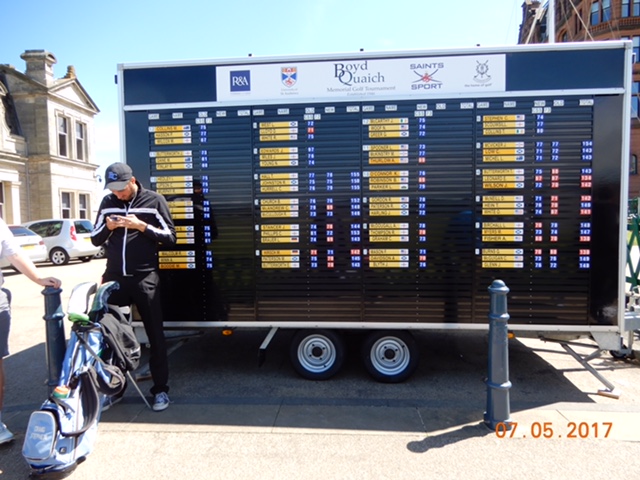
There was a memorial tournament going on with American golfers joining an international cast, and at the public clubhouse and in town there were scores of souvenir stores selling all things related to golf.
We returned to the van and met a German couple Hans and Ingrid who are touring Scotland for a bit. While in Perth, they received a ticket for parking in an area that did not allow camping vans. They needed some help with translating the ticket and asked if we could help. It was a hefty penalty – £60 but if they paid it quickly – in person, by check or online – it would be reduced by half. They were no longer in Perth and their wifi connection wouldn’t work, so we offered to help and using my iPhone we were able to get their payment sent off.
On our return we re-crossed the Firth of Forth – another name I’ve heard forever. Firth means estuary, Forth is the river = Estuary of the Forth River as it empties into the North Sea.
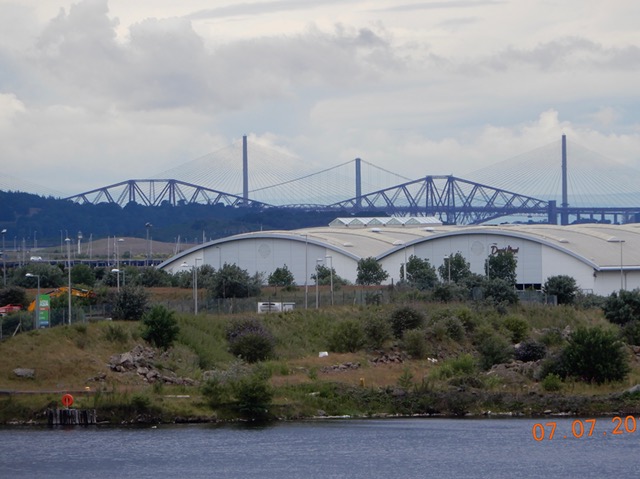
Three bridges cross the Forth there;
The old cantilevered iron railway bridge built in 1882 at the height of railroad power, is considered a symbol of Scotland AND its a UNESCO world heritage site;
The Forth Road Bridge is a twin-towered suspension bridge erected in 1964 to carry road traffic. It modernized the centuries-old ferry system, previously used to transverse the river. What struck me was the idea that in the 20th century ferries were still the only way for people and vehicles to cross the 1.5 mile expanse. I think the bridge was badly needed.
Our travel mentors – Robin and Alimay have a direct connection to the Forth Road Bridge: Robin’s father was largely responsible for its design.
I wish I had taken a better photo of it, but as we crossed I was entranced by the Iron Bridge on our left, as well as the new soon-to-be-opened Queensferry Bridge on our right.
As we drove towards Edinburgh we kept remarking how the city (at least the old city, including the castle) was hidden from us. Greenery and housing developments blocked any chance of seeing the city. Even as we reached our camping – Mortonhall – we would never has suspected we were on the outskirts of a major city, we could have been in any one of the small towns we have driven through.
 Bruce N' Peg